


Passive Components Blog
No Result
View All Result
  • Home
  • NewsFilter
    • All
    • Aerospace & Defence
    • Antenna
    • Applications
    • Automotive
    • Capacitors
    • Circuit Protection Devices
    • electro-mechanical news
    • Filters
    • Fuses
    • Inductors
    • Industrial
    • Integrated Passives
    • inter-connect news
    • Market & Supply Chain
    • Market Insights
    • Medical
    • Modelling and Simulation
    • New Materials & Supply
    • New Technologies
    • Non-linear Passives
    • Oscillators
    • Passive Sensors News
    • Resistors
    • RF & Microwave
    • Telecommunication
    • Weekly Digest

    Würth Elektroniks Flexible EMI Shielding Sheets Provides Quick and Easy Schielding Solution

    Samsung Introduces Automotive 1206 100uF X7T MLCC for Power Rails in ADAS and SoCs

    Hirose Releases Ultra‑low Profile FPC‑to‑board Connector

    YMIN Hybrid Aluminum Capacitors for Automotive LiDAR Power Rails

    Samsung Presents Ultra‑Thin Silicon Capacitors for AI and Server PDN

    YAGEO Introduces 310VAC SMD Y2 Safety MP Capacitors for Compact EMI Filtering

    DMASS: European Components Distribution Returns To Growth In Q1 2026

    German Component Distribution Market Rebounds in Q1 2026 According to FBDi

    Nippon Chemi-Con Announces New Capacitor series for AI, Automotive and Immersion Cooling

    Trending Tags

    • Ripple Current
    • RF
    • Leakage Current
    • Tantalum vs Ceramic
    • Snubber
    • Low ESR
    • Feedthrough
    • Derating
    • Dielectric Constant
    • New Products
    • Market Reports
  • VideoFilter
    • All
    • Antenna videos
    • Capacitor videos
    • Circuit Protection Video
    • Filter videos
    • Fuse videos
    • Inductor videos
    • Inter-Connect Video
    • Non-linear passives videos
    • Oscillator videos
    • Passive sensors videos
    • Resistor videos

    Why Isolated DC/DC Power Supplies Fail Late, Würth Elektronik Podcast

    Designing 800 V DC EMC Filters: Calculation, Simulation and Measurement

    Current Sense Transformer Datasheet and Design‑in Guide

    Designing a USB Type‑C Flyback Planar Transformer with Frenetic’s Planar Tool

    Magnetics Design in High‑Frequency GaN Converters

    Qi2 Wireless Charging: Inductors, Capacitors and EMC Filters

    Two‑capacitor paradox explained for engineers

    Capacitances of Nonlinear MLCCs: What Datasheets Don’t Tell You

    Tapped Inductor Buck Converter Fundamentals

    Trending Tags

    • Capacitors explained
    • Inductors explained
    • Resistors explained
    • Filters explained
    • Application Video Guidelines
    • EMC
    • New Products
    • Ripple Current
    • Simulation
    • Tantalum vs Ceramic
  • Knowledge Blog
  • DossiersNew
  • Suppliers
    • Who is Who
  • PCNS
    • PCNS 2025
    • PCNS 2023
    • PCNS 2021
    • PCNS 2019
    • PCNS 2017
  • Events
  • Home
  • NewsFilter
    • All
    • Aerospace & Defence
    • Antenna
    • Applications
    • Automotive
    • Capacitors
    • Circuit Protection Devices
    • electro-mechanical news
    • Filters
    • Fuses
    • Inductors
    • Industrial
    • Integrated Passives
    • inter-connect news
    • Market & Supply Chain
    • Market Insights
    • Medical
    • Modelling and Simulation
    • New Materials & Supply
    • New Technologies
    • Non-linear Passives
    • Oscillators
    • Passive Sensors News
    • Resistors
    • RF & Microwave
    • Telecommunication
    • Weekly Digest

    Würth Elektroniks Flexible EMI Shielding Sheets Provides Quick and Easy Schielding Solution

    Samsung Introduces Automotive 1206 100uF X7T MLCC for Power Rails in ADAS and SoCs

    Hirose Releases Ultra‑low Profile FPC‑to‑board Connector

    YMIN Hybrid Aluminum Capacitors for Automotive LiDAR Power Rails

    Samsung Presents Ultra‑Thin Silicon Capacitors for AI and Server PDN

    YAGEO Introduces 310VAC SMD Y2 Safety MP Capacitors for Compact EMI Filtering

    DMASS: European Components Distribution Returns To Growth In Q1 2026

    German Component Distribution Market Rebounds in Q1 2026 According to FBDi

    Nippon Chemi-Con Announces New Capacitor series for AI, Automotive and Immersion Cooling

    Trending Tags

    • Ripple Current
    • RF
    • Leakage Current
    • Tantalum vs Ceramic
    • Snubber
    • Low ESR
    • Feedthrough
    • Derating
    • Dielectric Constant
    • New Products
    • Market Reports
  • VideoFilter
    • All
    • Antenna videos
    • Capacitor videos
    • Circuit Protection Video
    • Filter videos
    • Fuse videos
    • Inductor videos
    • Inter-Connect Video
    • Non-linear passives videos
    • Oscillator videos
    • Passive sensors videos
    • Resistor videos

    Why Isolated DC/DC Power Supplies Fail Late, Würth Elektronik Podcast

    Designing 800 V DC EMC Filters: Calculation, Simulation and Measurement

    Current Sense Transformer Datasheet and Design‑in Guide

    Designing a USB Type‑C Flyback Planar Transformer with Frenetic’s Planar Tool

    Magnetics Design in High‑Frequency GaN Converters

    Qi2 Wireless Charging: Inductors, Capacitors and EMC Filters

    Two‑capacitor paradox explained for engineers

    Capacitances of Nonlinear MLCCs: What Datasheets Don’t Tell You

    Tapped Inductor Buck Converter Fundamentals

    Trending Tags

    • Capacitors explained
    • Inductors explained
    • Resistors explained
    • Filters explained
    • Application Video Guidelines
    • EMC
    • New Products
    • Ripple Current
    • Simulation
    • Tantalum vs Ceramic
  • Knowledge Blog
  • DossiersNew
  • Suppliers
    • Who is Who
  • PCNS
    • PCNS 2025
    • PCNS 2023
    • PCNS 2021
    • PCNS 2019
    • PCNS 2017
  • Events
No Result
View All Result
Passive Components Blog
No Result
View All Result

EMI Filters in Power Electronics

1.8.2024
Reading Time: 4 mins read
A A

This article based on Knowles Precision Devices blog explains role of EMI Filters in power electronics.

As power conversion systems evolve to leverage higher voltages and wide bandgap semiconductors like silicon carbide (SiC) and gallium nitride (GaN), system designers face new challenges in managing the electromagnetic interference (EMI) frequency landscape. Here’s how EMI filters play an important role in ensuring safe operation at higher voltages.

RelatedPosts

Knowles Releases 3825 X1/Y2 Safety MLCCs for High‑Voltage Applications

Knowles Expands High Q Ceramic Core Inductors

Knowles Doubles Capacitance of its Class I Ceramic C0G Capacitors

The Role of EMI Filters in Power Electronics 

EMI filters are designed to keep internally generated electrical noise from conducting across the system and negatively impacting operations elsewhere. In other words, they contain and manage noise. In power electronics, they take the form of power line filters that protect the line from upstream noise.

While the list may differ depending on system requirements, the core components of a power line filter include:  

  • A common-mode filter circuit with two or more line-to-chassis capacitors and a common-mode inductor
  • A differential mode (DM) filter circuit with at least one pair of series inductors and one line-to-line capacitor
  • Compensation networks to adjust the filter’s quality (Q) factor and adapt the output impedance as needed
  • Transient voltage suppression device(s) to defend against surges 

Figure 1 shows an EMI filter structure that could be useful for single-phase AC applications or for DC power inputs.
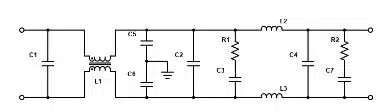
Figure 1: EMI filter structure designed for single-phase AC applications or DC power inputs 

L1, a common-mode choke, suppresses EMI and improves signal integrity. L1, C5 and C6 work together to manage second-order losses. C5 and C6 are commonly known as Y capacitors. L2 and L3 are the two inductors that form the differential-mode inductance. C1, C2 and C4, also known as X capacitors, are line-to-line capacitors for differential-mode loss. With common- and differential-mode losses and two RC shunt networks (R1, C3 and R2, C7), quality factor and output impedance are controllable.  

Normal/Differential Mode vs. Common Mode 

Differential-mode, or normal-mode, noise is a voltage differential that appears between the power line and a neutral or return line, where power naturally flows through an electric circuit. These currents travel in opposite directions on the circuit’s conductors. Normal-mode transients have a direct path through the circuit, so, naturally, they have an opportunity to degrade system performance.

Power supplies and motor controls that leverage high-frequency switching, like pulse width modulation (PWM) motor controls, are major differential-mode noise contributors. For example, with PWM controls, switching creates differential-mode noise at the source because of high ripple currents in DC link capacitors. 

Alternatively, common-mode currents travel in the same direction on the circuit’s conductors, so they return on a separate path. This kind of noise is more common between ground and two normal-mode lines. Since this type of noise is more common on more lines, it’s cause for concern; analog and digital circuits are susceptible to poor function and failure. Common-mode noise tends to be higher frequency than differential-mode noise because it originates from capacitive coupling. Higher frequency leads to coupling between components and lines. More coupling, more common-node noise. 

The Role of Safety Capacitors in EMI Filter Circuits for Power Electronics 

X capacitors and Y capacitors, identified in the description of Figure 1, are designated safety capacitors. Since they’re exposed to hazardous voltages more than other components, certification ensures that they’ll operate efficiently and safely under more extreme conditions.  

Class-X and Class-Y capacitors minimize EMI in different applications. Class-X, or “across-the-line” capacitors, are placed between wires carrying AC current to prevent shock in the event of failure. Class-Y capacitors, or “line-to-ground” capacitors, offer line-to-ground protection and are rigorously tested to minimize shock risk in the event of a ground failure. X1/Y1 safety capacitors combine both classes and can function appropriately regardless of where they’re placed in the circuit. 

Related

Source: Knowles Precision Devices

Recent Posts

Würth Elektroniks Flexible EMI Shielding Sheets Provides Quick and Easy Schielding Solution

17.6.2026
7

Samsung Introduces Automotive 1206 100uF X7T MLCC for Power Rails in ADAS and SoCs

17.6.2026
11

YMIN Hybrid Aluminum Capacitors for Automotive LiDAR Power Rails

17.6.2026
9

Samsung Presents Ultra‑Thin Silicon Capacitors for AI and Server PDN

17.6.2026
11

YAGEO Introduces 310VAC SMD Y2 Safety MP Capacitors for Compact EMI Filtering

16.6.2026
15

DMASS: European Components Distribution Returns To Growth In Q1 2026

16.6.2026
14

German Component Distribution Market Rebounds in Q1 2026 According to FBDi

16.6.2026
12

Nippon Chemi-Con Announces New Capacitor series for AI, Automotive and Immersion Cooling

16.6.2026
16

Ultrahigh Energy Storage in Lead‑Free BiFeO₃‑Based Ceramic Capacitors via Local Polar Structure Design

16.6.2026
20

Upcoming Events

Jul 14
16:00 - 17:00 CEST

EMC Design Essentials: Mastering Varistors and Common Mode Chokes

Jul 21
16:00 - 17:00 CEST

Safety by design: X and Y Interference suppression capacitors for power line filters

View Calendar

Popular Posts

  • Boost Converter Design and Calculation

    0 shares
    Share 0 Tweet 0
  • Buck Converter Design and Calculation

    0 shares
    Share 0 Tweet 0
  • LLC Resonant Converter Design and Calculation

    0 shares
    Share 0 Tweet 0
  • Flyback Converter Design and Calculation

    0 shares
    Share 0 Tweet 0
  • MLCC and Ceramic Capacitors

    0 shares
    Share 0 Tweet 0
  • Earthing Systems and IEC Classification Explained

    0 shares
    Share 0 Tweet 0
  • SEPIC Converter Design and Calculation

    0 shares
    Share 0 Tweet 0
  • Dual Active Bridge (DAB) Topology

    0 shares
    Share 0 Tweet 0
  • What Electronics Engineer Needs to Know About Passive Low Pass Filters

    0 shares
    Share 0 Tweet 0
  • MLCC Case Sizes Standards Explained

    0 shares
    Share 0 Tweet 0

Newsletter Subscription


Passive Components Blog

© EPCI - Leading Passive Components Educational and Information Site

  • Home
  • Privacy Policy
  • EPCI Membership & Advertisement
  • About

No Result
View All Result
  • Home
  • Knowledge Blog
  • Dossiers
  • PCNS

© EPCI - Leading Passive Components Educational and Information Site

This website uses cookies. By continuing to use this website you are giving consent to cookies being used. Visit our Privacy and Cookie Policy.
Go to mobile version