




Passive Components Blog
No Result
View All Result
  • Home
  • NewsFilter
    • All
    • Aerospace & Defence
    • Antenna
    • Applications
    • Automotive
    • Capacitors
    • Circuit Protection Devices
    • electro-mechanical news
    • Filters
    • Fuses
    • Inductors
    • Industrial
    • Integrated Passives
    • inter-connect news
    • Market & Supply Chain
    • Market Insights
    • Medical
    • Modelling and Simulation
    • New Materials & Supply
    • New Technologies
    • Non-linear Passives
    • Oscillators
    • Passive Sensors News
    • Resistors
    • RF & Microwave
    • Telecommunication
    • Weekly Digest

    Bourns Introduces Automotive BMS Signal Transformer with Integrated Common Mode Chokes

    Itelcond Introduces High‑Voltage Aluminium Capacitors for Modern IGBT DC‑links

    Bourns Introduces Automotive Shielded Power Inductors for Compact DC‑DC Converters

    EMC Design Fundamentals: Safe Use of Varistors and Common Mode Chokes in Mains and Data-Line Filters

    Murata Unveils Lead Disc Ceramic Capacitors for Automotive Safety and EMI Suppression

    SCHURTER Releases Intelligent Three‑Terminal Fuses for Safer Li‑ion Battery Systems

    Can Copper Conductive Inks Displace Silver in Hybrid Electronics?

    Square-Wave Harmonics and RMS Currents in Power Converters

    LeanBOM: Practical Cross‑Technology Capacitor Search by Real Working Conditions

    Trending Tags

    • Ripple Current
    • RF
    • Leakage Current
    • Tantalum vs Ceramic
    • Snubber
    • Low ESR
    • Feedthrough
    • Derating
    • Dielectric Constant
    • New Products
    • Market Reports
  • VideoFilter
    • All
    • Antenna videos
    • Capacitor videos
    • Circuit Protection Video
    • Filter videos
    • Fuse videos
    • Inductor videos
    • Inter-Connect Video
    • Non-linear passives videos
    • Oscillator videos
    • Passive sensors videos
    • Resistor videos

    EMC Design Fundamentals: Safe Use of Varistors and Common Mode Chokes in Mains and Data-Line Filters

    Ferrite versus Nanocrystalline Power Inductor Cores: Turns, Gap and Size

    KYOCERA AVX Presents Antenna Integrator Studio Tutorial for Antenna Placement and RF Design

    Power Design Simulation Tools for Faster Inductor Selection and Loss Optimization

    EMC‑Compliant PCB and Connector Design Guidelines

    Why Isolated DC/DC Power Supplies Fail Late, Würth Elektronik Podcast

    Designing 800 V DC EMC Filters: Calculation, Simulation and Measurement

    Current Sense Transformer Datasheet and Design‑in Guide

    Designing a USB Type‑C Flyback Planar Transformer with Frenetic’s Planar Tool

    Trending Tags

    • Capacitors explained
    • Inductors explained
    • Resistors explained
    • Filters explained
    • Application Video Guidelines
    • EMC
    • New Products
    • Ripple Current
    • Simulation
    • Tantalum vs Ceramic
  • Knowledge Blog
  • Dossiers
    • AI Hardware Dossier
    • Power Converter Dossier
    • Automotive Dossier
    • Capacitor Dossier
    • Resistor Dossier
    • Inductor Dossier
    • Circuit Protection Dossier
  • Suppliers
    • Who is Who
  • PCNS
    • PCNS 2025
    • PCNS 2023
    • PCNS 2021
    • PCNS 2019
    • PCNS 2017
  • Events
  • Home
  • NewsFilter
    • All
    • Aerospace & Defence
    • Antenna
    • Applications
    • Automotive
    • Capacitors
    • Circuit Protection Devices
    • electro-mechanical news
    • Filters
    • Fuses
    • Inductors
    • Industrial
    • Integrated Passives
    • inter-connect news
    • Market & Supply Chain
    • Market Insights
    • Medical
    • Modelling and Simulation
    • New Materials & Supply
    • New Technologies
    • Non-linear Passives
    • Oscillators
    • Passive Sensors News
    • Resistors
    • RF & Microwave
    • Telecommunication
    • Weekly Digest

    Bourns Introduces Automotive BMS Signal Transformer with Integrated Common Mode Chokes

    Itelcond Introduces High‑Voltage Aluminium Capacitors for Modern IGBT DC‑links

    Bourns Introduces Automotive Shielded Power Inductors for Compact DC‑DC Converters

    EMC Design Fundamentals: Safe Use of Varistors and Common Mode Chokes in Mains and Data-Line Filters

    Murata Unveils Lead Disc Ceramic Capacitors for Automotive Safety and EMI Suppression

    SCHURTER Releases Intelligent Three‑Terminal Fuses for Safer Li‑ion Battery Systems

    Can Copper Conductive Inks Displace Silver in Hybrid Electronics?

    Square-Wave Harmonics and RMS Currents in Power Converters

    LeanBOM: Practical Cross‑Technology Capacitor Search by Real Working Conditions

    Trending Tags

    • Ripple Current
    • RF
    • Leakage Current
    • Tantalum vs Ceramic
    • Snubber
    • Low ESR
    • Feedthrough
    • Derating
    • Dielectric Constant
    • New Products
    • Market Reports
  • VideoFilter
    • All
    • Antenna videos
    • Capacitor videos
    • Circuit Protection Video
    • Filter videos
    • Fuse videos
    • Inductor videos
    • Inter-Connect Video
    • Non-linear passives videos
    • Oscillator videos
    • Passive sensors videos
    • Resistor videos

    EMC Design Fundamentals: Safe Use of Varistors and Common Mode Chokes in Mains and Data-Line Filters

    Ferrite versus Nanocrystalline Power Inductor Cores: Turns, Gap and Size

    KYOCERA AVX Presents Antenna Integrator Studio Tutorial for Antenna Placement and RF Design

    Power Design Simulation Tools for Faster Inductor Selection and Loss Optimization

    EMC‑Compliant PCB and Connector Design Guidelines

    Why Isolated DC/DC Power Supplies Fail Late, Würth Elektronik Podcast

    Designing 800 V DC EMC Filters: Calculation, Simulation and Measurement

    Current Sense Transformer Datasheet and Design‑in Guide

    Designing a USB Type‑C Flyback Planar Transformer with Frenetic’s Planar Tool

    Trending Tags

    • Capacitors explained
    • Inductors explained
    • Resistors explained
    • Filters explained
    • Application Video Guidelines
    • EMC
    • New Products
    • Ripple Current
    • Simulation
    • Tantalum vs Ceramic
  • Knowledge Blog
  • Dossiers
    • AI Hardware Dossier
    • Power Converter Dossier
    • Automotive Dossier
    • Capacitor Dossier
    • Resistor Dossier
    • Inductor Dossier
    • Circuit Protection Dossier
  • Suppliers
    • Who is Who
  • PCNS
    • PCNS 2025
    • PCNS 2023
    • PCNS 2021
    • PCNS 2019
    • PCNS 2017
  • Events
No Result
View All Result
Passive Components Blog
No Result
View All Result

Fast-Lock ZIF Interconnections And Connector-less Flat Cables

26.2.2025
Reading Time: 6 mins read
A A

This paper was presented by Julien Logette, Axon Cable France during the 5th Space Passive Component Days (SPCD), an International Symposium held from October 15th to 18th, 2024, at ESA/ESTEC in Noordwijk, the Netherlands. Published under permission from ESA SPCD organizers.

Axon Cable is developing “connectorless” flat cable link solutions for the space market, featuring Zero Insertion Force (ZIF) connectors for PCB-mounted connections. The connectors, designed for both power and signal transmission, aim to enhance reliability by reducing connection points and are being optimized for space-grade applications. The project, part of an ongoing ARTES activity, seeks to achieve TRL 6 for these connectors, addressing the need for quick and easy integration in the growing space market.

RelatedPosts

ESA SPCD 26 Registration Open

ESA SPCD 26 Call for Papers Extended to 30th March

High-Density PCB Assemblies For Space Applications

A new connector design for flexible flat cables (FFCs) is presented, featuring a Zero Insertion Force (ZIF) interface for easy cable insertion and removal. The connector is designed to accommodate various cable cross-sections and includes features for EMI protection, double insulation, and mechanical fixation. Preliminary results show promising pull test and electrical performance, meeting the requirements for space applications.

Design phase nearing completion, Critical Design Review scheduled for Q4 2024. Axon will produce prototypes and conduct tests to validate automotive and industrial technologies for space use.

Key Points

  • FFC Advantages: Lightweight, flexible, superior heat dissipation, and higher current transmission compared to traditional round wires.
  • FFC Applications: Ideal for complex situations, particularly in the growing space sector for smaller satellites and mega-constellations.
  • Axon Cable’s Solution: Developing “connectorless” flat cable link solutions with fast-lock mechanisms for enhanced reliability and mass reduction in space applications.
  • During this study, the reliability of the locking of the ZIF connector, the quality of the electrical contacts as well as the double insulation rules, which were taken into account and adapted to the flat structure, are optimized to achieve a ZIF connection suitable for use in space. The aim is to achieve TRL 6 for the development of ZIF connectors for PCBs capable of accommodating flat cables supporting DC or low-frequency signals or a DC power supply (up to 10 A per track).

Survey

During a preliminary survey, Axon’ identified several FFC connectors in the market, allowing direct connection between FFC and units. These identified connectors are for industrial activities and none are available for space market.

The existing suppliers identified are either Asian or American. No European solution is available on the market. Thus there is a double interest of developing an European and a space compatible solution.
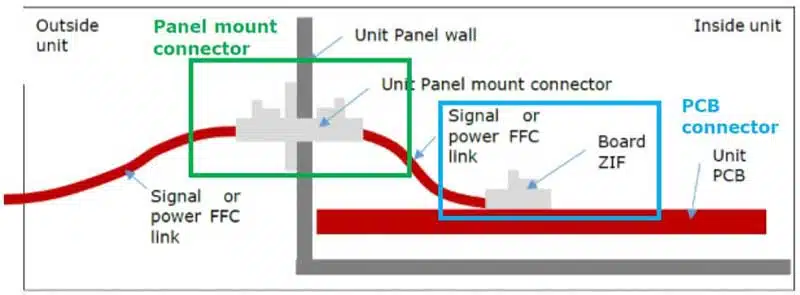
Fig. 1: PCB and Panel mount connector

Flat Cables and Connector Design

Flat cable design

The idea of this study was to develop a concept of connector that could be extended to various types of flat cables. Axon did the choice to select two flat cables already used on ongoing space projects, one for a power transmission application and the second one for signals transmission.

Axon’ P/NSectionDesignation
P584261Power 0.735mm² (#AWG18)FFC8x3.5×0.21 PI insulation + acrylic adhesive & SPC conductors
P584262Signal (#AWG26)FFC20x1.0x0.12 PI insulation+ acrylic adhesive & SPC conductors
Table 1. Type of flat cables to be connectorized.

Silver plated copper conductors (2 µm silver thickness) and 25 μm Polyimide tape insulation are used as a baseline of flat Flexible cable for space application. 76 μm Acrylic adhesive is used to fix the elements (insulation + flat conductors) as it has an excellent adhesion to copper and a good compatibility to space environment (low off gassing, good radiation resistance).
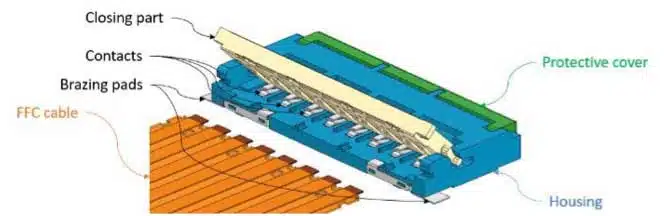
  • Cable Design Standard: Double insulation based on ECSS-Q-ST-70-12C standard.
  • Connector Design Goal: Easy installation and removal of flat cable without tools, zero insertion force.
  • Contact Design Consideration: Material, shape, and thickness ensure electrical contact and limit forces.
  • Connector Function: Positions, insulates, secures, and applies pressure to FFC cables and contacts.
  • Connector Design: Accommodates 8 power supply tracks (AWG 18) and 20 tracks (AWG 26) with a locking mechanism.
  • Materials and Features: LCP polymer housing, gold-plated Beryllium copper contacts and pads, optional EMI shielding.
  • Connector Insulation: Insulation barriers prevent direct access between conductors.
  • Soldered Joint Protection: Dedicated closing part protects and isolates connector terminations.
  • Equipment Connector Design: Shielded ZIF interface bonded to the chassis outside the equipment and an unshielded ZIF interface inside the equipment.

Electrical results

Preliminary measurements on the prototypes were conducted despite the use of body parts and contacts not made from final materials and slightly optimized shapes.

Contact resistance shows values <20 mΩ for Signal connector and <10 mΩ for Power connector. Concerning electrical insulation and Dielectric Withstanding Voltage (DWV), measurements results are:

For Signal connector

  • >30 GΩ with 500 VDC*
  • >2000 VRMS with threshold current of 0.5 mA

For Power

  • >30GΩ with 500VDC*
  • >3000 VRMS with threshold current of 0.5 mA

*maximum measurement range of the equipment.

ECSS-Q-ST-12-C ask the following values: Insulation resistance >10E10 Ω (10 GΩ) and DWV >1000 VRMS/mm for track to track.

Conclusion

This article presents axon’s work on an ESA TDE to propose flexible electrical connections for satellites using flat cables. The focus is on connecting flat cables directly to PCBs or equipment for power and weak signals. Design optimizations were made based on feedback from tests and trials. The design is robust and reliable, suitable for the space sector.

The design phase is nearing completion, with the Critical Design Review scheduled for Q4 2024. Axon will produce evaluation prototypes and conduct tests to prove that automotive and industrial technologies can be adapted for space use.

Read the full article:

AXON CABLE_ZIF connector for flat cablesDownload

Related

Source: ESA SPCD

Recent Posts

RF Filters and Passive Components Enabling the 7 Missile RF Subsystems

9.7.2026
57

Vishay Unveils Multi-Turn Position Sensor for Harsh Industrial Environments

7.7.2026
35

Molex Unveils Automotive Ethernet Connectors for Next‑Gen SDV Architectures

2.7.2026
46

YAGEO Announces July 2026 Capacitor Price Increase

1.7.2026
877

binder Prints Electronics on 3D Components Connector Surface

1.7.2026
21

EMC‑Compliant PCB and Connector Design Guidelines

22.6.2026
111

Hall-Effect Sensing for Harsh Environments: TT Electronics Selected in NASA’s Dragonfly Fan

22.6.2026
66

Stackpole Releases High-Frequency Thin Film Chip Resistors for RF up to 50 GHz

19.6.2026
57

Hirose Releases Ultra‑low Profile FPC‑to‑board Connector

17.6.2026
44

Upcoming Events

Jul 21
16:00 - 17:00 CEST

Safety by design: X and Y Interference suppression capacitors for power line filters

Jul 28
8:00 - 11:00 CEST

Post Procurement Testing of EEE Components for LEO Space Applications

Jul 29
17:30 - 18:30 CEST

To Ferrite or to Nanocrystalline in Transformer Design

View Calendar

Popular Posts

  • Boost Converter Design and Calculation

    0 shares
    Share 0 Tweet 0
  • Buck Converter Design and Calculation

    0 shares
    Share 0 Tweet 0
  • YAGEO Announces July 2026 Capacitor Price Increase

    0 shares
    Share 0 Tweet 0
  • Flyback Converter Design and Calculation

    0 shares
    Share 0 Tweet 0
  • LLC Resonant Converter Design and Calculation

    0 shares
    Share 0 Tweet 0
  • MLCC and Ceramic Capacitors

    0 shares
    Share 0 Tweet 0
  • Earthing Systems and IEC Classification Explained

    0 shares
    Share 0 Tweet 0
  • MLCCs in the Age of AI: Q2 2026 Market Tightness

    0 shares
    Share 0 Tweet 0
  • Nvidia Vera Rubin: Why One AI Rack Needs So Many More MLCC Capacitors

    0 shares
    Share 0 Tweet 0
  • Dual Active Bridge (DAB) Topology

    0 shares
    Share 0 Tweet 0

Newsletter Subscription


Passive Components Blog

© EPCI - Leading Passive Components Educational and Information Site

  • Home
  • Privacy Policy
  • EPCI Membership & Advertisement
  • About

No Result
View All Result
  • Home
  • Knowledge Blog
  • Dossiers
  • PCNS

© EPCI - Leading Passive Components Educational and Information Site

This website uses cookies. By continuing to use this website you are giving consent to cookies being used. Visit our Privacy and Cookie Policy.
Go to mobile version