











Passive Components Blog
No Result
View All Result
  • Home
  • NewsFilter
    • All
    • Aerospace & Defence
    • Antenna
    • Applications
    • Automotive
    • Capacitors
    • Circuit Protection Devices
    • electro-mechanical news
    • Filters
    • Fuses
    • Inductors
    • Industrial
    • Integrated Passives
    • inter-connect news
    • Market & Supply Chain
    • Market Insights
    • Medical
    • Modelling and Simulation
    • New Materials & Supply
    • New Technologies
    • Non-linear Passives
    • Oscillators
    • Passive Sensors News
    • Resistors
    • RF & Microwave
    • Telecommunication
    • Weekly Digest

    Littelfuse Announced TVS Diodes for 48 V Automotive Systems

    Spectrum Controls Joins Modelithics Program to Offer High‑Fidelity RF Models for Resistors, Attenuators and Terminations

    RF Filters and Passive Components Enabling the 7 Missile RF Subsystems

    Ferrite versus Nanocrystalline Power Inductor Cores: Turns, Gap and Size

    YAGEO Presents NANOMET Soft Magnetic Cores for High‑Density Power Conversion

    Coilcraft Releases High-Current Ferrite Beads for CISPR 25 EMC compliance

    From DCL to SSC: Bridging Electrical Symptoms and Structural Indicators in Tantalum Capacitors

    Vishay Unveils Multi-Turn Position Sensor for Harsh Industrial Environments

    YAGEO Introduces Automotive MOV Surge Protection Varistor

    Trending Tags

    • Ripple Current
    • RF
    • Leakage Current
    • Tantalum vs Ceramic
    • Snubber
    • Low ESR
    • Feedthrough
    • Derating
    • Dielectric Constant
    • New Products
    • Market Reports
  • VideoFilter
    • All
    • Antenna videos
    • Capacitor videos
    • Circuit Protection Video
    • Filter videos
    • Fuse videos
    • Inductor videos
    • Inter-Connect Video
    • Non-linear passives videos
    • Oscillator videos
    • Passive sensors videos
    • Resistor videos

    Ferrite versus Nanocrystalline Power Inductor Cores: Turns, Gap and Size

    KYOCERA AVX Presents Antenna Integrator Studio Tutorial for Antenna Placement and RF Design

    Power Design Simulation Tools for Faster Inductor Selection and Loss Optimization

    EMC‑Compliant PCB and Connector Design Guidelines

    Why Isolated DC/DC Power Supplies Fail Late, Würth Elektronik Podcast

    Designing 800 V DC EMC Filters: Calculation, Simulation and Measurement

    Current Sense Transformer Datasheet and Design‑in Guide

    Designing a USB Type‑C Flyback Planar Transformer with Frenetic’s Planar Tool

    Magnetics Design in High‑Frequency GaN Converters

    Trending Tags

    • Capacitors explained
    • Inductors explained
    • Resistors explained
    • Filters explained
    • Application Video Guidelines
    • EMC
    • New Products
    • Ripple Current
    • Simulation
    • Tantalum vs Ceramic
  • Knowledge Blog
  • Dossiers
    • AI Hardware Dossier
    • Power Converter Dossier
    • Automotive Dossier
    • Capacitor Dossier
    • Resistor Dossier
    • Inductor Dossier
    • Circuit Protection Dossier
  • Suppliers
    • Who is Who
  • PCNS
    • PCNS 2025
    • PCNS 2023
    • PCNS 2021
    • PCNS 2019
    • PCNS 2017
  • Events
  • Home
  • NewsFilter
    • All
    • Aerospace & Defence
    • Antenna
    • Applications
    • Automotive
    • Capacitors
    • Circuit Protection Devices
    • electro-mechanical news
    • Filters
    • Fuses
    • Inductors
    • Industrial
    • Integrated Passives
    • inter-connect news
    • Market & Supply Chain
    • Market Insights
    • Medical
    • Modelling and Simulation
    • New Materials & Supply
    • New Technologies
    • Non-linear Passives
    • Oscillators
    • Passive Sensors News
    • Resistors
    • RF & Microwave
    • Telecommunication
    • Weekly Digest

    Littelfuse Announced TVS Diodes for 48 V Automotive Systems

    Spectrum Controls Joins Modelithics Program to Offer High‑Fidelity RF Models for Resistors, Attenuators and Terminations

    RF Filters and Passive Components Enabling the 7 Missile RF Subsystems

    Ferrite versus Nanocrystalline Power Inductor Cores: Turns, Gap and Size

    YAGEO Presents NANOMET Soft Magnetic Cores for High‑Density Power Conversion

    Coilcraft Releases High-Current Ferrite Beads for CISPR 25 EMC compliance

    From DCL to SSC: Bridging Electrical Symptoms and Structural Indicators in Tantalum Capacitors

    Vishay Unveils Multi-Turn Position Sensor for Harsh Industrial Environments

    YAGEO Introduces Automotive MOV Surge Protection Varistor

    Trending Tags

    • Ripple Current
    • RF
    • Leakage Current
    • Tantalum vs Ceramic
    • Snubber
    • Low ESR
    • Feedthrough
    • Derating
    • Dielectric Constant
    • New Products
    • Market Reports
  • VideoFilter
    • All
    • Antenna videos
    • Capacitor videos
    • Circuit Protection Video
    • Filter videos
    • Fuse videos
    • Inductor videos
    • Inter-Connect Video
    • Non-linear passives videos
    • Oscillator videos
    • Passive sensors videos
    • Resistor videos

    Ferrite versus Nanocrystalline Power Inductor Cores: Turns, Gap and Size

    KYOCERA AVX Presents Antenna Integrator Studio Tutorial for Antenna Placement and RF Design

    Power Design Simulation Tools for Faster Inductor Selection and Loss Optimization

    EMC‑Compliant PCB and Connector Design Guidelines

    Why Isolated DC/DC Power Supplies Fail Late, Würth Elektronik Podcast

    Designing 800 V DC EMC Filters: Calculation, Simulation and Measurement

    Current Sense Transformer Datasheet and Design‑in Guide

    Designing a USB Type‑C Flyback Planar Transformer with Frenetic’s Planar Tool

    Magnetics Design in High‑Frequency GaN Converters

    Trending Tags

    • Capacitors explained
    • Inductors explained
    • Resistors explained
    • Filters explained
    • Application Video Guidelines
    • EMC
    • New Products
    • Ripple Current
    • Simulation
    • Tantalum vs Ceramic
  • Knowledge Blog
  • Dossiers
    • AI Hardware Dossier
    • Power Converter Dossier
    • Automotive Dossier
    • Capacitor Dossier
    • Resistor Dossier
    • Inductor Dossier
    • Circuit Protection Dossier
  • Suppliers
    • Who is Who
  • PCNS
    • PCNS 2025
    • PCNS 2023
    • PCNS 2021
    • PCNS 2019
    • PCNS 2017
  • Events
No Result
View All Result
Passive Components Blog
No Result
View All Result

Spectrum Controls Joins Modelithics Program to Offer High‑Fidelity RF Models for Resistors, Attenuators and Terminations

10.7.2026
Reading Time: 6 mins read
A A

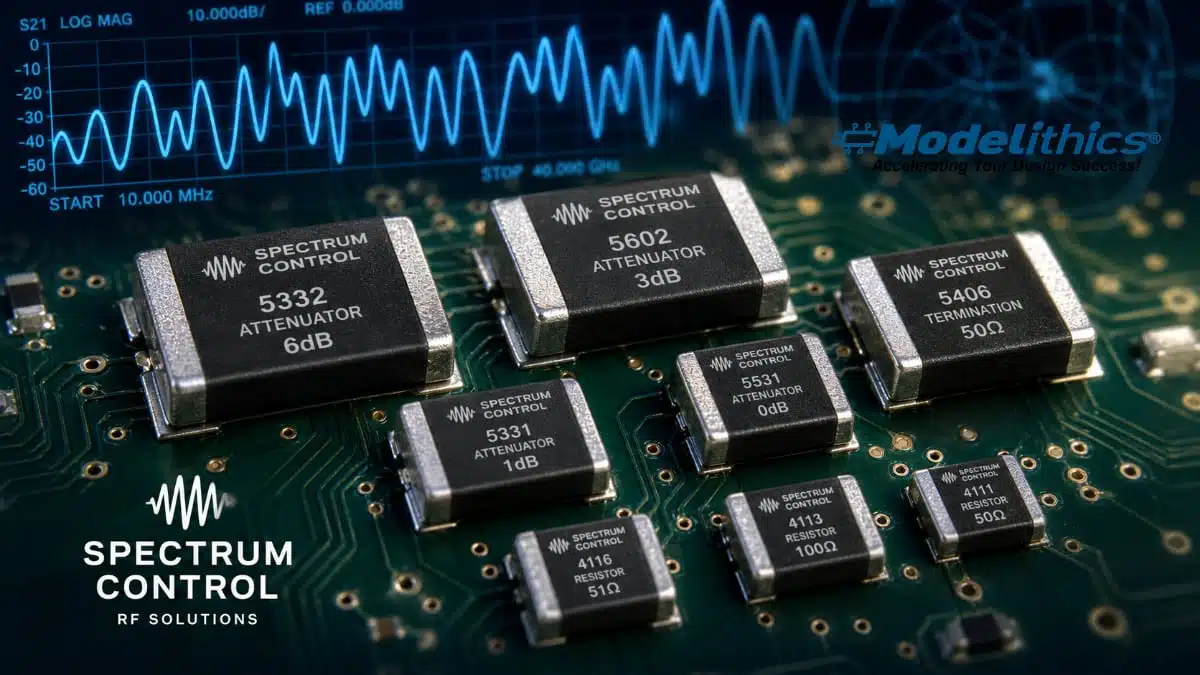
Modelithics and Spectrum Control have announced a new collaboration to develop high‑accuracy RF and microwave simulation models for Spectrum Control’s Powerfilm surface‑mount resistive components.

The initiative brings measurement‑based models for chip attenuators, resistors and terminations into leading EDA tools, helping RF and microwave designers move from datasheet to hardware with fewer iterations and lower risk. The models are offered through the Modelithics Vendor Partner (MVP) program, including 90‑day free trial access for selected users.

RelatedPosts

Modelithics Releases COMPLETE Library v26.2 for Keysight Genesys

Modelithics Releases COMPLETE v26.1 for Keysight ADS

Modelithics Expands COMPLETE+3D Library for Ansys HFSS

Key features and benefits

  • Measurement‑based models for Powerfilm resistive products
    The partnership targets Spectrum Control’s surface‑mount attenuators, chip resistors and terminations, which are widely used in high‑reliability RF and microwave designs where predictable performance and long‑term stability are critical.
  • Frequency coverage from low GHz up to 67 GHz
    The new models are characterized and validated over a very wide frequency range, allowing design engineers to use the same component families from lower microwave bands up into millimeter‑wave applications without switching to different modeling approaches.
  • Scalable models across substrates, pads and part values
    Modelithics Microwave Global Models are designed to be scalable, letting designers adjust geometry, substrate material, pad configuration and resistance or attenuation value while staying within the boundaries of measured data. This reduces the need for custom test runs every time a layout or substrate changes.
  • Multi‑dimensional S‑parameter validation
    Each model is validated against multi‑dimensional S‑parameter measurements and device specifications, improving confidence when matching, terminating or attenuating signals in demanding RF chains.
  • Direct integration with leading RF EDA platforms
    Spectrum Control Powerfilm models will be released within the Modelithics COMPLETE Library, supporting environments such as Keysight ADS and Cadence AWR Design Environment. Designers can drop components directly into schematics and layouts, sweep parameters and perform optimization using familiar workflows.
  • 90‑day free trial licenses via MVP program
    As a Sponsoring MVP, Spectrum Control is funding 90‑day free trial licenses for the new models so mutual customers can evaluate them in live design projects before committing to full library subscriptions.

Typical applications

Spectrum Control’s Powerfilm surface‑mount resistive portfolio targets board‑level RF and microwave designs where accurate amplitude control, impedance matching and power handling are essential.

Modelithics COMPLETE and MVP ecosystem

  • The models will be distributed through the Modelithics COMPLETE Library, which offers scalable models for a wide range of passive components, diodes, transistors and system‑level blocks across multiple EDA platforms.
  • Spectrum Control joins other passive and active component manufacturers in the Modelithics Vendor Partner program, which promotes collaboration during model development and provides flexible sponsorship and distribution arrangements, including vendor‑sponsored libraries that can be accessed at no cost by end users.
  • Dedicated Vendor Sponsored Library pages host information about the available models and free trial requests, including the Spectrum Control MVP landing page referenced in the press release.

Design‑in notes for engineers

The main value of the new Modelithics‑Spectrum Control initiative is that it turns Powerfilm datasheet information and discrete S‑parameter measurements into flexible, simulation‑ready models. This section highlights practical design‑in considerations for RF engineers and technical buyers.

  • Use scalable models to explore substrate trade‑offs
    Because the new models are scalable across substrates, designers can compare alumina, aluminum nitride and beryllium oxide options in the same schematic, estimating changes in thermal behavior, size and cost before committing to a particular material stack. High‑power terminations and attenuators benefit especially from this capability.
  • Sweep pad geometries to reflect real layout constraints
    RF layouts rarely match ideal application note footprints. Scalable pad and land‑pattern parameters allow engineers to sweep pad dimensions, spacing and ground connection styles, revealing how real‑world layout compromises affect insertion loss, return loss and power handling.
  • Optimize attenuation values and resistor networks in‑simulation
    For functions such as gain leveling or divider design, the models support sweeping attenuation values and resistance levels. This lets designers optimize for gain flatness, isolation and matching before committing to specific Powerfilm part numbers, reducing PCB spins. Final values should still be checked against discrete part ratings and tolerances in the datasheet.
  • Leverage high‑frequency coverage for mmWave feasibility studies
    With validated coverage extending towards 67 GHz, designers can test whether existing Powerfilm chip components remain suitable when migrating systems from classic microwave bands up to mmWave. This is useful when reusing existing IP in new bands, or when evaluating cost and availability of high‑reliability passive components at higher frequencies.
  • Combine component models with system‑level blocks
    Modelithics also offers system‑level component models, enabling co‑simulation of Powerfilm resistive elements along with couplers, filters, amplifiers and other blocks. This system perspective helps quantify the impact of attenuator and termination choice on overall link budget, noise figure and dynamic range.
  • Coordinate engineering and purchasing via the MVP program
    Since Spectrum Control is a Sponsoring MVP, technical teams can trial the models early while procurement engages with Spectrum Control on lead times, qualification and pricing. This reduces the gap between simulation and supply‑chain reality, particularly for mission‑critical and defense programs where vendor alignment is essential.

Source

This article is based on Modelithics’ official press release announcing Spectrum Control as a Sponsoring MVP and the joint development of high‑fidelity models for Powerfilm surface‑mount resistive products, complemented by public information from Modelithics and Spectrum Control describing the Powerfilm portfolio and Modelithics COMPLETE Library ecosystem.

References

  1. Modelithics MVP Vendor Sponsored Libraries
  2. Modelithics COMPLETE Library overview
  3. Modelithics Vendor Partners (MVP) program
  4. Spectrum Control Powerfilm overview
  5. Spectrum Control Powerfilm landing page
  6. Spectrum Control chip resistors – Powerfilm
  7. Spectrum Control terminations – Powerfilm
  8. Example Powerfilm chip attenuator datasheet (PCAAF‑T3)
  9. Modelithics brochures and COMPLETE Library platforms
  10. Passive Components Blog – Modelithics COMPLETE Library v25.8 for Keysight ADS
  11. Powerfilm application flyer

Related

Recent Posts

AI Hardware Demand for Passive Components Dossier

30.6.2026
144

Power Design Simulation Tools for Faster Inductor Selection and Loss Optimization

29.6.2026
37

Stackpole Releases High-Frequency Thin Film Chip Resistors for RF up to 50 GHz

19.6.2026
54

DMASS: European Components Distribution Returns To Growth In Q1 2026

16.6.2026
92

German Component Distribution Market Rebounds in Q1 2026 According to FBDi

16.6.2026
55

Murata Expands Ansys Simulation Models for RF inductors, MLCCs, and Power Inductors

16.6.2026
62

Modelithics Releases COMPLETE Library v26.2 for Keysight Genesys

8.6.2026
37

Power Converter Dossier: Passive Components Design and Selection Guide 2026

5.6.2026
99

Stackpole Introduces 1400A Busbar Shunt Resistors

2.6.2026
58

Upcoming Events

Jul 14
16:00 - 17:00 CEST

EMC Design Essentials: Mastering Varistors and Common Mode Chokes

Jul 21
16:00 - 17:00 CEST

Safety by design: X and Y Interference suppression capacitors for power line filters

Jul 28
8:00 - 11:00 CEST

Post Procurement Testing of EEE Components for LEO Space Applications

View Calendar

Popular Posts

  • Boost Converter Design and Calculation

    0 shares
    Share 0 Tweet 0
  • Buck Converter Design and Calculation

    0 shares
    Share 0 Tweet 0
  • Flyback Converter Design and Calculation

    0 shares
    Share 0 Tweet 0
  • LLC Resonant Converter Design and Calculation

    0 shares
    Share 0 Tweet 0
  • MLCC and Ceramic Capacitors

    0 shares
    Share 0 Tweet 0
  • YAGEO Announces July 2026 Capacitor Price Increase

    0 shares
    Share 0 Tweet 0
  • Earthing Systems and IEC Classification Explained

    0 shares
    Share 0 Tweet 0
  • Nvidia Vera Rubin: Why One AI Rack Needs So Many More MLCC Capacitors

    0 shares
    Share 0 Tweet 0
  • Dual Active Bridge (DAB) Topology

    0 shares
    Share 0 Tweet 0
  • MLCC Case Sizes Standards Explained

    0 shares
    Share 0 Tweet 0

Newsletter Subscription


Passive Components Blog

© EPCI - Leading Passive Components Educational and Information Site

  • Home
  • Privacy Policy
  • EPCI Membership & Advertisement
  • About

No Result
View All Result
  • Home
  • Knowledge Blog
  • Dossiers
  • PCNS

© EPCI - Leading Passive Components Educational and Information Site

This website uses cookies. By continuing to use this website you are giving consent to cookies being used. Visit our Privacy and Cookie Policy.
Go to mobile version