



A team led by Junlei Qi and Yuan-Hua Lin has reported tungsten bronze capacitors that combine increased dielectric permittivity with low loss and a near-zero temperature coefficient.
Published in Nature Electronics on 6 October 2026, the study links machine-learning-guided composition selection to atomic-scale characterization and prototype single-layer chip capacitors.
Key takeaways
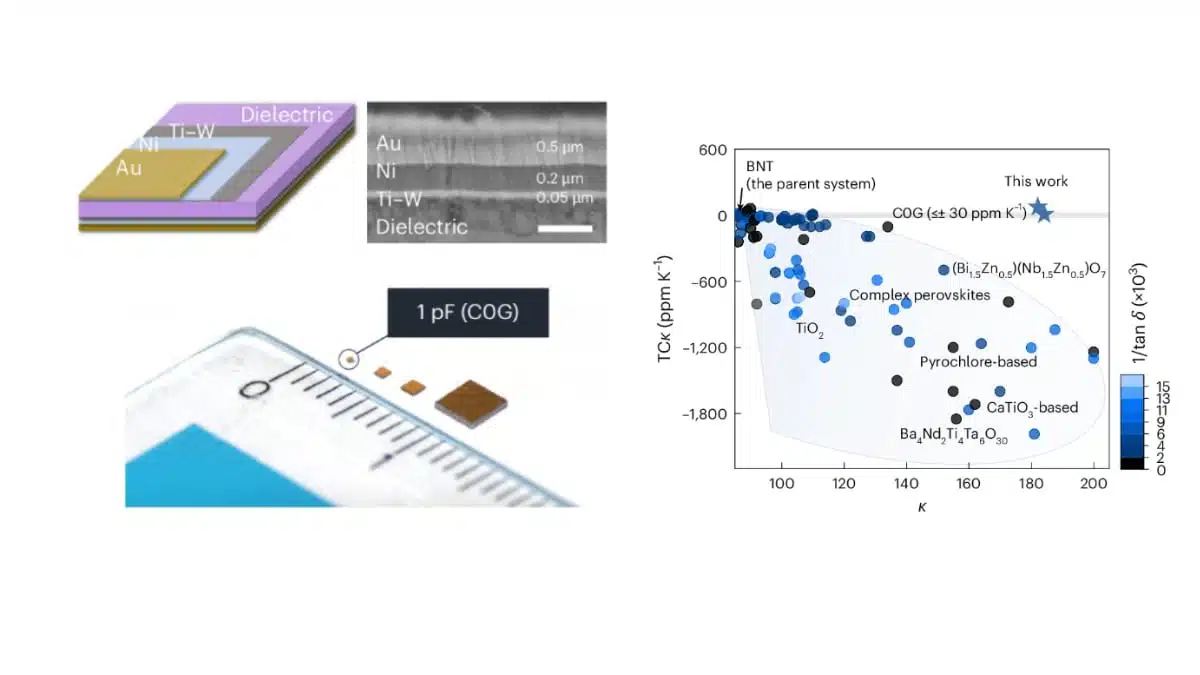
- The optimized Ba₄(Nd₀.₅Bi₀.₅)₉.₃₃(Ti₀.₉₉Ge₀.₀₁)₁₈O₅₄ ceramic, abbreviated BNBGT, achieved relative permittivity of approximately 185, loss tangent around 0.0005 and a reported temperature coefficient of −22 ppm/K. The complete measurement conditions require confirmation from the supplementary information.
- A 35 pF single-layer prototype maintained stable capacitance over the reported frequency range of 100 Hz to 10 MHz.
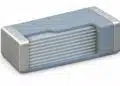
- A nominal 1 pF prototype measured 0.35 × 0.35 × 0.20 mm, compared with 0.90 × 0.90 × 0.20 mm for the commercial single-layer device selected in the paper—approximately 85% less volume.
- During a reported 100-hour test at 150°C and 1,000 V, capacitance changed by no more than 0.1%, with no observed failures. A voltage-to-field inconsistency needs clarification before interpreting the accelerated-life result.
Background
For precision ceramic capacitors, high permittivity is useful only when it arrives with acceptable dielectric loss and predictable capacitance. Increasing capacitance per unit volume while preserving temperature stability would help reduce the footprint of RF matching networks, filters and other small-capacitance circuits.
The basic relationship is : capacitance increases with dielectric permittivity and electrode overlap area, and decreases with dielectric thickness. A higher-permittivity material can therefore reduce the area needed for a given capacitance without requiring a thinner dielectric.
The difficulty is that the polarization mechanisms responsible for high permittivity can also introduce temperature dependence or loss. Ferroelectric materials offer high capacitance density, but their domain response complicates stability. Low-loss linear dielectrics avoid much of that behavior, often at the expense of permittivity. The practical distinction is explained in Temperature, Bias and Ageing Impact to Capacitance Stability of MLCC Ceramic Capacitors.
This study targets the stable, low-loss end of that trade-off—not the high-capacitance bulk-decoupling role of conventional Class II MLCCs.
What the researchers found
The starting material was Ba₄Nd₉.₃₃Ti₁₈O₅₄, abbreviated BNT. Its tungsten bronze framework contains corner-sharing metal–oxygen octahedra and different cation accommodation sites. “Tungsten bronze” describes the structural family; the optimized composition itself contains no tungsten.
The screening framework used literature-derived property datasets containing 250 materials for permittivity and 162 for its temperature coefficient. These are material counts, not thousands of independent experimental samples: the larger entry totals in the paper include multiple descriptors for each material.
Global screening identified the BNT structural family. A subsequent local-feature analysis connected permittivity with properties of the cations occupying four-membered-ring sites, and thermal response with metal–oxygen bond strength and covalency.
Bismuth substitution increased permittivity, but worsened the temperature coefficient. Introducing germanium at titanium sites then shifted the temperature response toward zero, with a modest reduction in permittivity.
| Composition | Reported relative permittivity | Reported temperature coefficient | Measurement context |
|---|---|---|---|
| Parent BNT | Approximately 85 | Approximately −70 ppm/K | Parent-material values cited in the paper; loss specified at 1 MHz |
| 50% Bi-substituted BNBT | 205 | −140 ppm/K | Ceramic composition series; full frequency and temperature interval require supplementary verification |
| Bi/Ge co-substituted BNBGT | Approximately 185 | −22 ppm/K | Optimized ceramic; full frequency and temperature interval require supplementary verification |
The important outcome is not maximum permittivity alone. Germanium sacrifices some of the bismuth-enabled increase to recover temperature stability.
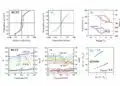
Atomic-resolution scanning transmission electron microscopy, Raman spectroscopy, X-ray absorption measurements and density-functional calculations support a proposed compensation mechanism. Strong Ge–O bonding promotes coupled octahedral distortion and off-centre cation displacement as the lattice expands. That additional polar response offsets the reduction in dielectric susceptibility normally associated with thermal expansion.
The microscopy compared structures at 25°C and 500°C. These temperatures describe the mechanism investigation, not a qualified capacitor operating range.
For the composition-series results, the paper reports three ceramic specimens from the same sintering batch, each measured with three technical replicates. This supports within-batch consistency, but does not establish independent-batch reproducibility.
Why tungsten bronze capacitors matter
The clearest component opportunity is a smaller temperature-stable single-layer ceramic capacitor. The demonstrated electrode system used titanium–tungsten, nickel and gold layers around the ceramic, rather than a co-fired multilayer architecture.
The nominal 1 pF comparison is tangible: reducing chip dimensions from 0.90 × 0.90 × 0.20 mm to 0.35 × 0.35 × 0.20 mm gives an approximately 85% volume reduction. However, that comparison applies to the particular commercial single-layer reference selected by the authors. It is not an 85% reduction against all commercial C0G capacitors or modern MLCCs.
A dielectric with this combination of properties could be attractive where footprint, temperature drift and dielectric dissipation matter simultaneously. RF matching and precision filtering are more immediate application targets than bulk energy storage.
Low dielectric loss also does not establish finished-component RF performance. Electrode resistance, termination geometry, mounting parasitics and self-resonance still determine impedance and effective quality factor.
Likewise, linear polarization loops are encouraging but are not a substitute for capacitance-versus-DC-bias curves. The distinction matters when translating a materials result into usable circuit capacitance; DC Bias Characteristics of Ceramic Capacitors provides relevant design context.
From lab to component
An editorial maturity estimate is TRL 3–4: experimental material validation with laboratory component prototypes. The work has moved beyond computational screening, but the retrieved evidence does not establish production qualification.
The paper reports linear polarization–field loops at 3 kV/mm and 10 Hz between −70°C and 150°C. It also reports bulk breakdown strength of approximately 40 kV/mm for a roughly 0.54 mm-thick specimen, and retention of more than 99.8% of initial capacitance after 1,000 thermal-shock cycles between −55°C and 150°C. These are encouraging screening results, not interchangeable measures of rated voltage or service lifetime.
An important ambiguity concerns accelerated-life testing. The text equates 1,000 V with approximately 25 kV/mm, implying a dielectric thickness of 40 µm. The illustrated devices have substantially larger overall thicknesses. The actual test specimen and active dielectric thickness must be confirmed before using that stress level quantitatively.
Moving to MLCCs would introduce additional requirements: tape casting, thin-layer uniformity, electrode co-firing and control of defect chemistry under the selected firing atmosphere. A nickel layer in a deposited electrode stack does not demonstrate compatibility with nickel base-metal-electrode co-firing.
The final composition avoids lead, although lead was explored during screening. That does not by itself establish RoHS compliance of a finished product. Raw-material cost, rare-earth sourcing, germanium availability and manufacturing yield also remain component-development questions.
What engineers should watch
- Complete capacitance and loss curves versus temperature, frequency, AC amplitude and DC bias, with clearly defined reference conditions.
- Reproducibility across independently processed batches, including phase purity, grain structure and composition tolerances.
- Performance after reducing dielectric thickness, especially breakdown statistics and leakage rather than only a bulk breakdown value.
- Demonstrated multilayer processing and compatibility with practical co-fired electrodes.
- Reliability test sample counts, active dielectric thicknesses, failure criteria, humidity exposure and acceleration assumptions.
- Finished-device ESR, quality factor, self-resonance, solderability and mechanical robustness.
Summary
The study demonstrates a useful materials-design approach: increase polarizability through bismuth substitution, then use germanium-mediated local bonding to compensate the temperature response. Laboratory single-layer capacitors translate that balance into a credible miniaturization example.
The result remains a prototype technology. Designers should remember the combination of permittivity, loss and thermal stability—not treat the reported volume reduction or accelerated tests as evidence of a qualified replacement component.
Further reading
- What Ceramic Technologies Are Best for High Power Density Applications?
- High Voltage C0G MLCC in DC-DC and OBC Applications
Source
This draft is based on the research article published in Nature Electronics and marked open access by the publisher. No matching institutional press release was located in the searches performed. The exact open-access license and complete supplementary methods could not be verified in this session. These are research results, not qualified commercial components; design decisions should await manufacturer specifications and standard qualification.
References
- Junlei Qi, Yiying Chen, Jincheng Qin, Bin Wei, Hao Pan, Tengfei Hu, Zhengqian Fu, Yixuan Wu, Ruoyi Lv, Faqiang Zhang, Yujun Zhang, Wei Xu, Jianrong Zeng, Shangming He, Zhe Zhu, Hang Su, Zhao Yang, Zhenxiao Fu, Zhifu Liu, Ce-wen Nan, Shujun Zhang and Yuan-Hua Lin, “Temperature-stable high-κ oxides for miniaturized capacitors,” Nature Electronics, published online 6 October 2026. DOI: 10.1038/s41928-026-01721-1.