






Passive Components Blog
No Result
View All Result
  • Home
  • NewsFilter
    • All
    • Aerospace & Defence
    • Antenna
    • Applications
    • Automotive
    • Capacitors
    • Circuit Protection Devices
    • electro-mechanical news
    • Filters
    • Fuses
    • Inductors
    • Industrial
    • Integrated Passives
    • inter-connect news
    • Market & Supply Chain
    • Market Insights
    • Medical
    • Modelling and Simulation
    • New Materials & Supply
    • New Technologies
    • Non-linear Passives
    • Oscillators
    • Passive Sensors News
    • Resistors
    • RF & Microwave
    • Telecommunication
    • Weekly Digest

    Designing 800 V DC EMC Filters: Calculation, Simulation and Measurement

    TDK Releases DC-link Film Capacitors with Ultra-low Inductance for SiC Power Converters

    Murata Introduces World First 2.2uF 100V Soft‑Term MLCC in 0805 Size for Automotive

    Murata and Xona Partner on LEO Satellite Navigation for Industrial Applications

    Bourns Offers Custom Magnetics for 3‑Phase Flying Capacitor Inverters

    YAGEO Releases Cost Efficient Pt‑RTD Sensors with Ni wires

    Nvidia Vera Rubin: Why One AI Rack Needs So Many More MLCC Capacitors

    Stackpole Introduces 1400A Busbar Shunt Resistors

    Tecate Unveils High‑temp 105C Supercapacitors for Harsh‑Environment Designs

    Trending Tags

    • Ripple Current
    • RF
    • Leakage Current
    • Tantalum vs Ceramic
    • Snubber
    • Low ESR
    • Feedthrough
    • Derating
    • Dielectric Constant
    • New Products
    • Market Reports
  • VideoFilter
    • All
    • Antenna videos
    • Capacitor videos
    • Circuit Protection Video
    • Filter videos
    • Fuse videos
    • Inductor videos
    • Inter-Connect Video
    • Non-linear passives videos
    • Oscillator videos
    • Passive sensors videos
    • Resistor videos

    Designing 800 V DC EMC Filters: Calculation, Simulation and Measurement

    Current Sense Transformer Datasheet and Design‑in Guide

    Designing a USB Type‑C Flyback Planar Transformer with Frenetic’s Planar Tool

    Magnetics Design in High‑Frequency GaN Converters

    Qi2 Wireless Charging: Inductors, Capacitors and EMC Filters

    Two‑capacitor paradox explained for engineers

    Capacitances of Nonlinear MLCCs: What Datasheets Don’t Tell You

    Tapped Inductor Buck Converter Fundamentals

    Planar vs Conventional Transformer: When it Make Sense

    Trending Tags

    • Capacitors explained
    • Inductors explained
    • Resistors explained
    • Filters explained
    • Application Video Guidelines
    • EMC
    • New Products
    • Ripple Current
    • Simulation
    • Tantalum vs Ceramic
  • Knowledge Blog
  • DossiersNew
  • Suppliers
    • Who is Who
  • PCNS
    • PCNS 2025
    • PCNS 2023
    • PCNS 2021
    • PCNS 2019
    • PCNS 2017
  • Events
  • Home
  • NewsFilter
    • All
    • Aerospace & Defence
    • Antenna
    • Applications
    • Automotive
    • Capacitors
    • Circuit Protection Devices
    • electro-mechanical news
    • Filters
    • Fuses
    • Inductors
    • Industrial
    • Integrated Passives
    • inter-connect news
    • Market & Supply Chain
    • Market Insights
    • Medical
    • Modelling and Simulation
    • New Materials & Supply
    • New Technologies
    • Non-linear Passives
    • Oscillators
    • Passive Sensors News
    • Resistors
    • RF & Microwave
    • Telecommunication
    • Weekly Digest

    Designing 800 V DC EMC Filters: Calculation, Simulation and Measurement

    TDK Releases DC-link Film Capacitors with Ultra-low Inductance for SiC Power Converters

    Murata Introduces World First 2.2uF 100V Soft‑Term MLCC in 0805 Size for Automotive

    Murata and Xona Partner on LEO Satellite Navigation for Industrial Applications

    Bourns Offers Custom Magnetics for 3‑Phase Flying Capacitor Inverters

    YAGEO Releases Cost Efficient Pt‑RTD Sensors with Ni wires

    Nvidia Vera Rubin: Why One AI Rack Needs So Many More MLCC Capacitors

    Stackpole Introduces 1400A Busbar Shunt Resistors

    Tecate Unveils High‑temp 105C Supercapacitors for Harsh‑Environment Designs

    Trending Tags

    • Ripple Current
    • RF
    • Leakage Current
    • Tantalum vs Ceramic
    • Snubber
    • Low ESR
    • Feedthrough
    • Derating
    • Dielectric Constant
    • New Products
    • Market Reports
  • VideoFilter
    • All
    • Antenna videos
    • Capacitor videos
    • Circuit Protection Video
    • Filter videos
    • Fuse videos
    • Inductor videos
    • Inter-Connect Video
    • Non-linear passives videos
    • Oscillator videos
    • Passive sensors videos
    • Resistor videos

    Designing 800 V DC EMC Filters: Calculation, Simulation and Measurement

    Current Sense Transformer Datasheet and Design‑in Guide

    Designing a USB Type‑C Flyback Planar Transformer with Frenetic’s Planar Tool

    Magnetics Design in High‑Frequency GaN Converters

    Qi2 Wireless Charging: Inductors, Capacitors and EMC Filters

    Two‑capacitor paradox explained for engineers

    Capacitances of Nonlinear MLCCs: What Datasheets Don’t Tell You

    Tapped Inductor Buck Converter Fundamentals

    Planar vs Conventional Transformer: When it Make Sense

    Trending Tags

    • Capacitors explained
    • Inductors explained
    • Resistors explained
    • Filters explained
    • Application Video Guidelines
    • EMC
    • New Products
    • Ripple Current
    • Simulation
    • Tantalum vs Ceramic
  • Knowledge Blog
  • DossiersNew
  • Suppliers
    • Who is Who
  • PCNS
    • PCNS 2025
    • PCNS 2023
    • PCNS 2021
    • PCNS 2019
    • PCNS 2017
  • Events
No Result
View All Result
Passive Components Blog
No Result
View All Result

Exploring the Benefits of High-Performance MLCC Capacitors for Aerospace and Defense

23.3.2023
Reading Time: 5 mins read
A A

This Knowles Precision Devices blog article discusses features and requirements on high-performance MLCC capacitors for aerospace and defense applications.

From military aircraft to electronic warfare defense systems, aerospace and defense applications are placing new demands on their power electronics.

RelatedPosts

Knowles Doubles Capacitance of its Class I Ceramic C0G Capacitors

Knowles Releases High Q Non-Magnetic X7R MLCCs for Medical Imaging

Knowles Unveils High-Performance Safety-Certified MLCC Capacitors

Defense electronics systems must function reliably for their lifetime while operating at higher voltages and wider temperature ranges, and all while becoming smaller, lighter, and consuming less power.

These demands are causing a new trend in circuit design. Electrical engineers are now shifting from using conventional silicon-based (Si) semiconductors to wide-bandgap semiconductors built with silicon carbide (SiC) or gallium nitride (GaN).

This is because electronic components built using these materials can switch faster, are more efficient, and have lower size, weight, and power (SWaP) then traditional Si-based options. As this shift is occurring, the “jobs” that need to be done by capacitors used in the power electronics systems of these aerospace and defense applications are changing as well.

Examining the Demanding Jobs Capacitors Must Perform in Aerospace and Defense Power Systems

The main function of any power system is to create and distribute “usable power” for a variety of devices throughout the application. In a military aircraft for example, this involves taking the “dirty” 270V DC energy provided by a large battery and stepping it down, regulating, and sometimes converting it into “clean” AC energy or lesser values of DC energy to be used in other systems throughout the aircraft. This is done using the following systems as shown in Figure 1:

  • Power converters and regulators – Convert high-voltage DC power into low-voltage DC power and control the flow of electrical power throughout the aircraft.
  • Inverters – Convert and regulate DC power into AC power for use in an aircraft’s avionics and weapons systems.
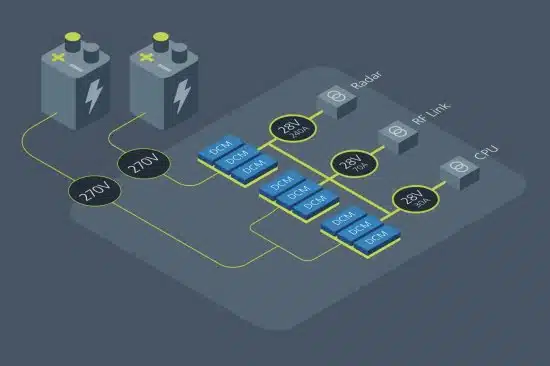
Figure 1. An example of how power flows from the main power source through converters, regulators, and inverters to be converted or regulated for use in other systems throughout the aircraft. Source.

For these systems to function reliably, components, such as capacitors, that provide high-reliability, high-Q, EMI suppression, noise reduction, line filtering, energy storage, decoupling of high-frequency noise, and voltage regulation are needed.

For a variety of functions within the power system, these many requirements are best met by multilayer ceramic capacitors (MLCCs). Let’s look more closely at the many jobs these MLCCs must perform in the power system.

Decoupling & Bypass: As decoupling capacitors, MLCCs help maintain stable power supply voltage in the presence of high-frequency noise and other power-related challenges. These capacitors are typically placed close to the power electronics components they are decoupling to minimize the impact of high-frequency noise and other power-related challenges as well as shunting energy from these signals back to the return path.

Energy Storage: MLCCs can be used as resonant capacitors for energy storage that can provide short, but high, bursts of energy when needed. This can be particularly important for high voltage applications.

Filtering: MLCCs can be used to filter out unwanted noise and other high-frequency signals that can interfere with the operation of power electronics components.

Snubbers: Another form of filtering, MLCCs are used as snubber capacitors to suppress harmful voltage transient spikes and noise that comes from switching very fast.

EMI Suppression: Surface mount and panel mount MLCCs or planar arrays are used as filters in connectors to suppress electromagnetic interference (EMI) generated by the power electronics components, which can increase as target switching frequencies increase. A single array can provide multiple capacitance values.

Voltage Regulation: MLCCs can be used to create voltage regulation circuits to maintain a stable power supply voltage.

High-Reliability Components are a Must

Since the consequences of failure of even the smallest component in an aerospace and defense application can be dire, and many of these applications have long lifespans, all the jobs we just discussed must be performed by high-reliability components. High-reliability components are made from the same high-quality materials as standard components, but high-reliability components are subjected to additional screening and testing to ensure long-term reliability.

The most common methods vendors use for screening components for reliability are based on established military specifications (MIL-SPECS). The following are three of the most frequently used MIL-SPECS for screening today:

  • MIL-PRF-55681 – A general purpose military high-reliability specification
  • MIL-PRF-49467 – Covers requirements for general purpose, ceramic multilayer high voltage capacitors
  • MIL-PRF-123 – Provides an increased level of reliability over MIL-PRF-55681 and is commonly used for space applications

When screening MLCCs using MIL-SPECS, components are powered up from 100 percent to 200 percent of the voltage rating while being brought up to an operating temperature of 125 degrees for 100 or more hours.

All this stringent testing is applied to 100 percent of the MLCCs in the lot to ensure each component coming out of the factory is in pristine condition and is likely to sustain high performance over the application’s lifespan. The components that are weeded out by screening are discarded or sent back for further evaluation.


Related

Source: Knowles

Recent Posts

TDK Releases DC-link Film Capacitors with Ultra-low Inductance for SiC Power Converters

4.6.2026
15

Murata Introduces World First 2.2uF 100V Soft‑Term MLCC in 0805 Size for Automotive

4.6.2026
6

Murata and Xona Partner on LEO Satellite Navigation for Industrial Applications

3.6.2026
24

Nvidia Vera Rubin: Why One AI Rack Needs So Many More MLCC Capacitors

2.6.2026
90

Tecate Unveils High‑temp 105C Supercapacitors for Harsh‑Environment Designs

2.6.2026
16

Passive Components in 2026: From Invisible Commodity to Design Parameter

2.6.2026
40

May 2026 Interconnect, Passives and Electromechanical Components Market Insights

29.5.2026
98

Passive Components Enable Safe and Reliable ADAS Architectures

28.5.2026
70

YMIN Releases Square Supercapacitors for AI Server Power System

27.5.2026
53

Upcoming Events

Jun 16
16:00 - 17:00 CEST

EMC with EMC – EMC‑compliant design with electromechanical connectors

View Calendar

Popular Posts

  • Buck Converter Design and Calculation

    0 shares
    Share 0 Tweet 0
  • Boost Converter Design and Calculation

    0 shares
    Share 0 Tweet 0
  • MLCC and Ceramic Capacitors

    0 shares
    Share 0 Tweet 0
  • Flyback Converter Design and Calculation

    0 shares
    Share 0 Tweet 0
  • LLC Resonant Converter Design and Calculation

    0 shares
    Share 0 Tweet 0
  • Capacitor Charging and Discharging

    0 shares
    Share 0 Tweet 0
  • What Electronics Engineer Needs to Know About Passive Low Pass Filters

    0 shares
    Share 0 Tweet 0
  • Dual Active Bridge (DAB) Topology

    0 shares
    Share 0 Tweet 0
  • SEPIC Converter Design and Calculation

    0 shares
    Share 0 Tweet 0
  • Earthing Systems and IEC Classification Explained

    0 shares
    Share 0 Tweet 0

Newsletter Subscription


Passive Components Blog

© EPCI - Leading Passive Components Educational and Information Site

  • Home
  • Privacy Policy
  • EPCI Membership & Advertisement
  • About

No Result
View All Result
  • Home
  • Knowledge Blog
  • Dossiers
  • PCNS

© EPCI - Leading Passive Components Educational and Information Site

This website uses cookies. By continuing to use this website you are giving consent to cookies being used. Visit our Privacy and Cookie Policy.
Go to mobile version