





Passive Components Blog
No Result
View All Result
  • Home
  • NewsFilter
    • All
    • Aerospace & Defence
    • Antenna
    • Applications
    • Automotive
    • Capacitors
    • Circuit Protection Devices
    • electro-mechanical news
    • Filters
    • Fuses
    • Inductors
    • Industrial
    • Integrated Passives
    • inter-connect news
    • Market & Supply Chain
    • Market Insights
    • Medical
    • Modelling and Simulation
    • New Materials & Supply
    • New Technologies
    • Non-linear Passives
    • Oscillators
    • Passive Sensors News
    • Resistors
    • RF & Microwave
    • Telecommunication
    • Weekly Digest

    Miniaturization of Tantalum Capacitors: Structural Limit Under Constant Rating

    Heatsink Design and Thermal Interface Materials for Reliable Electronics

    Murata New MLCC Bulk Case Packaging Cuts Packaging Material by 99%

    Wk 17 Electronics Supply Chain Digest

    Exxelia Introduces SMD High‑Voltage Mica Capacitors

    Modelithics Releases COMPLETE v26.1 for Keysight ADS

    April 2026 Interconnect, Passives and Electromechanical Components Market Insights

    SPICE Simulation of Non-Linear Resistors: Vishay’s Thermistor and PPTC Modelling Ecosystem

    KYOCERA AVX Introduces Traction‑Grade DC Link Film Capacitors

    Trending Tags

    • Ripple Current
    • RF
    • Leakage Current
    • Tantalum vs Ceramic
    • Snubber
    • Low ESR
    • Feedthrough
    • Derating
    • Dielectric Constant
    • New Products
    • Market Reports
  • VideoFilter
    • All
    • Antenna videos
    • Capacitor videos
    • Circuit Protection Video
    • Filter videos
    • Fuse videos
    • Inductor videos
    • Inter-Connect Video
    • Non-linear passives videos
    • Oscillator videos
    • Passive sensors videos
    • Resistor videos

    Why Power Inductors Use a Ferrite Core With an Air Gap

    Transformer-Based Power-Line Harvester Magnetic Design

    Thermal Modeling of Magnetics

    Standard vs Planar LLC transformers Comparison for Battery Chargers

    How Modern Tools Model Magnetic Components for Power Electronics

    Advanced Loss Modeling for Planar Magnetics in the Frenetic Planar Tool

    2026 Power Magnetics Design Trends: Flyback, DAB and Planar

    Enabling Software‑Defined Vehicle Architectures: Automotive Ethernet and Zonal Smart Power

    Calculating Resistance Value of a Flyback RC Snubber 

    Trending Tags

    • Capacitors explained
    • Inductors explained
    • Resistors explained
    • Filters explained
    • Application Video Guidelines
    • EMC
    • New Products
    • Ripple Current
    • Simulation
    • Tantalum vs Ceramic
  • Knowledge Blog
  • DossiersNew
  • Suppliers
    • Who is Who
  • PCNS
    • PCNS 2025
    • PCNS 2023
    • PCNS 2021
    • PCNS 2019
    • PCNS 2017
  • Events
  • Home
  • NewsFilter
    • All
    • Aerospace & Defence
    • Antenna
    • Applications
    • Automotive
    • Capacitors
    • Circuit Protection Devices
    • electro-mechanical news
    • Filters
    • Fuses
    • Inductors
    • Industrial
    • Integrated Passives
    • inter-connect news
    • Market & Supply Chain
    • Market Insights
    • Medical
    • Modelling and Simulation
    • New Materials & Supply
    • New Technologies
    • Non-linear Passives
    • Oscillators
    • Passive Sensors News
    • Resistors
    • RF & Microwave
    • Telecommunication
    • Weekly Digest

    Miniaturization of Tantalum Capacitors: Structural Limit Under Constant Rating

    Heatsink Design and Thermal Interface Materials for Reliable Electronics

    Murata New MLCC Bulk Case Packaging Cuts Packaging Material by 99%

    Wk 17 Electronics Supply Chain Digest

    Exxelia Introduces SMD High‑Voltage Mica Capacitors

    Modelithics Releases COMPLETE v26.1 for Keysight ADS

    April 2026 Interconnect, Passives and Electromechanical Components Market Insights

    SPICE Simulation of Non-Linear Resistors: Vishay’s Thermistor and PPTC Modelling Ecosystem

    KYOCERA AVX Introduces Traction‑Grade DC Link Film Capacitors

    Trending Tags

    • Ripple Current
    • RF
    • Leakage Current
    • Tantalum vs Ceramic
    • Snubber
    • Low ESR
    • Feedthrough
    • Derating
    • Dielectric Constant
    • New Products
    • Market Reports
  • VideoFilter
    • All
    • Antenna videos
    • Capacitor videos
    • Circuit Protection Video
    • Filter videos
    • Fuse videos
    • Inductor videos
    • Inter-Connect Video
    • Non-linear passives videos
    • Oscillator videos
    • Passive sensors videos
    • Resistor videos

    Why Power Inductors Use a Ferrite Core With an Air Gap

    Transformer-Based Power-Line Harvester Magnetic Design

    Thermal Modeling of Magnetics

    Standard vs Planar LLC transformers Comparison for Battery Chargers

    How Modern Tools Model Magnetic Components for Power Electronics

    Advanced Loss Modeling for Planar Magnetics in the Frenetic Planar Tool

    2026 Power Magnetics Design Trends: Flyback, DAB and Planar

    Enabling Software‑Defined Vehicle Architectures: Automotive Ethernet and Zonal Smart Power

    Calculating Resistance Value of a Flyback RC Snubber 

    Trending Tags

    • Capacitors explained
    • Inductors explained
    • Resistors explained
    • Filters explained
    • Application Video Guidelines
    • EMC
    • New Products
    • Ripple Current
    • Simulation
    • Tantalum vs Ceramic
  • Knowledge Blog
  • DossiersNew
  • Suppliers
    • Who is Who
  • PCNS
    • PCNS 2025
    • PCNS 2023
    • PCNS 2021
    • PCNS 2019
    • PCNS 2017
  • Events
No Result
View All Result
Passive Components Blog
No Result
View All Result

Researchers Present Hybrid Supercapacitor Zn-Ion Microcapacitors

12.5.2025
Reading Time: 3 mins read
A A

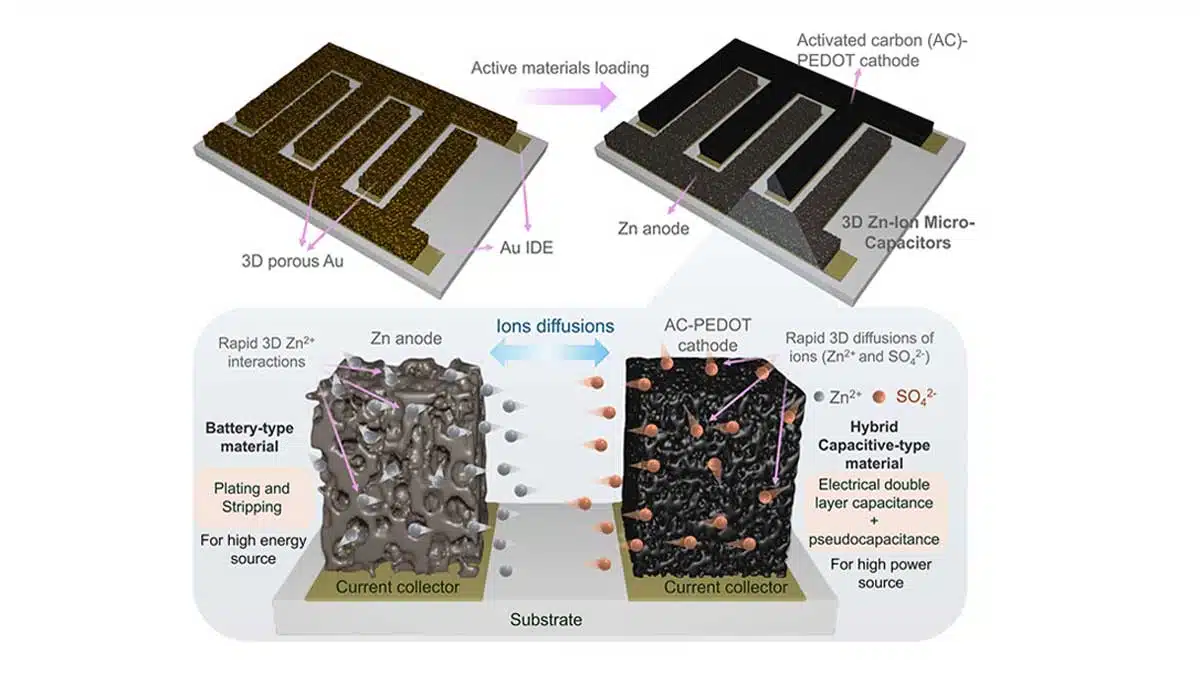
The study published in ACS Nano Journal (DOI: 10.1021/acsnano.5c00917) presents the design and fabrication of high-performance zinc-ion microcapacitors hybrid supercapacitors (ZIMCs) using 3D gold (Au) interdigitated electrodes (IDEs) as porous current collectors.

The 3D Au IDEs, fabricated using a dynamic bubbling electrodeposition technique, are loaded with zinc (Zn) as the anode and a hybrid activated carbon (AC) coated with PEDOT (AC-PEDOT) as the cathode.

RelatedPosts

Miniaturization of Tantalum Capacitors: Structural Limit Under Constant Rating

Heatsink Design and Thermal Interface Materials for Reliable Electronics

Murata New MLCC Bulk Case Packaging Cuts Packaging Material by 99%

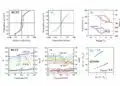
The resulting ZIMCs exhibit enhanced charge storage performance, with the 3D Au Zn//AC-PEDOT configuration demonstrating a significant increase in CV area compared to planar counterparts.

The ongoing evolution of wearable and implantable technologies has heightened the demand for compact, high-performance energy storage devices. Zinc-ion microcapacitors (ZIMCs) have emerged as promising candidates by merging battery-type and capacitor-type charge storage mechanisms.

Despite their potential, challenges in electrode material optimization and device architecture have hindered their widespread adoption. This article explores an innovative approach leveraging porous 3D interdigitated current collectors and hybrid microcathodes to enhance ZIMC performance.

Key Points

  1. Advanced Electrode Architecture: Introduction of 3D gold interdigitated electrodes (3D Au IDEs) as porous current collectors.
  2. Hybrid Microcathodes: Utilization of zinc (Zn) anodes coupled with activated carbon coated with PEDOT (AC-PEDOT) cathodes.
  3. Fabrication Technique: Application of a microplotter technique for precise material deposition.
  4. Performance Metrics: Achieved areal capacity of 1.3 μAh/cm², peak areal energy of 1.11 μWh/cm², and peak areal power of 640 μW/cm².
  5. Enhanced Device Stability: Improved long-term cycling stability and superior charge storage capabilities.

Extended Summary

Zinc-ion microcapacitors (ZIMCs) are pivotal for powering next-generation compact electronics due to their hybrid energy storage mechanism, combining the benefits of high energy density from batteries and high power density from capacitors. Traditional planar electrode structures limit performance due to restricted ion transport pathways and suboptimal material utilization.

This study introduces a novel design employing 3D Au IDEs as porous current collectors. These collectors are fabricated using an advanced microplotter technique that allows precise layering and patterning on a ceramic substrate. The Zn anode and AC-PEDOT cathode are sequentially deposited onto these porous structures, enhancing the electrode-electrolyte interface and facilitating faster ion diffusion.

Electrochemical analyses, including cyclic voltammetry (CV) and galvanostatic charge-discharge (GCD) tests, reveal that the 3D Au IDE-based ZIMCs significantly outperform traditional planar designs. The devices exhibit a marked increase in both capacitive-controlled and diffusion-controlled charge storage contributions. Notably, the 3D Au Zn//AC-PEDOT ZIMCs demonstrate superior rate capability and energy density, attributed to the synergistic effects of the porous structure and hybrid electrode materials.

Long-term cycling tests confirm the device’s stability, with a capacity retention of up to 78% after 5000 cycles. The incorporation of PEDOT onto the AC cathode enhances pseudocapacitive behavior, further boosting overall performance. Electrochemical impedance spectroscopy (EIS) indicates reduced charge transfer resistance, affirming efficient charge transport within the 3D porous framework.

Conclusion

The integration of 3D porous Au IDEs with hybrid AC-PEDOT cathodes presents a transformative approach in micro-scale energy storage. This architecture not only optimizes charge storage capacity and cycling stability but also sets a new benchmark in the performance of ZIMCs. This work paves the way for the development of high-performance, compact energy storage solutions critical for future wearable and implantable electronic devices.

Read the full article:

Design of Porous 3D Interdigitated Current Collectors and Hybrid Microcathodes for Zn-Ion Microcapacitors, Yujia Fan, Nibagani Naresh, Yijia Zhu, Mingqing Wang, and Buddha Deka BoruahACS Nano 2025 19 (13), 13314-13324 DOI: 10.1021/acsnano.5c00917

Related

Source: ACSnano Journal

Recent Posts

Miniaturization of Tantalum Capacitors: Structural Limit Under Constant Rating

27.4.2026
2

Murata New MLCC Bulk Case Packaging Cuts Packaging Material by 99%

27.4.2026
3

Exxelia Introduces SMD High‑Voltage Mica Capacitors

27.4.2026
4

Modelithics Releases COMPLETE v26.1 for Keysight ADS

23.4.2026
11

April 2026 Interconnect, Passives and Electromechanical Components Market Insights

22.4.2026
47

KYOCERA AVX Introduces Traction‑Grade DC Link Film Capacitors

21.4.2026
40

When More Capacitance Hurts Reliability: The Role of the Metallic Skeleton in Tantalum Anodes

20.4.2026
40

YAGEO Introduces High‑Current Y2/X1 Film Capacitors for Wide-bandgap Power Systems

17.4.2026
33

YAGEO Introduces High Rel MLCCs Beyond MIL-Spec Limits

16.4.2026
53

Upcoming Events

Apr 27
15:00 - 16:00 CEST

Commercial Space Screening Approach for Agile, High-Reliability Payloads

Apr 29
10:00 - 11:00 CDT

SEPIC Design Done Right

Apr 30
10:00 - 11:00 CDT

Programming Embedded Systems

View Calendar

Popular Posts

  • Buck Converter Design and Calculation

    0 shares
    Share 0 Tweet 0
  • Boost Converter Design and Calculation

    0 shares
    Share 0 Tweet 0
  • Flyback Converter Design and Calculation

    0 shares
    Share 0 Tweet 0
  • LLC Resonant Converter Design and Calculation

    0 shares
    Share 0 Tweet 0
  • MLCC and Ceramic Capacitors

    0 shares
    Share 0 Tweet 0
  • Dual Active Bridge (DAB) Topology

    0 shares
    Share 0 Tweet 0
  • Capacitor Charging and Discharging

    0 shares
    Share 0 Tweet 0
  • What Electronics Engineer Needs to Know About Passive Low Pass Filters

    0 shares
    Share 0 Tweet 0
  • Ripple Current and its Effects on the Performance of Capacitors

    3 shares
    Share 3 Tweet 0
  • MLCC Case Sizes Standards Explained

    0 shares
    Share 0 Tweet 0

Newsletter Subscription


Passive Components Blog

© EPCI - Leading Passive Components Educational and Information Site

  • Home
  • Privacy Policy
  • EPCI Membership & Advertisement
  • About

No Result
View All Result
  • Home
  • Knowledge Blog
  • PCNS

© EPCI - Leading Passive Components Educational and Information Site

This website uses cookies. By continuing to use this website you are giving consent to cookies being used. Visit our Privacy and Cookie Policy.
Go to mobile version