





Passive Components Blog
No Result
View All Result
  • Home
  • NewsFilter
    • All
    • Aerospace & Defence
    • Antenna
    • Applications
    • Automotive
    • Capacitors
    • Circuit Protection Devices
    • electro-mechanical news
    • Filters
    • Fuses
    • Inductors
    • Industrial
    • Integrated Passives
    • inter-connect news
    • Market & Supply Chain
    • Market Insights
    • Medical
    • Modelling and Simulation
    • New Materials & Supply
    • New Technologies
    • Non-linear Passives
    • Oscillators
    • Passive Sensors News
    • Resistors
    • RF & Microwave
    • Telecommunication
    • Weekly Digest

    Nvidia Vera Rubin: Why One AI Rack Needs So Many More MLCC Capacitors

    Stackpole Introduces 1400A Busbar Shunt Resistors

    Tecate Unveils High‑temp 105C Supercapacitors for Harsh‑Environment Designs

    Bourns Expands 1000V High‑Power Fuses for Semiconductor and Battery Protection

    Passive Components in 2026: From Invisible Commodity to Design Parameter

    Bourns Introduces High Current Chip Ferrite Beads for Dense Power Rails

    Wk 22 Electronics Supply Chain Digest

    Vishay Releases High‑Current Radial Inductors up to 209 A

    May 2026 Interconnect, Passives and Electromechanical Components Market Insights

    Trending Tags

    • Ripple Current
    • RF
    • Leakage Current
    • Tantalum vs Ceramic
    • Snubber
    • Low ESR
    • Feedthrough
    • Derating
    • Dielectric Constant
    • New Products
    • Market Reports
  • VideoFilter
    • All
    • Antenna videos
    • Capacitor videos
    • Circuit Protection Video
    • Filter videos
    • Fuse videos
    • Inductor videos
    • Inter-Connect Video
    • Non-linear passives videos
    • Oscillator videos
    • Passive sensors videos
    • Resistor videos

    Current Sense Transformer Datasheet and Design‑in Guide

    Designing a USB Type‑C Flyback Planar Transformer with Frenetic’s Planar Tool

    Magnetics Design in High‑Frequency GaN Converters

    Qi2 Wireless Charging: Inductors, Capacitors and EMC Filters

    Two‑capacitor paradox explained for engineers

    Capacitances of Nonlinear MLCCs: What Datasheets Don’t Tell You

    Tapped Inductor Buck Converter Fundamentals

    Planar vs Conventional Transformer: When it Make Sense

    Modeling Fringing Field Losses in Inductors & Transformers

    Trending Tags

    • Capacitors explained
    • Inductors explained
    • Resistors explained
    • Filters explained
    • Application Video Guidelines
    • EMC
    • New Products
    • Ripple Current
    • Simulation
    • Tantalum vs Ceramic
  • Knowledge Blog
  • DossiersNew
  • Suppliers
    • Who is Who
  • PCNS
    • PCNS 2025
    • PCNS 2023
    • PCNS 2021
    • PCNS 2019
    • PCNS 2017
  • Events
  • Home
  • NewsFilter
    • All
    • Aerospace & Defence
    • Antenna
    • Applications
    • Automotive
    • Capacitors
    • Circuit Protection Devices
    • electro-mechanical news
    • Filters
    • Fuses
    • Inductors
    • Industrial
    • Integrated Passives
    • inter-connect news
    • Market & Supply Chain
    • Market Insights
    • Medical
    • Modelling and Simulation
    • New Materials & Supply
    • New Technologies
    • Non-linear Passives
    • Oscillators
    • Passive Sensors News
    • Resistors
    • RF & Microwave
    • Telecommunication
    • Weekly Digest

    Nvidia Vera Rubin: Why One AI Rack Needs So Many More MLCC Capacitors

    Stackpole Introduces 1400A Busbar Shunt Resistors

    Tecate Unveils High‑temp 105C Supercapacitors for Harsh‑Environment Designs

    Bourns Expands 1000V High‑Power Fuses for Semiconductor and Battery Protection

    Passive Components in 2026: From Invisible Commodity to Design Parameter

    Bourns Introduces High Current Chip Ferrite Beads for Dense Power Rails

    Wk 22 Electronics Supply Chain Digest

    Vishay Releases High‑Current Radial Inductors up to 209 A

    May 2026 Interconnect, Passives and Electromechanical Components Market Insights

    Trending Tags

    • Ripple Current
    • RF
    • Leakage Current
    • Tantalum vs Ceramic
    • Snubber
    • Low ESR
    • Feedthrough
    • Derating
    • Dielectric Constant
    • New Products
    • Market Reports
  • VideoFilter
    • All
    • Antenna videos
    • Capacitor videos
    • Circuit Protection Video
    • Filter videos
    • Fuse videos
    • Inductor videos
    • Inter-Connect Video
    • Non-linear passives videos
    • Oscillator videos
    • Passive sensors videos
    • Resistor videos

    Current Sense Transformer Datasheet and Design‑in Guide

    Designing a USB Type‑C Flyback Planar Transformer with Frenetic’s Planar Tool

    Magnetics Design in High‑Frequency GaN Converters

    Qi2 Wireless Charging: Inductors, Capacitors and EMC Filters

    Two‑capacitor paradox explained for engineers

    Capacitances of Nonlinear MLCCs: What Datasheets Don’t Tell You

    Tapped Inductor Buck Converter Fundamentals

    Planar vs Conventional Transformer: When it Make Sense

    Modeling Fringing Field Losses in Inductors & Transformers

    Trending Tags

    • Capacitors explained
    • Inductors explained
    • Resistors explained
    • Filters explained
    • Application Video Guidelines
    • EMC
    • New Products
    • Ripple Current
    • Simulation
    • Tantalum vs Ceramic
  • Knowledge Blog
  • DossiersNew
  • Suppliers
    • Who is Who
  • PCNS
    • PCNS 2025
    • PCNS 2023
    • PCNS 2021
    • PCNS 2019
    • PCNS 2017
  • Events
No Result
View All Result
Passive Components Blog
No Result
View All Result

Researchers Proposed Enhanced Energy Storage MLCC

1.10.2025
Reading Time: 4 mins read
A A
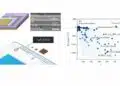
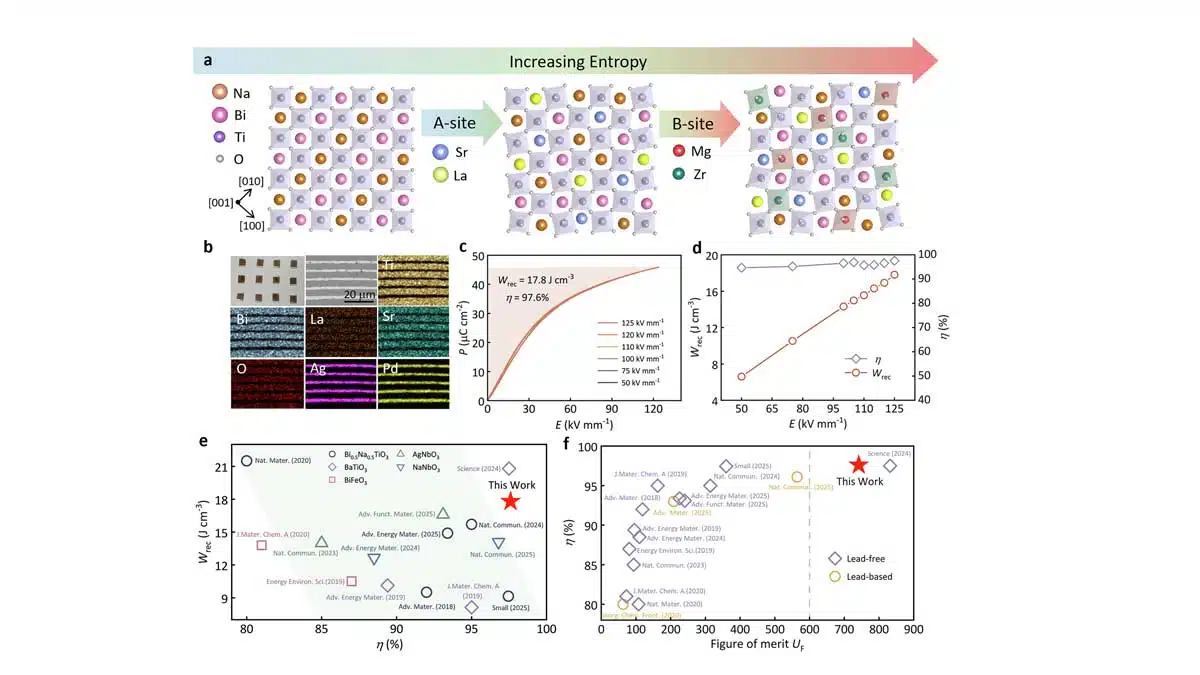
a Schematic diagram of the BNT-based components constructed based on the entropy-increase strategy. b Digital photograph, cross-sectional SEM image, and EDS mappings of the MLCCs. c Unipolar P-E loops of MLCCs as a function of applied E. d Wrec and η of the MLCCs as a function of applied E. The comparison of (e) Wrec and η, (f) η and UF of the MLCCs with those of other recently reported state-of-the-art MLCCs. source: Nature Communications

a Schematic diagram of the BNT-based components constructed based on the entropy-increase strategy. b Digital photograph, cross-sectional SEM image, and EDS mappings of the MLCCs. c Unipolar P-E loops of MLCCs as a function of applied E. d Wrec and η of the MLCCs as a function of applied E. The comparison of (e) Wrec and η, (f) η and UF of the MLCCs with those of other recently reported state-of-the-art MLCCs. source: Nature Communications


This post presents the findings from the research article titled “Enhanced energy-storage in lead-free multilayer capacitors via entropy-assisted polymorphic domain engineering” published in Nature Communications (2025).

The study focuses on improving the energy storage performance of environmentally friendly, lead-free multilayer ceramic capacitors (MLCCs) through a stepwise dual-site entropy-assisted engineering strategy.

RelatedPosts

Nvidia Vera Rubin: Why One AI Rack Needs So Many More MLCC Capacitors

Stackpole Introduces 1400A Busbar Shunt Resistors

Tecate Unveils High‑temp 105C Supercapacitors for Harsh‑Environment Designs

The use of high-entropy design facilitates the coexistence of multiple polymorphic domains and enhances the dielectric breakdown strength, leading to superior energy storage density and efficiency.

Key Points

  • Development of lead-free Bi0.5Na0.5TiO3 (BNT)-based MLCCs using a dual-site, stepwise entropy-increase strategy.
  • Coexistence of rhombohedral (R), tetragonal (T), and cubic (C) domains delays polarization saturation while maintaining high maximum polarization (Pm).
  • Entropy-induced non-periodic lattice distortion leads to grain refinement and substantially improved electrical resistance.
  • Achieved a recoverable energy density (Wrec) of 17.8 J·cm−3 with an energy efficiency (η) of 97.6%.
  • MLCCs demonstrated excellent thermal, fatigue, and frequency stability, suitable for pulsed power applications.

Extended Summary

1. Entropy-Assisted Design of MLCCs

The research introduces a two-step dual-site entropy-increase approach to optimize the structure of BNT-based MLCCs. First, Sr2+ and La3+ were incorporated at the A-site to form a medium configuration entropy (Sconfig) component. Subsequently, Mg2+ and Zr4+ were introduced at the B-site, resulting in high Sconfig (1.60 R). This dual-site approach promotes structural disorder, facilitating the formation of multiple coexisting nanodomains, including R3c, P4bm, and cubic phases.

2. Energy Storage Performance

The energy storage performance of the MLCCs was assessed via unipolar polarization–electric field (P-E) loops. The recoverable energy density and efficiency are given by:

Wrec = ∫ E dP ,     η = (Wrec / Wtotal) × 100%

The high-entropy BNSLTMZ MLCCs achieved:

SampleWrec (J·cm−3)η (%)Eb (kV·mm−1)
BNT (pristine)2.11040
BNSLT (medium entropy)5.285.460
BNSLTMZ (high entropy)17.897.6125

Notably, the MLCCs maintained low remanent polarization (Pr) and demonstrated slender P-E loops, indicative of efficient relaxor behavior.

3. Structural and Microstructural Insights

High-resolution X-ray diffraction (XRD), Raman spectroscopy, and aberration-corrected HAADF-STEM revealed the coexistence of multiple polymorphic domains and transition regions. The cation displacement mapping and lattice distortion analysis showed that entropy-induced non-periodic distortions delay polarization saturation and enhance breakdown endurance.

The average grain size decreased from 2.01 μm in pristine BNT to 0.67 μm in the high-entropy sample, which correlates with increased electrical resistance and suppressed leakage currents (from 8.3×10⁻⁸ to 8.1×10⁻⁹ A·cm−2).

4. Stability and Charge-Discharge Characteristics

The MLCCs exhibited superior stability across a broad range of temperatures (0–100 °C), frequencies (10–100 Hz), and fatigue cycles (up to 106). Charge-discharge tests demonstrated a high discharge energy density (Wd > 5.6 J·cm−3) and rapid discharge time (t0.9 ≈ 0.83 μs) under an electric field of 70 kV·mm−1. The peak current density achieved was 311 A·cm−2, with a power density of 108 MW·cm−3.

Conclusion

The stepwise dual-site entropy-assisted strategy successfully enhances the energy storage properties of lead-free BNT-based MLCCs. By inducing polymorphic domain coexistence and lattice distortions, the approach improves maximum polarization, breakdown strength, and energy efficiency. The resulting MLCCs combine high recoverable energy density, exceptional efficiency, and robust operational stability, positioning them as promising candidates for next-generation pulsed power and energy storage applications.

Read the complete article:

Li, J., Zhang, Y., Liu, Z. et al. Enhanced energy-storage in lead-free multilayer capacitors via entropy-assisted polymorphic domain engineering. Nat Commun 16, 8580 (2025). https://doi.org/10.1038/s41467-025-63584-y

Related

Source: Nature Communications

Recent Posts

Nvidia Vera Rubin: Why One AI Rack Needs So Many More MLCC Capacitors

2.6.2026
4

Tecate Unveils High‑temp 105C Supercapacitors for Harsh‑Environment Designs

2.6.2026
5

Passive Components in 2026: From Invisible Commodity to Design Parameter

2.6.2026
10

May 2026 Interconnect, Passives and Electromechanical Components Market Insights

29.5.2026
83

Passive Components Enable Safe and Reliable ADAS Architectures

28.5.2026
63

Current Sense Transformer Datasheet and Design‑in Guide

27.5.2026
62

Designing a USB Type‑C Flyback Planar Transformer with Frenetic’s Planar Tool

27.5.2026
30

YMIN Releases Square Supercapacitors for AI Server Power System

27.5.2026
51

Exxelia Extends Temperature Range of its PP Film Capacitors to 140C

1.6.2026
44

Upcoming Events

Jun 2
16:00 - 17:00 CEST

Calculation, Simulation and Measurement of 800V EMC Filters

Jun 16
16:00 - 17:00 CEST

EMC with EMC – EMC‑compliant design with electromechanical connectors

View Calendar

Popular Posts

  • Buck Converter Design and Calculation

    0 shares
    Share 0 Tweet 0
  • Boost Converter Design and Calculation

    0 shares
    Share 0 Tweet 0
  • Flyback Converter Design and Calculation

    0 shares
    Share 0 Tweet 0
  • MLCC and Ceramic Capacitors

    0 shares
    Share 0 Tweet 0
  • LLC Resonant Converter Design and Calculation

    0 shares
    Share 0 Tweet 0
  • Capacitor Charging and Discharging

    0 shares
    Share 0 Tweet 0
  • What Electronics Engineer Needs to Know About Passive Low Pass Filters

    0 shares
    Share 0 Tweet 0
  • Dual Active Bridge (DAB) Topology

    0 shares
    Share 0 Tweet 0
  • Ripple Current and its Effects on the Performance of Capacitors

    3 shares
    Share 3 Tweet 0
  • SEPIC Converter Design and Calculation

    0 shares
    Share 0 Tweet 0

Newsletter Subscription


Passive Components Blog

© EPCI - Leading Passive Components Educational and Information Site

  • Home
  • Privacy Policy
  • EPCI Membership & Advertisement
  • About

No Result
View All Result
  • Home
  • Knowledge Blog
  • Dossiers
  • PCNS

© EPCI - Leading Passive Components Educational and Information Site

This website uses cookies. By continuing to use this website you are giving consent to cookies being used. Visit our Privacy and Cookie Policy.
Go to mobile version