




Passive Components Blog
No Result
View All Result
  • Home
  • NewsFilter
    • All
    • Aerospace & Defence
    • Antenna
    • Applications
    • Automotive
    • Capacitors
    • Circuit Protection Devices
    • electro-mechanical news
    • Filters
    • Fuses
    • Inductors
    • Industrial
    • Integrated Passives
    • inter-connect news
    • Market & Supply Chain
    • Market Insights
    • Medical
    • Modelling and Simulation
    • New Materials & Supply
    • New Technologies
    • Non-linear Passives
    • Oscillators
    • Passive Sensors News
    • Resistors
    • RF & Microwave
    • Telecommunication
    • Weekly Digest

    Nvidia Vera Rubin: Why One AI Rack Needs So Many More MLCC Capacitors

    Stackpole Introduces 1400A Busbar Shunt Resistors

    Tecate Unveils High‑temp 105C Supercapacitors for Harsh‑Environment Designs

    Bourns Expands 1000V High‑Power Fuses for Semiconductor and Battery Protection

    Passive Components in 2026: From Invisible Commodity to Design Parameter

    Bourns Introduces High Current Chip Ferrite Beads for Dense Power Rails

    Wk 22 Electronics Supply Chain Digest

    Vishay Releases High‑Current Radial Inductors up to 209 A

    May 2026 Interconnect, Passives and Electromechanical Components Market Insights

    Trending Tags

    • Ripple Current
    • RF
    • Leakage Current
    • Tantalum vs Ceramic
    • Snubber
    • Low ESR
    • Feedthrough
    • Derating
    • Dielectric Constant
    • New Products
    • Market Reports
  • VideoFilter
    • All
    • Antenna videos
    • Capacitor videos
    • Circuit Protection Video
    • Filter videos
    • Fuse videos
    • Inductor videos
    • Inter-Connect Video
    • Non-linear passives videos
    • Oscillator videos
    • Passive sensors videos
    • Resistor videos

    Current Sense Transformer Datasheet and Design‑in Guide

    Designing a USB Type‑C Flyback Planar Transformer with Frenetic’s Planar Tool

    Magnetics Design in High‑Frequency GaN Converters

    Qi2 Wireless Charging: Inductors, Capacitors and EMC Filters

    Two‑capacitor paradox explained for engineers

    Capacitances of Nonlinear MLCCs: What Datasheets Don’t Tell You

    Tapped Inductor Buck Converter Fundamentals

    Planar vs Conventional Transformer: When it Make Sense

    Modeling Fringing Field Losses in Inductors & Transformers

    Trending Tags

    • Capacitors explained
    • Inductors explained
    • Resistors explained
    • Filters explained
    • Application Video Guidelines
    • EMC
    • New Products
    • Ripple Current
    • Simulation
    • Tantalum vs Ceramic
  • Knowledge Blog
  • DossiersNew
  • Suppliers
    • Who is Who
  • PCNS
    • PCNS 2025
    • PCNS 2023
    • PCNS 2021
    • PCNS 2019
    • PCNS 2017
  • Events
  • Home
  • NewsFilter
    • All
    • Aerospace & Defence
    • Antenna
    • Applications
    • Automotive
    • Capacitors
    • Circuit Protection Devices
    • electro-mechanical news
    • Filters
    • Fuses
    • Inductors
    • Industrial
    • Integrated Passives
    • inter-connect news
    • Market & Supply Chain
    • Market Insights
    • Medical
    • Modelling and Simulation
    • New Materials & Supply
    • New Technologies
    • Non-linear Passives
    • Oscillators
    • Passive Sensors News
    • Resistors
    • RF & Microwave
    • Telecommunication
    • Weekly Digest

    Nvidia Vera Rubin: Why One AI Rack Needs So Many More MLCC Capacitors

    Stackpole Introduces 1400A Busbar Shunt Resistors

    Tecate Unveils High‑temp 105C Supercapacitors for Harsh‑Environment Designs

    Bourns Expands 1000V High‑Power Fuses for Semiconductor and Battery Protection

    Passive Components in 2026: From Invisible Commodity to Design Parameter

    Bourns Introduces High Current Chip Ferrite Beads for Dense Power Rails

    Wk 22 Electronics Supply Chain Digest

    Vishay Releases High‑Current Radial Inductors up to 209 A

    May 2026 Interconnect, Passives and Electromechanical Components Market Insights

    Trending Tags

    • Ripple Current
    • RF
    • Leakage Current
    • Tantalum vs Ceramic
    • Snubber
    • Low ESR
    • Feedthrough
    • Derating
    • Dielectric Constant
    • New Products
    • Market Reports
  • VideoFilter
    • All
    • Antenna videos
    • Capacitor videos
    • Circuit Protection Video
    • Filter videos
    • Fuse videos
    • Inductor videos
    • Inter-Connect Video
    • Non-linear passives videos
    • Oscillator videos
    • Passive sensors videos
    • Resistor videos

    Current Sense Transformer Datasheet and Design‑in Guide

    Designing a USB Type‑C Flyback Planar Transformer with Frenetic’s Planar Tool

    Magnetics Design in High‑Frequency GaN Converters

    Qi2 Wireless Charging: Inductors, Capacitors and EMC Filters

    Two‑capacitor paradox explained for engineers

    Capacitances of Nonlinear MLCCs: What Datasheets Don’t Tell You

    Tapped Inductor Buck Converter Fundamentals

    Planar vs Conventional Transformer: When it Make Sense

    Modeling Fringing Field Losses in Inductors & Transformers

    Trending Tags

    • Capacitors explained
    • Inductors explained
    • Resistors explained
    • Filters explained
    • Application Video Guidelines
    • EMC
    • New Products
    • Ripple Current
    • Simulation
    • Tantalum vs Ceramic
  • Knowledge Blog
  • DossiersNew
  • Suppliers
    • Who is Who
  • PCNS
    • PCNS 2025
    • PCNS 2023
    • PCNS 2021
    • PCNS 2019
    • PCNS 2017
  • Events
No Result
View All Result
Passive Components Blog
No Result
View All Result

Silicon Capacitors Reliable Performance in Harsh Conditions

24.9.2025
Reading Time: 4 mins read
A A

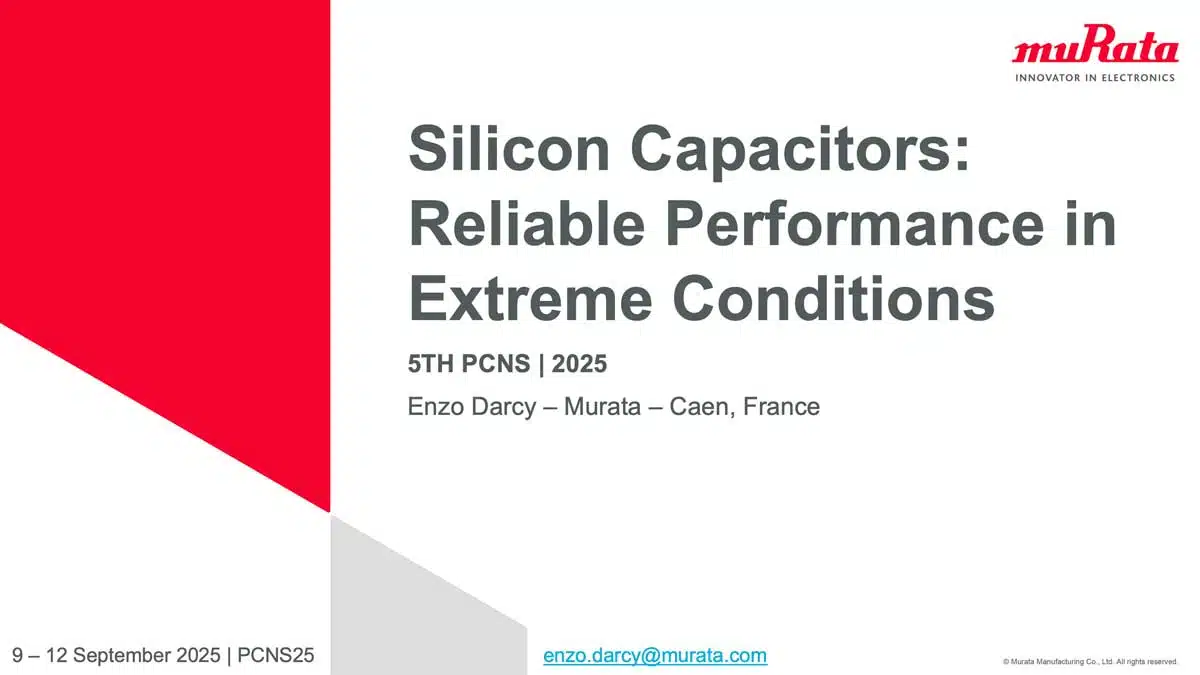
The paper “Muratas Silicon Capacitors: Reliable Performance in Extreme Conditions” was presented by Enzo Darcy, Caen, France at the 5th PCNS Passive Components Networking Symposium 9-12th September 2025, Seville, Spain as paper No. 1.3.

Introduction

Murata’s silicon capacitors have emerged as a reliable solution for applications operating in the harshest conditions, from deep space missions to cryogenic environments. Their design leverages Passive Integration Connecting Substrate (PICS) technology, enabling ultra-miniaturization, exceptional stability, and high reliability. Unlike conventional Multi-Layer Ceramic Capacitors (MLCCs), Murata’s devices maintain performance across extreme temperatures, under radiation exposure, and during mechanical stress.

RelatedPosts

Murata Expands Thermistor Production Capacity at Yokaichi Plant

Murata Introduces Crystal and NTC Set for Automotive UWB Timing

Murata New MLCC Bulk Case Packaging Cuts Packaging Material by 99%

Key Points

  • Wide Temperature Range: Operate reliably from -250 °C to +300 °C.
  • Miniaturization and Weight Savings: Significantly smaller and lighter than MLCCs.
  • High-Frequency Performance: Low ESR, low ESL, and high capacitance density support applications up to 220 GHz.
  • Exceptional Reliability: No voltage derating required, with lifetimes exceeding 50 years at 250 °C.
  • Radiation and Shock Resistance: Withstand heavy ions and total ionizing dose without performance loss.

Extended Summary

Murata silicon capacitors are built using PICS technology, enabling integration of high-density capacitors with superior thermal and electrical stability. The technology allows for ultra-deep trench structures and Metal-Insulator-Metal (MIM) or trench Metal-Oxide-Semiconductor (MOS) capacitor formation, facilitating miniaturization without sacrificing performance.

When compared to MLCCs, Murata capacitors exhibit clear advantages in environments requiring extreme reliability. MLCC performance drops significantly above 125 °C to 150 °C, often requiring voltage derating, which increases size and weight. Murata’s capacitors, on the other hand, maintain stable capacitance and low leakage currents even at 300 °C, with insulation resistance two orders of magnitude higher than standard NPO/COG dielectrics. This makes them particularly valuable in aerospace and industrial applications where miniaturization and long-term reliability are critical.

High-frequency applications benefit from Murata’s extremely low parasitic elements. The eXtrem-Broadband X2SC series, for example, provides 10 nF in a 0.6 × 0.3 mm package, with ESR below 220 mΩ and ESL below 20 pH. Such characteristics ensure strong signal integrity for devices operating up to 220 GHz.

Environmental robustness is a defining strength. Murata capacitors withstand rigorous thermal cycling (300 cycles from -65 °C to +200 °C) and mechanical stress tests without electrical degradation. They also exhibit excellent radiation tolerance, surviving heavy-ion exposure up to 62.5 MeV·cm²/mg and total doses around 293 krad without failures. This resilience makes them suitable for space missions, cryogenic experiments, and geothermal drilling systems.

In terms of longevity, Time-Dependent Dielectric Breakdown (TDDB) testing indicates that Murata capacitors can operate for over 50 years at 250 °C under 10 V, far surpassing MLCCs, which often fail within a year under far less extreme conditions.

Conclusion

Murata’s silicon capacitors set a new benchmark for high-reliability passive components, excelling in thermal stability, radiation resistance, lifetime, and miniaturization. Their performance makes them a superior alternative to traditional MLCCs in aerospace, cryogenic, and high-frequency applications. By combining extreme environmental resilience with compact form factors, Murata capacitors enable next-generation electronic systems designed for the most demanding operational scenarios.


1_3_Murata_Silicon_Capacitor_Space_application_White_paper_EnzoDownload

Related

Source: PCNS

Recent Posts

Nvidia Vera Rubin: Why One AI Rack Needs So Many More MLCC Capacitors

2.6.2026
35

Tecate Unveils High‑temp 105C Supercapacitors for Harsh‑Environment Designs

2.6.2026
8

Passive Components in 2026: From Invisible Commodity to Design Parameter

2.6.2026
19

May 2026 Interconnect, Passives and Electromechanical Components Market Insights

29.5.2026
91

Passive Components Enable Safe and Reliable ADAS Architectures

28.5.2026
66

Current Sense Transformer Datasheet and Design‑in Guide

27.5.2026
64

Designing a USB Type‑C Flyback Planar Transformer with Frenetic’s Planar Tool

27.5.2026
31

YMIN Releases Square Supercapacitors for AI Server Power System

27.5.2026
51

Exxelia Extends Temperature Range of its PP Film Capacitors to 140C

1.6.2026
47

Upcoming Events

Jun 16
16:00 - 17:00 CEST

EMC with EMC – EMC‑compliant design with electromechanical connectors

View Calendar

Popular Posts

  • Buck Converter Design and Calculation

    0 shares
    Share 0 Tweet 0
  • Boost Converter Design and Calculation

    0 shares
    Share 0 Tweet 0
  • Flyback Converter Design and Calculation

    0 shares
    Share 0 Tweet 0
  • MLCC and Ceramic Capacitors

    0 shares
    Share 0 Tweet 0
  • LLC Resonant Converter Design and Calculation

    0 shares
    Share 0 Tweet 0
  • Capacitor Charging and Discharging

    0 shares
    Share 0 Tweet 0
  • What Electronics Engineer Needs to Know About Passive Low Pass Filters

    0 shares
    Share 0 Tweet 0
  • Dual Active Bridge (DAB) Topology

    0 shares
    Share 0 Tweet 0
  • Ripple Current and its Effects on the Performance of Capacitors

    3 shares
    Share 3 Tweet 0
  • SEPIC Converter Design and Calculation

    0 shares
    Share 0 Tweet 0

Newsletter Subscription


Passive Components Blog

© EPCI - Leading Passive Components Educational and Information Site

  • Home
  • Privacy Policy
  • EPCI Membership & Advertisement
  • About

No Result
View All Result
  • Home
  • Knowledge Blog
  • Dossiers
  • PCNS

© EPCI - Leading Passive Components Educational and Information Site

This website uses cookies. By continuing to use this website you are giving consent to cookies being used. Visit our Privacy and Cookie Policy.
Go to mobile version