



Passive Components Blog
No Result
View All Result
  • Home
  • NewsFilter
    • All
    • Aerospace & Defence
    • Antenna
    • Applications
    • Automotive
    • Capacitors
    • Circuit Protection Devices
    • electro-mechanical news
    • Filters
    • Fuses
    • Inductors
    • Industrial
    • Integrated Passives
    • inter-connect news
    • Market & Supply Chain
    • Market Insights
    • Medical
    • Modelling and Simulation
    • New Materials & Supply
    • New Technologies
    • Non-linear Passives
    • Oscillators
    • Passive Sensors News
    • Resistors
    • RF & Microwave
    • Telecommunication
    • Weekly Digest

    Würth Elektronik Expands Nanocrystalline Cable Cores for Broadband EMI Suppression

    High‑Speed Supercapacitor Balancing for AI Data Center Power Systems

    Bourns Introduced Automotive TVS Diodes for Compact ESD Protection

    EMC‑Compliant PCB and Connector Design Guidelines

    Practical Value of Structural Diagnostics for Tantalum Capacitor Anodes

    Hall-Effect Sensing for Harsh Environments: TT Electronics Selected in NASA’s Dragonfly Fan

    Bourns Releases Automotive Gate Driver Transformer for Isolated Power

    Stackpole Releases High-Frequency Thin Film Chip Resistors for RF up to 50 GHz

    Knowles Expands High‑Q Ceramic Core Inductors for RF designs

    Trending Tags

    • Ripple Current
    • RF
    • Leakage Current
    • Tantalum vs Ceramic
    • Snubber
    • Low ESR
    • Feedthrough
    • Derating
    • Dielectric Constant
    • New Products
    • Market Reports
  • VideoFilter
    • All
    • Antenna videos
    • Capacitor videos
    • Circuit Protection Video
    • Filter videos
    • Fuse videos
    • Inductor videos
    • Inter-Connect Video
    • Non-linear passives videos
    • Oscillator videos
    • Passive sensors videos
    • Resistor videos

    EMC‑Compliant PCB and Connector Design Guidelines

    Why Isolated DC/DC Power Supplies Fail Late, Würth Elektronik Podcast

    Designing 800 V DC EMC Filters: Calculation, Simulation and Measurement

    Current Sense Transformer Datasheet and Design‑in Guide

    Designing a USB Type‑C Flyback Planar Transformer with Frenetic’s Planar Tool

    Magnetics Design in High‑Frequency GaN Converters

    Qi2 Wireless Charging: Inductors, Capacitors and EMC Filters

    Two‑capacitor paradox explained for engineers

    Capacitances of Nonlinear MLCCs: What Datasheets Don’t Tell You

    Trending Tags

    • Capacitors explained
    • Inductors explained
    • Resistors explained
    • Filters explained
    • Application Video Guidelines
    • EMC
    • New Products
    • Ripple Current
    • Simulation
    • Tantalum vs Ceramic
  • Knowledge Blog
  • DossiersNew
  • Suppliers
    • Who is Who
  • PCNS
    • PCNS 2025
    • PCNS 2023
    • PCNS 2021
    • PCNS 2019
    • PCNS 2017
  • Events
  • Home
  • NewsFilter
    • All
    • Aerospace & Defence
    • Antenna
    • Applications
    • Automotive
    • Capacitors
    • Circuit Protection Devices
    • electro-mechanical news
    • Filters
    • Fuses
    • Inductors
    • Industrial
    • Integrated Passives
    • inter-connect news
    • Market & Supply Chain
    • Market Insights
    • Medical
    • Modelling and Simulation
    • New Materials & Supply
    • New Technologies
    • Non-linear Passives
    • Oscillators
    • Passive Sensors News
    • Resistors
    • RF & Microwave
    • Telecommunication
    • Weekly Digest

    Würth Elektronik Expands Nanocrystalline Cable Cores for Broadband EMI Suppression

    High‑Speed Supercapacitor Balancing for AI Data Center Power Systems

    Bourns Introduced Automotive TVS Diodes for Compact ESD Protection

    EMC‑Compliant PCB and Connector Design Guidelines

    Practical Value of Structural Diagnostics for Tantalum Capacitor Anodes

    Hall-Effect Sensing for Harsh Environments: TT Electronics Selected in NASA’s Dragonfly Fan

    Bourns Releases Automotive Gate Driver Transformer for Isolated Power

    Stackpole Releases High-Frequency Thin Film Chip Resistors for RF up to 50 GHz

    Knowles Expands High‑Q Ceramic Core Inductors for RF designs

    Trending Tags

    • Ripple Current
    • RF
    • Leakage Current
    • Tantalum vs Ceramic
    • Snubber
    • Low ESR
    • Feedthrough
    • Derating
    • Dielectric Constant
    • New Products
    • Market Reports
  • VideoFilter
    • All
    • Antenna videos
    • Capacitor videos
    • Circuit Protection Video
    • Filter videos
    • Fuse videos
    • Inductor videos
    • Inter-Connect Video
    • Non-linear passives videos
    • Oscillator videos
    • Passive sensors videos
    • Resistor videos

    EMC‑Compliant PCB and Connector Design Guidelines

    Why Isolated DC/DC Power Supplies Fail Late, Würth Elektronik Podcast

    Designing 800 V DC EMC Filters: Calculation, Simulation and Measurement

    Current Sense Transformer Datasheet and Design‑in Guide

    Designing a USB Type‑C Flyback Planar Transformer with Frenetic’s Planar Tool

    Magnetics Design in High‑Frequency GaN Converters

    Qi2 Wireless Charging: Inductors, Capacitors and EMC Filters

    Two‑capacitor paradox explained for engineers

    Capacitances of Nonlinear MLCCs: What Datasheets Don’t Tell You

    Trending Tags

    • Capacitors explained
    • Inductors explained
    • Resistors explained
    • Filters explained
    • Application Video Guidelines
    • EMC
    • New Products
    • Ripple Current
    • Simulation
    • Tantalum vs Ceramic
  • Knowledge Blog
  • DossiersNew
  • Suppliers
    • Who is Who
  • PCNS
    • PCNS 2025
    • PCNS 2023
    • PCNS 2021
    • PCNS 2019
    • PCNS 2017
  • Events
No Result
View All Result
Passive Components Blog
No Result
View All Result

Space Evaluation Testing on SAW Filter Based on Piezo-On-Insulator Technology

29.9.2025
Reading Time: 4 mins read
A A

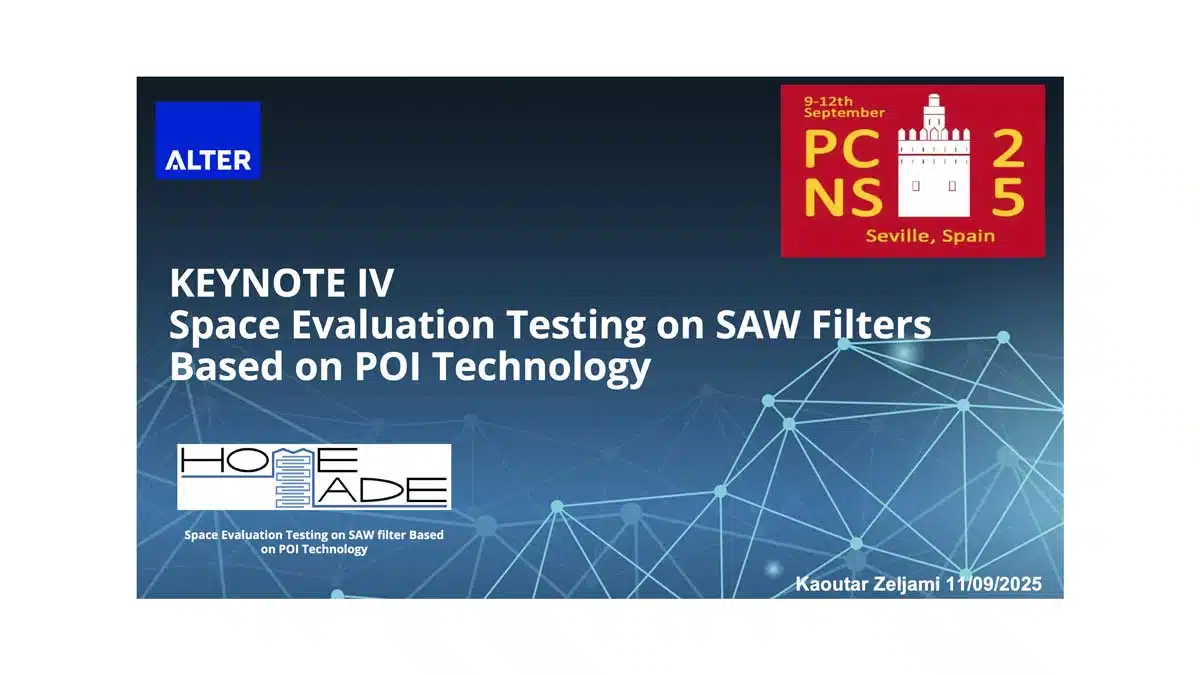
The paper “Space Evaluation Testing on SAW Filter Based on POI Technology” was presented by Kaoutar Zeljami, ALTER Technology TÜV NORD, Sevilla, Spain at the 5th PCNS Passive Components Networking Symposium 9-12th September 2025, Seville, Spain as Keynote IV paper.

Introduction

RelatedPosts

Advances in the Environmental Performance of Polymer Capacitors

How to Manage Supercapacitors Leakage Current and Self Discharge 

Qualification of Commercial Supercapacitors for Space Applications

The study focuses on the evaluation of Surface Acoustic Wave (SAW) filters based on Piezo-On-Insulator (POI) technology for potential use in space applications, particularly in L-band GPS systems.

The research is part of the HOMEMADE project, which aims to equip the European space industry with low-cost, high-performance SAW filters suitable for 5G direct satellite connectivity. SAW filters are essential in enabling high-quality factor RF performance while minimizing satellite size and weight.

The evaluation is a critical step in determining the technology’s robustness and reliability under harsh environmental conditions.

Key Points

  • SAW filters with POI substrate offer high integration, thermal stability, low insertion loss, and strong rejection.
  • Evaluation tests were based on ESCC 2263502 and ESCC 3502 standards.
  • Testing included constructional analysis, temperature and power step-stress tests, life tests, thermal cycling, and humidity assessment.
  • Devices demonstrated strong environmental resilience with minor deviations related to the die attach process.
  • Post-process annealing is critical for long-term stability of the filters.

Extended Summary

The evaluation involved 3.8SQ hermetic L-band GPS SAW filters developed within the HOMEMADE project by SOITEC. The devices were mounted on dedicated RO4350B test boards with 50-ohm grounded coplanar waveguides and SMA connectors for electrical measurements up to 18 GHz. Before soldering, filters were baked at 125ºC for 24 hours and soldered using a SnPb reflow profile with a peak of 235ºC.

The test campaign began with a thorough constructional analysis. Visual inspections, PIND, gross leak tests, and SEM analysis showed that the devices had no visible defects or contaminations. Bond pull tests were successful, but die shear tests revealed some failures in three samples, linked to die attachment rather than the POI technology itself. Slight wedge bond separations were observed, and material analysis confirmed compliance with space material restrictions.

Temperature step-stress tests determined the filters could reliably operate up to 105ºC without performance degradation, while power step-stress tests confirmed that the devices could handle up to +10 dBm with no electrical drift or internal structural damage to the interdigital transducers (IDTs). SEM inspections after testing confirmed IDT integrity.

Steady-state accelerated life tests were carried out at 105ºC with a -10 dBm RF signal for up to 1000 hours. Results demonstrated minimal passband drift (approximately 2 MHz) in the worst-case sample, linked to the omission of a post front-end annealing process. Complementary samples confirmed that a 250ºC annealing step is essential to stabilize Al-Cu electrodes.

Additional tests included low-temperature life testing at -55ºC for 1000 hours, which showed no anomalies, and thermal cycling between -55ºC and 125ºC for 100 cycles. Follow-up humidity testing at +85ºC and 85% RH revealed no electrical performance changes. The final thermal cycling and visual inspections confirmed the filters’ durability.

Overall, the evaluation demonstrated that POI-based SAW filters are robust and suitable for space applications. Detected deviations were attributed to assembly processes and can be mitigated through improved die attachment and post-annealing steps.

Conclusion

The extended evaluation of L-band GPS SAW filters based on POI substrates validates their potential for use in space environments, meeting the stringent requirements for 5G direct satellite connectivity. The filters showed resilience to thermal, power, and environmental stress tests, with only minor improvements needed in assembly processes to achieve full compliance with ESCC and MIL-STD standards. These findings support the continuation toward space qualification and the integration of POI-based SAW filters into future satellite constellations.


KNIV_ALTER SOITEC_Keynote_Space Evaluation Testing on SAW Filter Based on POI TechnologyDownload

Related

Recent Posts

Hall-Effect Sensing for Harsh Environments: TT Electronics Selected in NASA’s Dragonfly Fan

22.6.2026
20

Stackpole Releases High-Frequency Thin Film Chip Resistors for RF up to 50 GHz

19.6.2026
11

Knowles Expands High‑Q Ceramic Core Inductors for RF designs

19.6.2026
20

Molex Expanded AirBorn SInergy Hybrid Connectors with 25 A Power Modules

16.6.2026
22

Bourns Completes Rakon Acquisition, Enters Timing Market

12.6.2026
64

Knowles Expands High Q Ceramic Core Inductors

11.6.2026
38

HEICO’s Exxelia Expands High-Voltage Ceramic Capacitor Portfolio with CalRamic Acquisition

10.6.2026
53

Evans Group Unifies Four High-Rel Capacitor Leaders

5.6.2026
54

Designing 800 V DC EMC Filters: Calculation, Simulation and Measurement

4.6.2026
141

Upcoming Events

Jun 30
17:00 - 18:00 CEST

PSMA Capacitor Committee Webinar: High Voltage Pulse Capacitors

Jul 14
16:00 - 17:00 CEST

EMC Design Essentials: Mastering Varistors and Common Mode Chokes

Jul 21
16:00 - 17:00 CEST

Safety by design: X and Y Interference suppression capacitors for power line filters

View Calendar

Popular Posts

  • Boost Converter Design and Calculation

    0 shares
    Share 0 Tweet 0
  • Buck Converter Design and Calculation

    0 shares
    Share 0 Tweet 0
  • LLC Resonant Converter Design and Calculation

    0 shares
    Share 0 Tweet 0
  • Flyback Converter Design and Calculation

    0 shares
    Share 0 Tweet 0
  • MLCC and Ceramic Capacitors

    0 shares
    Share 0 Tweet 0
  • Earthing Systems and IEC Classification Explained

    0 shares
    Share 0 Tweet 0
  • Nvidia Vera Rubin: Why One AI Rack Needs So Many More MLCC Capacitors

    0 shares
    Share 0 Tweet 0
  • Dual Active Bridge (DAB) Topology

    0 shares
    Share 0 Tweet 0
  • SEPIC Converter Design and Calculation

    0 shares
    Share 0 Tweet 0
  • MLCC Case Sizes Standards Explained

    0 shares
    Share 0 Tweet 0

Newsletter Subscription


Passive Components Blog

© EPCI - Leading Passive Components Educational and Information Site

  • Home
  • Privacy Policy
  • EPCI Membership & Advertisement
  • About

No Result
View All Result
  • Home
  • Knowledge Blog
  • Dossiers
  • PCNS

© EPCI - Leading Passive Components Educational and Information Site

This website uses cookies. By continuing to use this website you are giving consent to cookies being used. Visit our Privacy and Cookie Policy.
Go to mobile version