





Passive Components Blog
No Result
View All Result
  • Home
  • NewsFilter
    • All
    • Aerospace & Defence
    • Antenna
    • Applications
    • Automotive
    • Capacitors
    • Circuit Protection Devices
    • electro-mechanical news
    • Filters
    • Fuses
    • Inductors
    • Industrial
    • Integrated Passives
    • inter-connect news
    • Market & Supply Chain
    • Market Insights
    • Medical
    • Modelling and Simulation
    • New Materials & Supply
    • New Technologies
    • Non-linear Passives
    • Oscillators
    • Passive Sensors News
    • Resistors
    • RF & Microwave
    • Telecommunication
    • Weekly Digest

    Wk 11 Electronics Supply Chain Digest

    Binder Extends NCC Circular Connectors for Harsh Environments

    Standard vs Planar LLC transformers Comparison for Battery Chargers

    Würth Elektronik and Grinn Launch Edge AI Cooperation

    Bourns Expanded Semi-Shielded Low Profile Automotive Power Inductor

    Peak Nano to Develop Fusion Grade High Energy Film Capacitors

    Murata New Vibration Sensor Targets High‑Frequency Predictive Maintenance

    Kyocera Releases 30fs Jitter Differential Clock Oscillator

    Panasonic Expands Automotive PP Film Capacitors Voltage Range

    Trending Tags

    • Ripple Current
    • RF
    • Leakage Current
    • Tantalum vs Ceramic
    • Snubber
    • Low ESR
    • Feedthrough
    • Derating
    • Dielectric Constant
    • New Products
    • Market Reports
  • VideoFilter
    • All
    • Antenna videos
    • Capacitor videos
    • Circuit Protection Video
    • Filter videos
    • Fuse videos
    • Inductor videos
    • Inter-Connect Video
    • Non-linear passives videos
    • Oscillator videos
    • Passive sensors videos
    • Resistor videos

    Standard vs Planar LLC transformers Comparison for Battery Chargers

    How Modern Tools Model Magnetic Components for Power Electronics

    Advanced Loss Modeling for Planar Magnetics in the Frenetic Planar Tool

    2026 Power Magnetics Design Trends: Flyback, DAB and Planar

    Enabling Software‑Defined Vehicle Architectures: Automotive Ethernet and Zonal Smart Power

    Calculating Resistance Value of a Flyback RC Snubber 

    One‑Pulse Characterization of Nonlinear Power Inductors

    Thermistor Linearization Challenges

    Coaxial Connectors and How to Connect with PCB

    Trending Tags

    • Capacitors explained
    • Inductors explained
    • Resistors explained
    • Filters explained
    • Application Video Guidelines
    • EMC
    • New Products
    • Ripple Current
    • Simulation
    • Tantalum vs Ceramic
  • Knowledge Blog
  • DossiersNew
  • Suppliers
    • Who is Who
  • PCNS
    • PCNS 2025
    • PCNS 2023
    • PCNS 2021
    • PCNS 2019
    • PCNS 2017
  • Events
  • Home
  • NewsFilter
    • All
    • Aerospace & Defence
    • Antenna
    • Applications
    • Automotive
    • Capacitors
    • Circuit Protection Devices
    • electro-mechanical news
    • Filters
    • Fuses
    • Inductors
    • Industrial
    • Integrated Passives
    • inter-connect news
    • Market & Supply Chain
    • Market Insights
    • Medical
    • Modelling and Simulation
    • New Materials & Supply
    • New Technologies
    • Non-linear Passives
    • Oscillators
    • Passive Sensors News
    • Resistors
    • RF & Microwave
    • Telecommunication
    • Weekly Digest

    Wk 11 Electronics Supply Chain Digest

    Binder Extends NCC Circular Connectors for Harsh Environments

    Standard vs Planar LLC transformers Comparison for Battery Chargers

    Würth Elektronik and Grinn Launch Edge AI Cooperation

    Bourns Expanded Semi-Shielded Low Profile Automotive Power Inductor

    Peak Nano to Develop Fusion Grade High Energy Film Capacitors

    Murata New Vibration Sensor Targets High‑Frequency Predictive Maintenance

    Kyocera Releases 30fs Jitter Differential Clock Oscillator

    Panasonic Expands Automotive PP Film Capacitors Voltage Range

    Trending Tags

    • Ripple Current
    • RF
    • Leakage Current
    • Tantalum vs Ceramic
    • Snubber
    • Low ESR
    • Feedthrough
    • Derating
    • Dielectric Constant
    • New Products
    • Market Reports
  • VideoFilter
    • All
    • Antenna videos
    • Capacitor videos
    • Circuit Protection Video
    • Filter videos
    • Fuse videos
    • Inductor videos
    • Inter-Connect Video
    • Non-linear passives videos
    • Oscillator videos
    • Passive sensors videos
    • Resistor videos

    Standard vs Planar LLC transformers Comparison for Battery Chargers

    How Modern Tools Model Magnetic Components for Power Electronics

    Advanced Loss Modeling for Planar Magnetics in the Frenetic Planar Tool

    2026 Power Magnetics Design Trends: Flyback, DAB and Planar

    Enabling Software‑Defined Vehicle Architectures: Automotive Ethernet and Zonal Smart Power

    Calculating Resistance Value of a Flyback RC Snubber 

    One‑Pulse Characterization of Nonlinear Power Inductors

    Thermistor Linearization Challenges

    Coaxial Connectors and How to Connect with PCB

    Trending Tags

    • Capacitors explained
    • Inductors explained
    • Resistors explained
    • Filters explained
    • Application Video Guidelines
    • EMC
    • New Products
    • Ripple Current
    • Simulation
    • Tantalum vs Ceramic
  • Knowledge Blog
  • DossiersNew
  • Suppliers
    • Who is Who
  • PCNS
    • PCNS 2025
    • PCNS 2023
    • PCNS 2021
    • PCNS 2019
    • PCNS 2017
  • Events
No Result
View All Result
Passive Components Blog
No Result
View All Result

Combining Capacitors and Inductors into Tiny 3D Rolled Membrane

14.8.2020
Reading Time: 2 mins read
A A
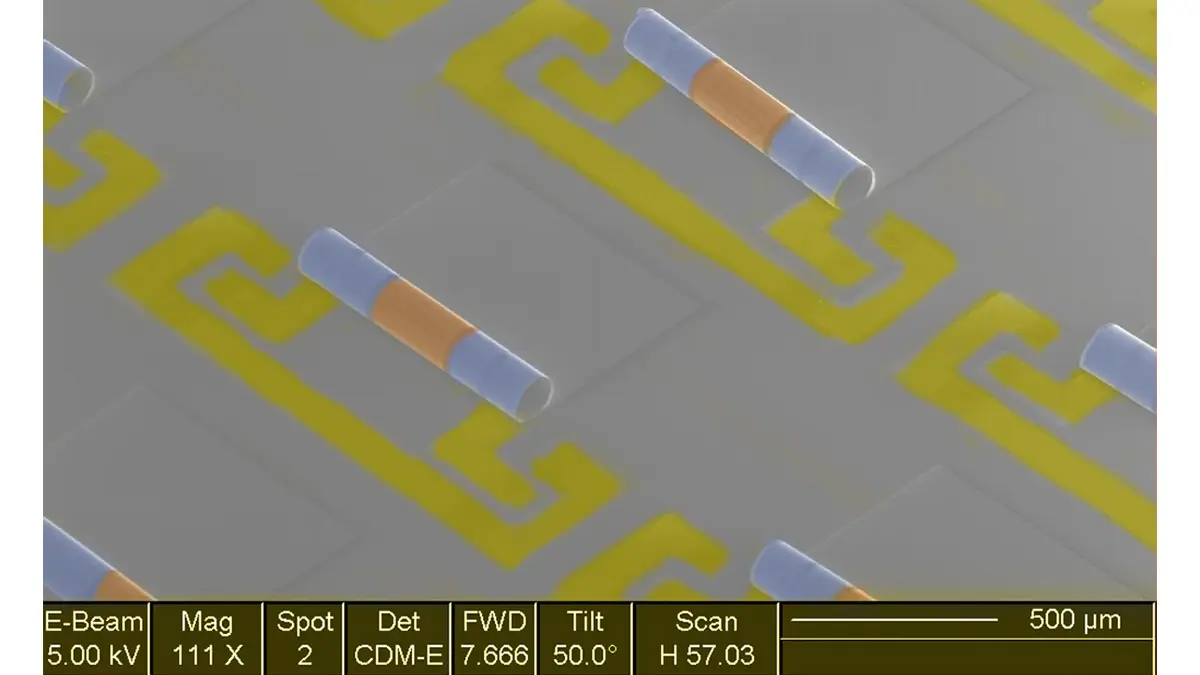
This electron microscope image shows an array of new chip components that combine the inductors (blue) and capacitors (yellow) needed to make electronic signal filters in phones and other wireless devices. Source: Xiuling Li

This electron microscope image shows an array of new chip components that combine the inductors (blue) and capacitors (yellow) needed to make electronic signal filters in phones and other wireless devices. Source: Xiuling Li

New hybrid components could shrink the size of electronic filters used in communication devices. Researchers at the University of Illinois, Urbana-Champaign have devised a method of combining capacitors and inductors in a tiny, 3D rolled membrane. This will save space in the electronic filters found in phones and other wireless devices. They eliminate or enhance specific input signals to get the best output signals. While essential, these filters take up space on the chips that researchers are constantly trying to make smaller.

In the lab, the team used a specialized etching and lithography process to pattern 2D circuits onto thin membranes. In the circuits, they join capacitors and inductors together with ground or signal lines, all in a single plane. The multilayer membrane was then rolled into a thin tube and placed on a chip. 

RelatedPosts

Wk 11 Electronics Supply Chain Digest

Binder Extends NCC Circular Connectors for Harsh Environments

Standard vs Planar LLC transformers Comparison for Battery Chargers

Combining capacitors and inductors on a single cylindrical tubular component begins with depositing metals using electron-beam evaporation and lithography to define the metal pattern and etching process. The final etching step triggers the self-rolling process of the stacked membrane.

“The patterns, or masks, uses to form the circuitry on the 2D membrane layers can be tuned to deliver whatever kind of electrical interactions we need for a particular device,” says researcher and grad student Mark Kraman. “Experimenting with different filter designs is relatively simple using this technique because we only need to modify the mask structure to make changes.”

The team tested the rolled components performance and found that the filters were suitable for applications in the 1 to 10 GHz frequency range. Although the designs are for use in RF communication devices, the team is confident that other frequencies, including those in the megahertz range, will be possible based on their track record in developing high-power inductors in past projects.

The team is working with several simple filter designs but says filter network combination can theoretically be made using the same process. The researchers suggest their method of combining inductors and capacitors monolithically could bring passive electronic circuits to a whole new level.
Related

Source: University of Illinois

Recent Posts

Standard vs Planar LLC transformers Comparison for Battery Chargers

13.3.2026
13

Bourns Expanded Semi-Shielded Low Profile Automotive Power Inductor

12.3.2026
13

Peak Nano to Develop Fusion Grade High Energy Film Capacitors

11.3.2026
28

Panasonic Expands Automotive PP Film Capacitors Voltage Range

9.3.2026
23

Panasonic Extends Automotive Power Inductor Line

9.3.2026
30

February 2026 Interconnect, Passives and Electromechanical Components Market Insights

9.3.2026
55

YAGEO Presents 3.6 kW LLC Transformer Platform

6.3.2026
51

Empower Extends Embedded Silicon Capacitors for AI

6.3.2026
43

How Modern Tools Model Magnetic Components for Power Electronics

5.3.2026
48

Upcoming Events

Mar 19
13:00 - 14:00 CDT

Smart Consideration of Inductor Thermal Performance

Mar 21
All day

PSMA Capacitor Workshop 2026

Apr 21
16:00 - 17:00 CEST

Heatsink Solutions: Thermal Management in electronic devices

View Calendar

Popular Posts

  • Buck Converter Design and Calculation

    0 shares
    Share 0 Tweet 0
  • Boost Converter Design and Calculation

    0 shares
    Share 0 Tweet 0
  • Flyback Converter Design and Calculation

    0 shares
    Share 0 Tweet 0
  • LLC Resonant Converter Design and Calculation

    0 shares
    Share 0 Tweet 0
  • MLCC Manufacturers Consider Price Increase as AI Demand Outpaces Supply

    0 shares
    Share 0 Tweet 0
  • Dual Active Bridge (DAB) Topology

    0 shares
    Share 0 Tweet 0
  • Ripple Current and its Effects on the Performance of Capacitors

    3 shares
    Share 3 Tweet 0
  • MLCC and Ceramic Capacitors

    0 shares
    Share 0 Tweet 0
  • MLCC Case Sizes Standards Explained

    0 shares
    Share 0 Tweet 0
  • 3-Phase EMI Filter Design, Simulation, Calculation and Test

    0 shares
    Share 0 Tweet 0

Newsletter Subscription


Passive Components Blog

© EPCI - Leading Passive Components Educational and Information Site

  • Home
  • Privacy Policy
  • EPCI Membership & Advertisement
  • About

No Result
View All Result
  • Home
  • Knowledge Blog
  • PCNS

© EPCI - Leading Passive Components Educational and Information Site

This website uses cookies. By continuing to use this website you are giving consent to cookies being used. Visit our Privacy and Cookie Policy.
Go to mobile version