


Passive Components Blog
No Result
View All Result
  • Home
  • NewsFilter
    • All
    • Aerospace & Defence
    • Antenna
    • Applications
    • Automotive
    • Capacitors
    • Circuit Protection Devices
    • electro-mechanical news
    • Filters
    • Fuses
    • Inductors
    • Industrial
    • Integrated Passives
    • inter-connect news
    • Market & Supply Chain
    • Market Insights
    • Medical
    • Modelling and Simulation
    • New Materials & Supply
    • New Technologies
    • Non-linear Passives
    • Oscillators
    • Passive Sensors News
    • Resistors
    • RF & Microwave
    • Telecommunication
    • Weekly Digest

    Samsung Introduced Low ESL 3-Terminal Reverse-Geometry MLCCs for High-Performance ADAS

    Würth Elektronik Presents New Bidirectional Digital Isolators

    Using Stress–Strain Curves to Diagnose Tantalum Powders for Capacitors

    Coilcraft Introduces SMT Current Sense Transformers for High‑Performance Power Electronics

    Samsung Launches Ultra-Compact 008004 High Q MLCC for Next-Generation RF Applications

    Nichicon Extends Rechargeable Batteries Temperature to Rival Supercapacitors

    Two‑capacitor paradox explained for engineers

    YAGEO Releases Compact RJ45 Connector for Multi‑Gigabit Ethernet

    Circuit Protection Technology Annual Dossier

    Trending Tags

    • Ripple Current
    • RF
    • Leakage Current
    • Tantalum vs Ceramic
    • Snubber
    • Low ESR
    • Feedthrough
    • Derating
    • Dielectric Constant
    • New Products
    • Market Reports
  • VideoFilter
    • All
    • Antenna videos
    • Capacitor videos
    • Circuit Protection Video
    • Filter videos
    • Fuse videos
    • Inductor videos
    • Inter-Connect Video
    • Non-linear passives videos
    • Oscillator videos
    • Passive sensors videos
    • Resistor videos

    Two‑capacitor paradox explained for engineers

    Capacitances of Nonlinear MLCCs: What Datasheets Don’t Tell You

    Tapped Inductor Buck Converter Fundamentals

    Planar vs Conventional Transformer: When it Make Sense

    Modeling Fringing Field Losses in Inductors & Transformers

    Why Power Inductors Use a Ferrite Core With an Air Gap

    Transformer-Based Power-Line Harvester Magnetic Design

    Thermal Modeling of Magnetics

    Standard vs Planar LLC transformers Comparison for Battery Chargers

    Trending Tags

    • Capacitors explained
    • Inductors explained
    • Resistors explained
    • Filters explained
    • Application Video Guidelines
    • EMC
    • New Products
    • Ripple Current
    • Simulation
    • Tantalum vs Ceramic
  • Knowledge Blog
  • DossiersNew
  • Suppliers
    • Who is Who
  • PCNS
    • PCNS 2025
    • PCNS 2023
    • PCNS 2021
    • PCNS 2019
    • PCNS 2017
  • Events
  • Home
  • NewsFilter
    • All
    • Aerospace & Defence
    • Antenna
    • Applications
    • Automotive
    • Capacitors
    • Circuit Protection Devices
    • electro-mechanical news
    • Filters
    • Fuses
    • Inductors
    • Industrial
    • Integrated Passives
    • inter-connect news
    • Market & Supply Chain
    • Market Insights
    • Medical
    • Modelling and Simulation
    • New Materials & Supply
    • New Technologies
    • Non-linear Passives
    • Oscillators
    • Passive Sensors News
    • Resistors
    • RF & Microwave
    • Telecommunication
    • Weekly Digest

    Samsung Introduced Low ESL 3-Terminal Reverse-Geometry MLCCs for High-Performance ADAS

    Würth Elektronik Presents New Bidirectional Digital Isolators

    Using Stress–Strain Curves to Diagnose Tantalum Powders for Capacitors

    Coilcraft Introduces SMT Current Sense Transformers for High‑Performance Power Electronics

    Samsung Launches Ultra-Compact 008004 High Q MLCC for Next-Generation RF Applications

    Nichicon Extends Rechargeable Batteries Temperature to Rival Supercapacitors

    Two‑capacitor paradox explained for engineers

    YAGEO Releases Compact RJ45 Connector for Multi‑Gigabit Ethernet

    Circuit Protection Technology Annual Dossier

    Trending Tags

    • Ripple Current
    • RF
    • Leakage Current
    • Tantalum vs Ceramic
    • Snubber
    • Low ESR
    • Feedthrough
    • Derating
    • Dielectric Constant
    • New Products
    • Market Reports
  • VideoFilter
    • All
    • Antenna videos
    • Capacitor videos
    • Circuit Protection Video
    • Filter videos
    • Fuse videos
    • Inductor videos
    • Inter-Connect Video
    • Non-linear passives videos
    • Oscillator videos
    • Passive sensors videos
    • Resistor videos

    Two‑capacitor paradox explained for engineers

    Capacitances of Nonlinear MLCCs: What Datasheets Don’t Tell You

    Tapped Inductor Buck Converter Fundamentals

    Planar vs Conventional Transformer: When it Make Sense

    Modeling Fringing Field Losses in Inductors & Transformers

    Why Power Inductors Use a Ferrite Core With an Air Gap

    Transformer-Based Power-Line Harvester Magnetic Design

    Thermal Modeling of Magnetics

    Standard vs Planar LLC transformers Comparison for Battery Chargers

    Trending Tags

    • Capacitors explained
    • Inductors explained
    • Resistors explained
    • Filters explained
    • Application Video Guidelines
    • EMC
    • New Products
    • Ripple Current
    • Simulation
    • Tantalum vs Ceramic
  • Knowledge Blog
  • DossiersNew
  • Suppliers
    • Who is Who
  • PCNS
    • PCNS 2025
    • PCNS 2023
    • PCNS 2021
    • PCNS 2019
    • PCNS 2017
  • Events
No Result
View All Result
Passive Components Blog
No Result
View All Result

KYOCERA AVX Introduces Circuit Matching Service for Crystal Timing Devices

15.2.2023
Reading Time: 2 mins read
A A

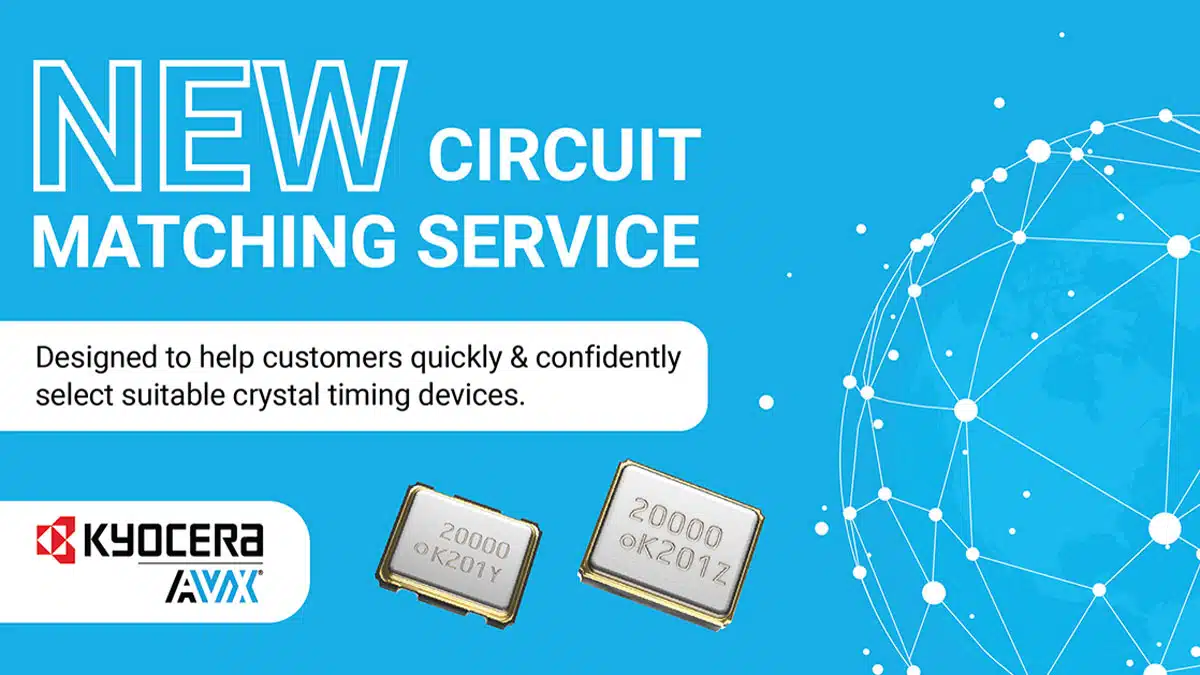
The new KYOCERA AVX online tool and global design support service will help customers quickly and confidently select crystal timing devices optimized for their ICs.

KYOCERA AVX, a leading global manufacturer of advanced electronic components engineered to accelerate technological innovation and build a better future, has introduced a new circuit matching service designed to help customers quickly and confidently select suitable crystal timing devices.

RelatedPosts

KYOCERA 10 µF 0201 MLCC Brings High‑Capacitance into Mobile Designs

KYOCERA AVX Extends MLV Varistors for 48V Automotive Protection

Kyocera Developed Multilayer Ceramic Core Substrate for AI Packages

When oscillator circuits aren’t optimized for customers’ ICs or timing devices, it can result in abnormal oscillation or even prevent oscillation, which could lead to device failure. The new online circuit matching service identifies KYOCERA AVX crystal timing devices recommended by leading global IC manufacturers to ensure that customers choose compatible timing devices. This assurance delivers critical benefits including improved oscillation start-up times and stable oscillation with higher gain margins, which are especially valuable in automotive industry designs.

The online tool features timing device recommendations for ICs manufactured by 40 leading global suppliers. The resulting circuit matching report provides customers with parameters including start-up time, drive level, initial frequency deviation, and negative resistance. It also provides recommended circuit constants for load capacitors, feedback resistors, and dampening resistors.

If additional support is needed, customers can have their PCBs evaluated by KYOCERA AVX technical support centers in the U.S., Germany, China, Korea, and Japan.

“We’re proud to launch our new circuit matching service and to provide our crystal timing device customers with confidence and peace of mind,” said Bob Azuma, Marketing Director, KYOCERA AVX. “KYOCERA is a leading global developer of cutting-edge crystal timing devices. We offer ultraminiature and high-accuracy solutions, as well as products engineered for a wide range of operating temperatures, and our new online IC matching tool and global design support service will make it quicker and easier than ever for customers to identify the crystal components they need to develop robust and reliable oscillation circuits.”

Related

Source: KYOCERA AVX

Recent Posts

Würth Elektronik Presents New Bidirectional Digital Isolators

20.5.2026
10

Würth Elektronik Introduces Compact Flat-wire SMT Power Inductors for Automotive

5.5.2026
70

KYOCERA AVX Extends MLV Varistors for 48V Automotive Protection

5.5.2026
42

Murata Introduces Crystal and NTC Set for Automotive UWB Timing

30.4.2026
34

Murata New MLCC Bulk Case Packaging Cuts Packaging Material by 99%

27.4.2026
113

KYOCERA AVX Introduces Traction‑Grade DC Link Film Capacitors

21.4.2026
70

Würth Elektronik Expanded Capacity for Validation and Services in Asia

16.4.2026
32

KYOCERA AVX MIL-PRF-32535 BME NP0 MLCCs Approved to the DLA QPD

16.4.2026
40

Murata Automotive MLCCs Push Capacitance Limits for ADAS and Power Lines

16.4.2026
88

Upcoming Events

Jun 2
16:00 - 17:00 CEST

Calculation, Simulation and Measurement of 800V EMC Filters

Jun 16
16:00 - 17:00 CEST

EMC with EMC – EMC‑compliant design with electromechanical connectors

View Calendar

Popular Posts

  • Buck Converter Design and Calculation

    0 shares
    Share 0 Tweet 0
  • Boost Converter Design and Calculation

    0 shares
    Share 0 Tweet 0
  • Flyback Converter Design and Calculation

    0 shares
    Share 0 Tweet 0
  • LLC Resonant Converter Design and Calculation

    0 shares
    Share 0 Tweet 0
  • MLCC and Ceramic Capacitors

    0 shares
    Share 0 Tweet 0
  • Capacitor Charging and Discharging

    0 shares
    Share 0 Tweet 0
  • What Electronics Engineer Needs to Know About Passive Low Pass Filters

    0 shares
    Share 0 Tweet 0
  • Dual Active Bridge (DAB) Topology

    0 shares
    Share 0 Tweet 0
  • Ripple Current and its Effects on the Performance of Capacitors

    3 shares
    Share 3 Tweet 0
  • Samsung Electro-Mechanics Releases High-Capacitance MLCCs for AI Server Applications

    0 shares
    Share 0 Tweet 0

Newsletter Subscription


Passive Components Blog

© EPCI - Leading Passive Components Educational and Information Site

  • Home
  • Privacy Policy
  • EPCI Membership & Advertisement
  • About

No Result
View All Result
  • Home
  • Knowledge Blog
  • PCNS

© EPCI - Leading Passive Components Educational and Information Site

This website uses cookies. By continuing to use this website you are giving consent to cookies being used. Visit our Privacy and Cookie Policy.
Go to mobile version