




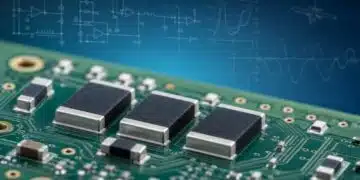








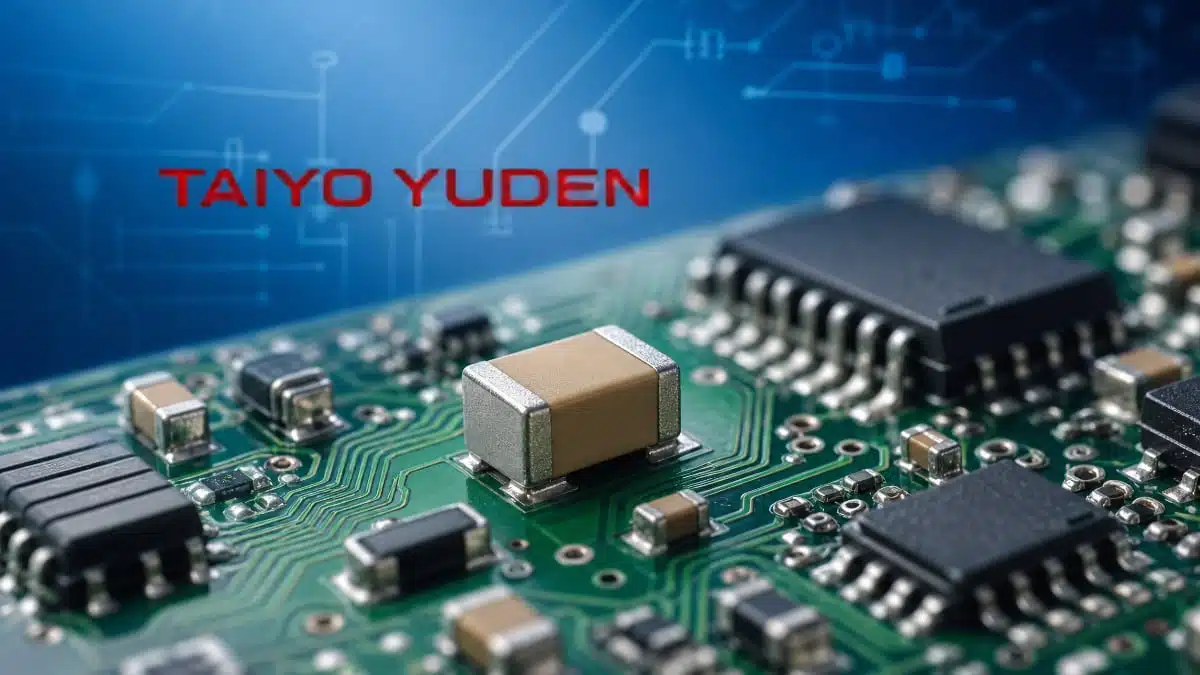
TAIYO YUDEN has released a new automotive‑grade multilayer ceramic capacitor (MLCC), type MAASA32MAD7227MP1D71, offering 220 µF in a 3225 (1210) package while meeting AEC‑Q200 requirements for passive components in vehicles.
This MLCC capacitor more than doubles the capacitance of the company’s previous 100 µF part in the same size, targeting output smoothing and decoupling in demanding automotive ECUs and safety systems. For designers, it provides a way to increase bulk capacitance and stability without increasing footprint or moving to larger, less integration‑friendly capacitor technologies.
Key features and benefits
- High capacitance in 3225 size – 220 µF nominal capacitance in a 3.2 × 2.5 × 2.8 mm (maximum height) MLCC, enabling significant energy storage and ripple smoothing in a compact footprint.
- More than double previous generation – Capacitance is more than twice that of TAIYO YUDEN’s conventional 100 µF MLCC in the same 3225 case size (MAASP32MAD7107MPCA01), allowing drop‑in upgrades where higher capacitance is needed.
- Automotive‑grade reliability – Complies with AEC‑Q200 passive component reliability testing, supporting use in harsh automotive environments where vibration, temperature cycling, and long lifetime are critical.
- Optimized for output smoothing and decoupling – Designed for stabilizing DC rails and suppressing dynamic load transients in control units, safety modules, and information systems.
- Supports highly integrated ECUs and SDV architectures – Addresses rising IC processing power and current consumption driven by ADAS and software‑defined vehicle concepts, where local high‑value decoupling is needed close to power pins.
- Potential for BoM and space reduction – High capacitance in a single device can reduce the number of parallel capacitors around high‑current ICs, simplifying layout and potentially improving reliability by lowering solder joint count.
Typical applications
The MAASA32MAD7227MP1D71 is targeted at a wide range of automotive electronic systems where stable power rails and high dynamic load currents coexist.
- Control systems such as engine control units (ECUs), where high‑capacitance MLCCs help maintain supply stability during injector and actuator events.
- Safety systems including anti‑lock braking systems (ABS) and advanced driver assistance systems (ADAS), where transient loads from radar, camera, and processing SoCs require robust local decoupling.
- Information and display systems, for example instrument clusters and infotainment modules, which combine digital processing, graphics engines, and communication interfaces on shared power rails.
- Networked automotive electronics and domain controllers in evolving SDV architectures, where increasing processing density and scalable power distribution benefit from compact bulk capacitance near point‑of‑load regulators.
In many of these cases, the capacitor will sit directly at the output of a DC‑DC converter or close to a large digital or mixed‑signal IC, working in combination with smaller‑value MLCCs and sometimes with aluminum or polymer capacitors to shape the overall impedance profile over frequency.
Technical highlights
The table below summarizes the key attributes mentioned in the press material and associated product page. Where a specific parameter is not explicitly stated in the release, it should be taken from the official datasheet according to the manufacturer.
| Parameter | Value / Note |
|---|---|
| Part number | MAASA32MAD7227MP1D71 |
| Capacitance | 220 µF nominal |
| Size code | 3225 (approx. 3.2 × 2.5 mm footprint) |
| Maximum height | 2.8 mm |
| Technology | Multilayer ceramic capacitor (MLCC) |
| Qualification | AEC‑Q200 compliant (passive automotive component reliability standard) |
| Application class/details | For output smoothing and decoupling in automotive systems |
| Production location | Tamamura Plant, Gunma Prefecture, Japan |
| Mass production start | May 2026 |
In practice, achieving 220 µF in this case size suggests an optimized dielectric system and internal structure aimed at high volumetric efficiency, which can be particularly attractive where board area and height restrictions are strict in ECUs and camera modules. Exact details such as rated voltage, allowable ripple current, temperature range, and tolerance are provided in the official datasheet and should be verified at design‑in according to the specific use case.
Design‑in notes for engineers
- Check voltage derating strategy
When using very high capacitance MLCCs in automotive environments, it is important to apply appropriate voltage derating relative to the rated voltage specified in the datasheet, especially at higher ambient temperatures and under DC bias. - Consider DC bias and temperature effects
The effective capacitance of high‑value MLCCs typically decreases under DC bias and over temperature, so designers should size the component with adequate margin based on the worst‑case operating point defined in the system requirements and manufacturer curves. - Combine with smaller capacitors for high‑frequency decoupling
A single 220 µF MLCC is effective for low‑frequency energy storage and load‑step smoothing, but it is usually complemented with smaller‑value MLCCs (for example in the nF to low‑µF range) placed very close to IC power pins to ensure low impedance at higher frequencies. - Layout and mechanical considerations
In vibration‑intensive automotive environments, layout strategies such as placing the MLCC close to the neutral mechanical axis of the board, using appropriate pad design, and managing board flex can help reduce mechanical stress and risk of cracking. - Thermal and ripple current assessment
High‑capacitance MLCCs in switching power paths are subject to ripple current and self‑heating; designers should compare the expected ripple profile against the manufacturer’s specified limits and verify temperature rise during validation testing. - Qualification and documentation
Since the device is AEC‑Q200 compliant, design teams should obtain the detailed qualification report, PPAP documentation if required, and ensure that internal quality and reliability teams review and approve the component for the relevant automotive design level.
By treating the MAASA32MAD7227MP1D71 as a compact bulk capacitor that can often replace multiple lower‑value parts, engineers can simplify the capacitor network around power regulators while maintaining or improving transient performance, provided system‑level impedance and EMC requirements are carefully validated.
Source
This article is based on information provided by TAIYO YUDEN in their official product news release and associated online product specification resources.