






Passive Components Blog
No Result
View All Result
  • Home
  • News
    • All
    • Aerospace & Defence
    • Antenna
    • Applications
    • Automotive
    • Capacitors
    • Circuit Protection Devices
    • electro-mechanical news
    • Filters
    • Fuses
    • Inductors
    • Industrial
    • Integrated Passives
    • inter-connect news
    • Market & Supply Chain
    • Market Insights
    • Medical
    • Modelling and Simulation
    • New Materials & Supply
    • New Technologies
    • Non-linear Passives
    • Oscillators
    • Passive Sensors News
    • Resistors
    • RF & Microwave
    • Telecommunication
    • Weekly Digest

    August 2026 Interconnect, Passives and Electromechanical Components Market Insights

    AEM Introduced High-Power Fuses for Compact Automotive and Industrial Overcurrent Protection

    Knowles Cornell Dubilier 105C Flatpack Aluminum Electrolytic Capacitors Target Low-Profile High-Density Power Designs

    Vishay Thin Film Chip Resistors Combine up to 50 GHz Operation with High Power Density

    Samsung Electro-Mechanics Secures KRW 1.0722 Trillion AI Server MLCC Supply Contract

    KYOCERA AVX Adds 0201 C0G RF MLCCs to KGU Ultra-Low-ESR Capacitor Series

    Vishay Extends High-Current Common-Mode Chokes with 30 A EMI Filtering up to 150 °C

    Bourns Copper-Electrode MOV Series Targets High-Energy Line Surge Protection

    Bourns Expands 12 mm SMD Incremental Encoder with Shaft-Length Options for Compact HMI Controls

    Trending Tags

    • Ripple Current
    • RF
    • Leakage Current
    • Tantalum vs Ceramic
    • Snubber
    • Low ESR
    • Feedthrough
    • Derating
    • Dielectric Constant
    • New Products
    • Market Reports
  • Knowledge Blog
  • Dossiers
    • AI Hardware Dossier
    • Automotive Dossier
    • Industrial Robotics Dossier
    • Power Converter Dossier
    • Capacitor Dossier
    • Resistor Dossier
    • Inductor Dossier
    • Circuit Protection Dossier
  • Suppliers
    • Who is Who
  • PCNS
    • PCNS 2025
    • PCNS 2023
    • PCNS 2021
    • PCNS 2019
    • PCNS 2017
  • Events
  • Home
  • News
    • All
    • Aerospace & Defence
    • Antenna
    • Applications
    • Automotive
    • Capacitors
    • Circuit Protection Devices
    • electro-mechanical news
    • Filters
    • Fuses
    • Inductors
    • Industrial
    • Integrated Passives
    • inter-connect news
    • Market & Supply Chain
    • Market Insights
    • Medical
    • Modelling and Simulation
    • New Materials & Supply
    • New Technologies
    • Non-linear Passives
    • Oscillators
    • Passive Sensors News
    • Resistors
    • RF & Microwave
    • Telecommunication
    • Weekly Digest

    August 2026 Interconnect, Passives and Electromechanical Components Market Insights

    AEM Introduced High-Power Fuses for Compact Automotive and Industrial Overcurrent Protection

    Knowles Cornell Dubilier 105C Flatpack Aluminum Electrolytic Capacitors Target Low-Profile High-Density Power Designs

    Vishay Thin Film Chip Resistors Combine up to 50 GHz Operation with High Power Density

    Samsung Electro-Mechanics Secures KRW 1.0722 Trillion AI Server MLCC Supply Contract

    KYOCERA AVX Adds 0201 C0G RF MLCCs to KGU Ultra-Low-ESR Capacitor Series

    Vishay Extends High-Current Common-Mode Chokes with 30 A EMI Filtering up to 150 °C

    Bourns Copper-Electrode MOV Series Targets High-Energy Line Surge Protection

    Bourns Expands 12 mm SMD Incremental Encoder with Shaft-Length Options for Compact HMI Controls

    Trending Tags

    • Ripple Current
    • RF
    • Leakage Current
    • Tantalum vs Ceramic
    • Snubber
    • Low ESR
    • Feedthrough
    • Derating
    • Dielectric Constant
    • New Products
    • Market Reports
  • Knowledge Blog
  • Dossiers
    • AI Hardware Dossier
    • Automotive Dossier
    • Industrial Robotics Dossier
    • Power Converter Dossier
    • Capacitor Dossier
    • Resistor Dossier
    • Inductor Dossier
    • Circuit Protection Dossier
  • Suppliers
    • Who is Who
  • PCNS
    • PCNS 2025
    • PCNS 2023
    • PCNS 2021
    • PCNS 2019
    • PCNS 2017
  • Events
No Result
View All Result
Passive Components Blog
No Result
View All Result

What Are Bias Filter and Self-Bias Networks?

9.11.2023
Reading Time: 4 mins read
A A

This article based on Knowles Precision Devices blog introduces bias filter networks and self-bias networks – the two types of biasing components developed by Knowles Precision Devices for use in high-frequency microwave and RF applications.

What Are Bias Filter Networks?

Bias filter networks in RF amplifiers refer to specific arrangements of passive components like resistors, capacitors, and inductors that provide a stable DC bias voltage or current to the active devices in the amplifier. 

RelatedPosts

Knowles Cornell Dubilier 105C Flatpack Aluminum Electrolytic Capacitors Target Low-Profile High-Density Power Designs

Filter Capacitors in Electric Vehicles: Knowles Safety MLCCs for BMS and Isolated DC/DC Converters

Knowles Introduces PP Film Capacitors for High‑Stress Power Electronics

They have three main functions:

  • Biasing: Providing the required DC voltage/current to the transistors to keep them operating in their optimal region.
  • Filtering: Using capacitors and inductors to prevent RF signals from flowing back into the DC supply or other circuit sections, avoiding interference and instability.
  • Decoupling: Isolating different amplifier stages to prevent their performances from impacting each other, which is important in multi-stage amplifiers

Bias filter networks play a crucial role in ensuring RF amplifiers operate efficiently, maintain linearity, and minimize noise/interference.

What Are Self-Bias Networks?

Self-bias networks in RF/microwave circuits are configurations designed to automatically set the DC bias point of active devices like transistors without requiring an external bias supply. They consist of resistors and capacitors connected to the device’s terminals in a voltage divider configuration to provide the bias voltage, while blocking DC signals.

The main advantage of self-bias networks is they automatically adjust the bias point based on factors like device characteristics and temperature to maintain consistent circuit performance. They simplify design and reduce components needed.
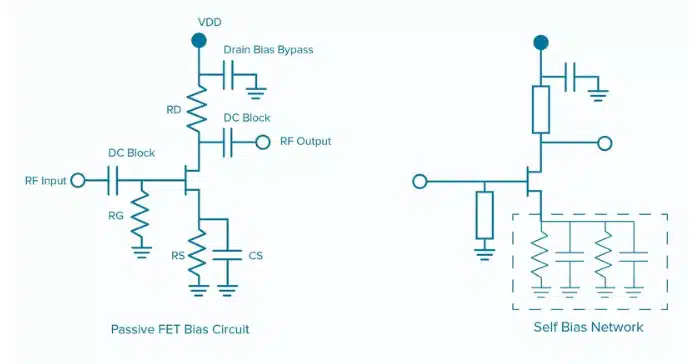
Figure 1. A Passive FET Bias Network and a Self Bias Network product used on the source leg of a FET.

How Bias Filter Networks and Self-Bias Networks Work

Bias filter networks filter noise from DC supplies and reduce RF feedback in high-frequency applications like wireless communications. They combine high-permittivity dielectrics and thin-film processing to filter noise when transmitting DC voltage from point A to B in a circuit.

Bias filter networks should be used in applications that require filtering of noise and isolation of RF signals from DC bias lines, such as:

  • Gate biasing for FETs and MMICs
  • Varactor control lines in VCOs, frequency synthesizers, and PLLs
  • Mixed signal modules with both analog and high-speed digital signals
  • Cascaded high-gain amplifier modules sharing a common gate bias

Self-bias networks integrate decoupling capacitors and user-selectable bias resistors to optimize bias currents for amplifiers, such as GaAs and GaN FET amplifiers. They use high-permittivity ceramics and thin-film resistors to provide adjustable bias resistance and improve gain flatness/stability in FETs.
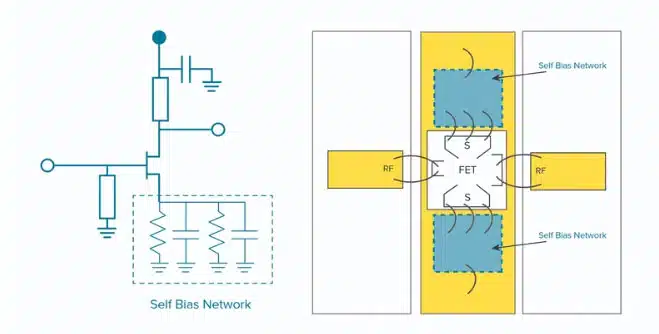
Figure 2. Custom application of a self-bias network, implemented in a hybrid assembly, with a self-bias network attached source connections of the MMIC.

Integrating Bias Filter Networks and Self-Bias Networks from Knowles Precision Devices

Knowles leverages specialized expertise with high-permittivity materials and thin-film processing o develop customized bias filter and self-bias networks that provide critical biasing, filtering and isolation functions in high-frequency microwave and RF applications. With a broad range of solutions, Knowles bias filter networks are designed to filter RF signals from bias and control lines from 10 MHz to 40 GHz.

With bias filter and self-bias networks from Knowles, engineers:

  • Simplify assembly by integrating multiple discreet components into one surface-mountable package
  • Reduce size, weight and power consumption
  • Effectively filter noise and optimize biasing
  • Maximize isolation when mounting directly on a ground plane

Related

Source: Knowles Precision Devices

Recent Posts

Bourns Introduces LTCC Band Pass Filters for 5G C‑Band RF Front‑End Designs

29.7.2026
50

Bourns Introduces LTCC GNSS L‑Band Diplexer for Compact RF Front Ends

24.7.2026
54

RF Filters and Passive Components Enabling the 7 Missile RF Subsystems

9.7.2026
130

Designing 800 V DC EMC Filters: Calculation, Simulation and Measurement

4.6.2026
423

Qi2 Wireless Charging: Inductors, Capacitors and EMC Filters

21.5.2026
211

TDK Releases Ultra‑small EMI Noise Suppression Filters

8.4.2026
84

Kyocera Offers Small SAW Filters for IoT RF Modules

23.2.2026
78

Transient Suppression Guide

22.5.2026
1.4k

Overvoltage and Transient Protection for DC/DC Power Modules

13.11.2025
555

Upcoming Events

Sep 10
11:00 - 12:00 CEST

Equipment models and model strategies for Space Missions

Sep 16
17:00 - 18:00 CEST

Designing a 5 kW, 800 V-to-50 V PSFB Converter for Next-Generation Data Centers

Sep 29
16:00 - 17:00 CEST

Cybersecurity 2026

View Calendar

Popular Posts

  • Buck Converter Design and Calculation

    0 shares
    Share 0 Tweet 0
  • LLC Resonant Converter Design and Calculation

    0 shares
    Share 0 Tweet 0
  • Boost Converter Design and Calculation

    0 shares
    Share 0 Tweet 0
  • Earthing Systems and IEC Classification Explained

    0 shares
    Share 0 Tweet 0
  • MLCC and Ceramic Capacitors

    0 shares
    Share 0 Tweet 0
  • Flyback Converter Design and Calculation

    0 shares
    Share 0 Tweet 0
  • Capacitor Charging and Discharging

    0 shares
    Share 0 Tweet 0
  • Audio Capacitors: Choosing Capacitors for Crossover Circuits

    0 shares
    Share 0 Tweet 0
  • Resistor Symbols

    0 shares
    Share 0 Tweet 0
  • Thermistors Basics, NTC and PTC Thermistors

    0 shares
    Share 0 Tweet 0

Newsletter Subscription


Passive Components Blog

© 2015–2026
All rights reserved

  • Home
  • Privacy Policy
  • EPCI Membership & Advertisement
  • About

No Result
View All Result
  • Home
  • Knowledge Blog
  • Dossiers
  • PCNS

© 2015–2026
All rights reserved