


Passive Components Blog
No Result
View All Result
  • Home
  • News
    • All
    • Aerospace & Defence
    • Antenna
    • Applications
    • Automotive
    • Capacitors
    • Circuit Protection Devices
    • electro-mechanical news
    • Filters
    • Fuses
    • Inductors
    • Industrial
    • Integrated Passives
    • inter-connect news
    • Market & Supply Chain
    • Market Insights
    • Medical
    • Modelling and Simulation
    • New Materials & Supply
    • New Technologies
    • Non-linear Passives
    • Optoelectronics and Isolation
    • Oscillators
    • Passive Sensors News
    • Resistors
    • RF & Microwave
    • Telecommunication
    • Weekly Digest
    Samsung Electro-Mechanics CL05Z106MS66PN automotive MLCC illustration with a rectangular ceramic body and metal end terminations

    Samsung Adds 0402 10 µF X7T MLCC for ADAS Power Rails

    Bourns PTVS03-450E-H power TVS diode in a surface-mount DFN package

    Bourns Releases 450 V Power TVS for DC Bus Clamping

    MLCC construction image

    Samsung Electro-Mechanics Patent Targets to Reduce Moisture and Cracks in High-Capacity MLCCs

    Samsung Electro-Mechanics MFC molded frame ceramic capacitor with epoxy encapsulation and external metal frame

    Samsung 100V Molded Frame MLCC Targets 48V AI Server PSUs

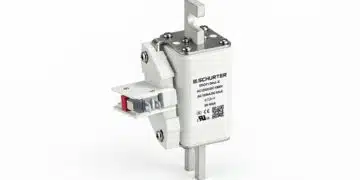
    SCHURTER EKO square-body DC fuse variants with ceramic bodies and different metal terminal arrangements

    SCHURTER EKO DC Fuses Extend to 1500 V and 2000 A

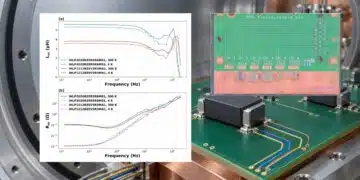
    illustration of packaged SMD power inductors on a four-wire cryogenic characterization board

    Cryogenic SMD Inductors at 4 K: Low DCR, Persistent AC Loss

    Wk 43 Electronics Supply Chain Digest

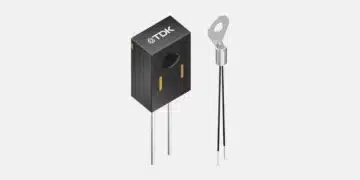
    TDK M704 and M705 NTC temperature sensors with a leaded plastic housing and metal-tag ring-lug assembly

    TDK M704 and M705 NTC Sensors for High-Voltage Power Systems

    Conceptual illustration for Modelithics COMPLETE 26.5 showing RF capacitors, inductors and resistors on a microwave PCB.

    Modelithics COMPLETE 26.5 Adds RF Passive Models for AWR

    Trending Tags

    • Ripple Current
    • RF
    • Leakage Current
    • Tantalum vs Ceramic
    • Snubber
    • Low ESR
    • Feedthrough
    • Derating
    • Dielectric Constant
    • New Products
    • Market Reports
  • Knowledge Blog
  • Dossiers
    • Aerospace and Defense Passive Components Dossier
    • AI Hardware Dossier
    • Automotive Dossier
    • Industrial Robotics Dossier
    • Power Converter Dossier
    • Capacitor Dossier
    • Circuit Protection Dossier
    • Inductor Dossier
    • Resistor Dossier
    • Silicon Capacitors and Integrated Passives Dossier
  • Suppliers
    • Who is Who
  • PCNS
    • PCNS 2025
    • PCNS 2023
    • PCNS 2021
    • PCNS 2019
    • PCNS 2017
  • Events
No Result
View All Result
Passive Components Blog
No Result
View All Result

What Are EMI Filters?

8.8.2023
Reading Time: 3 mins read
A A

This article based on Knowles Precision Devices blog explains what EMI is, why it needs to be filtered and how EMI filters are operating.

to understand what an electromagnetic interference (EMI) filter is, and what it does, we need to first know what EMI is and why it needs to be filtered.

RelatedPosts

Knowles A-Series RF Attenuators Target Compact 20 GHz Designs

Electrification Raises Demands on DC-Link Capacitors

Knowles Cornell Dubilier 105C Flatpack Aluminum Electrolytic Capacitors Target Low-Profile High-Density Power Designs

EMI refers to undesirable electromagnetic emissions or disturbances generated either by electronic devices or natural sources in the environment that can interfere with the proper functioning of other nearby devices or systems.

EMI noise can propagate through power supply lines and radiate into the environment, potentially causing disruptions or malfunctions in other electronic systems. For many devices, this could cause big issues, which is why many government organizations have developed regulatory standards for electromagnetic compatibility (EMC), or when two pieces of electronic equipment can function in the same environment without adversely impacting one another. 

Further read: Introduction to EMI Filtering

How are EMI Filters Used?

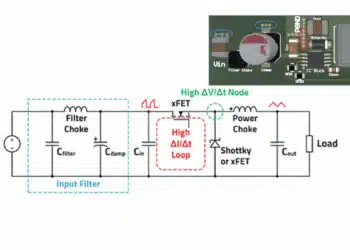
In power electronics, EMI filters are used to suppress and filter out unwanted high-frequency electromagnetic noise generated by the switching operations of power electronic circuits. For ceramic EMI filters specifically, the main function of these components is to provide a low-impedance path to the unwanted high-frequency noise while allowing the desired power signals to pass through with minimum impedance. The EMI filter acts as a low-pass filter, attenuating the high-frequency noise and preventing its propagation (featured image).

What Applications Need EMI Filters?

EMI filters help ensure reliable operation of power electronic systems by effectively reducing EMI noise and preventing interference with sensitive electronic components which minimizes the risk of malfunction or data corruption, and helps manufacturers meet electromagnetic compatibility standards. EMI filters are commonly used in applications such as power supplies, inverters, motor drives, LED lighting, and other electronic devices where EMI mitigation is critical. With proper EMI filtering, these devices can then be trusted for use in mission-critical applications where failure is not an option such as medical devices and aerospace and defense equipment.

Why are Ceramic Capacitors a Good Fit for EMI Filters?  

Ceramic materials possess excellent electrical and mechanical properties that make them suitable for EMI filter applications. Ceramic EMI filters are typically constructed using multilayer ceramic capacitors (MLCCs) or ceramic disc capacitors. These capacitors are designed to have high capacitance values and low equivalent series inductance (ESL) and equivalent series resistance (ESR) to minimize the impedance of the desired power signals. EMI filters made with ceramic are also designed to exhibit high impedance at high frequencies, effectively filtering out the EMI noise.

When ceramic capacitors are used for EMI filters, the filters are typically connected in parallel with the power supply lines or between the power supply and the electronic device being protected. The MLCC used as a filter can be integrated into the printed circuit board (PCB) design or implemented as discrete components. The number and configuration of the filters will depend on the specific EMI requirements and the complexity of the power electronics system.

Helping You Select the Ideal EMI Filtering Option  

When an electronic system needs a capacitor to serve a critical role, such as EMI filtering, it is best to consult with expert engineers that can work with you to properly specify the size and type of capacitor needed. As a specialty components manufacturer with unrivaled ceramics expertise, Knowles Precision Devices can help. We make a variety of high-reliability surface and panel mount filters, discoidal capacitors, and planar capacitor arrays that can be used for EMI filtering. Our core wet manufacturing process and ceramic handling expertise allows us to produce components with mechanical precision and electrical accuracy, enabling filter assemblies to function reliably and withstand the most rigorous of electrical specifications.

Related

Source: Knowles Precision Devices

Recent Posts

MLCC construction image

Samsung Electro-Mechanics Patent Targets to Reduce Moisture and Cracks in High-Capacity MLCCs

26.10.2026
27
Silicon capacitors and integrated passives dossier cover

Silicon Capacitors and Integrated Passives Dossier Report 10/26

8.10.2026
74
Würth Elektronik electronica 2026 presentation featuring electronic components, PCB technologies and high-current PowerBusbar connection solutions.

Würth Elektronik Previews Components, PCBs and Power Solutions at electronica 2026

30.9.2026
36
TLVR multiphase coupled inductors, auxiliary ballast inductor

TLVR Coupled Inductors: Fast Load-Step Response and Current-Dependent Ballast-Inductor Optimisation

24.9.2026
106
Frenetic planar ER transformer simulation for a 5 kW 800 V-to-50 V PSFB converter, showing low-profile core geometry and high-current planar winding arrangement

5 kW 800 V-to-50 V PSFB Transformer Design for Data Centers

18.9.2026
118

Current-Dependent Inductors: Using Non-Linear Inductance in Buck Converters and PFC Stages

24.8.2026
87

Current Sense Transformers: Ferrite vs Nanocrystalline Cores for Accurate Current Measurement

5.8.2026
207

Bourns Introduces LTCC Band Pass Filters for 5G C‑Band RF Front‑End Designs

29.7.2026
58

Bourns Introduces LTCC GNSS L‑Band Diplexer for Compact RF Front Ends

24.7.2026
62

Upcoming Events

Oct 28
13:00 - 14:00 CDT

Inductor Design in a Multi-Phase Buck Converter

Nov 24
16:00 - 17:00 CET

Select the Correct Components for Your DC/DC Converter

Dec 1
16:00 - 17:00 CET

Developing low-noise mixed-signal systems

View Calendar

Popular Posts

  • Buck Converter Design and Calculation

    0 shares
    Share 0 Tweet 0
  • Boost Converter Design and Calculation

    0 shares
    Share 0 Tweet 0
  • LLC Resonant Converter Design and Calculation

    0 shares
    Share 0 Tweet 0
  • September 2026 Interconnect, Passives and Electromechanical Components Market Insights

    0 shares
    Share 0 Tweet 0
  • Capacitor Charging and Discharging

    0 shares
    Share 0 Tweet 0
  • Flyback Converter Design and Calculation

    0 shares
    Share 0 Tweet 0
  • MLCC and Ceramic Capacitors

    0 shares
    Share 0 Tweet 0
  • RF Connector Types: How To Choose the Right One

    0 shares
    Share 0 Tweet 0
  • Passive Low Pass Filters: Fundamentals and EMI Design

    0 shares
    Share 0 Tweet 0
  • Audio Capacitors: Choosing Capacitors for Crossover Circuits

    0 shares
    Share 0 Tweet 0

Newsletter Subscription


Passive Components Blog

© 2015–2026
All rights reserved

  • Home
  • Privacy Policy
  • EPCI Membership & Advertisement
  • About

No Result
View All Result
  • Home
  • Knowledge Blog
  • Dossiers
  • PCNS

© 2015–2026
All rights reserved