



Passive Components Blog at passive-components.eu is the world’s leading blog, offering a specialized knowledge hub dedicated to passive components like capacitors, resistors, inductors, and related technologies. The blog provides in-depth coverage of market developments and global trends in the field of passive components.
This 2025 roundup compiles the most influential articles for engineers, product managers, and procurement teams who are monitoring the passive component markets, technologies, and applications in 2025.
How this list was selected
The articles below were chosen based on visitor view statistics to highlight their significance in shaping the passive components landscape for 2025. These include market outlooks, technology and innovation pieces, and valuable insights into design and sourcing. Content aligned with 2025 themes, such as AI hardware, electric vehicles and automotive, embedded and miniaturized passives, and global market developments with enduring value, was given priority.
Key themes in passive components 2025
- AI and passive components: AI servers and accelerators significantly increase MLCC and polymer capacitor demand, drive higher switching frequencies, and push innovations in ultra‑high‑capacitance MLCCs for power rails and modules.
- EV and automotive electrification: Electrified powertrains, ADAS and zonal architectures require advanced capacitors, precision resistors and robust inductors qualified to automotive standards, tightening links between EV passive components and materials innovation.
- Miniaturization and integrated passives: PCB‑embedded components, MLO RF filters, glass‑core interposers and compact MLCCs show how miniaturization and integration reduce footprint while improving signal integrity and thermal behavior.
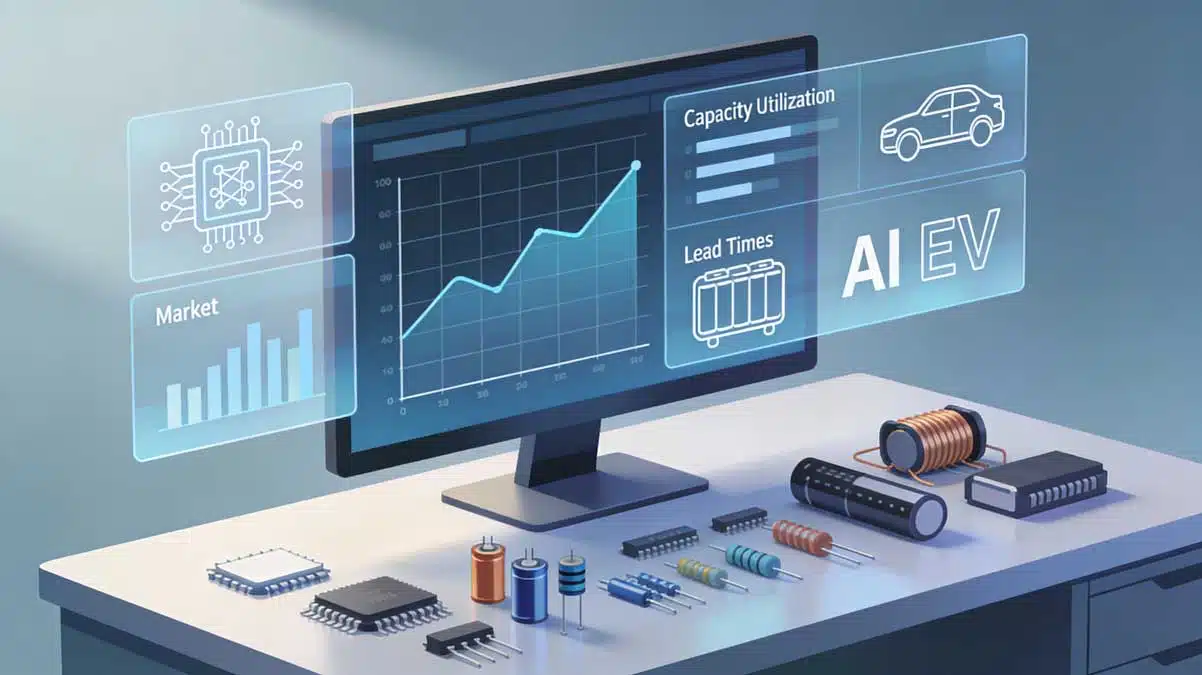
- Passive components market 2025 and distribution: Market data and monthly market‑insight series reveal a market normalizing after prior volatility, with AI momentum offsetting softer segments and highlighting the need for agile inventory and lead‑time management.
- Costs, geography and supply chain: Analyses of 2025 production costs show value concentrated in materials and know‑how, reinforcing that long‑term competitiveness in passive components depends on advanced materials, regional policy and resilient supply chains.
-
1. Buck Converter Design and Calculation
This remains the most popular article in our series, providing in-depth insights into the design and calculation of buck converters. Our knowledge blog features the “Power Converters Design” series, which offers valuable guidelines on the use of passive components in power converters. These guidelines are based on Würth Elektronik’s “DC/DC Converter Handbook.” The articles have been reviewed and updated in 2025. Read more.
Other articles in the converter design series are also highly regarded by electronic hardware designers:
- SEPIC Converter Design and Calculation
- Boost Converter Design and Calculation
- Flyback Converter Design and Calculation
2. How to Design an Inductor
Inductors are designed for specific applications, and the design process varies accordingly. When learning the basics of inductor design, you’ll need to select a core with a specific gap or distributed gap and a winding (choose the type of wire) to meet certain electrical specifications for inductance and current rating.
This article written by Dr. Chema Molina, Frenetic describes the practical process How to design an inductor that also serve as inductor selection guide. Each type of inductor is specific for a different application and the design procedure will be different. Read more.
3. Ripple Current and its Effects on the Performance of Capacitors
Capacitors play a crucial role in most analog and digital electronic circuits. However, one of their limitations is the power dissipated by a capacitor, which depends on the ripple current and the equivalent series resistance (ESR). Therefore, the ripple current capability is a key parameter to consider when selecting a capacitor for a specific application. For more information, read the article from our knowledge blog. Read more.
4. What is a Dielectric Constant of Plastic Materials?
This article provides an overview of typical ε (dielectric constant) values for various common organic dielectrics and includes an extensive list of 120 polar and non-polar plastic materials, detailing their minimum and maximum permittivity values. The article now includes the range of dissipation factor (DF) values and links to additional articles on flammability / UL94 considerations and coefficient of linear thermal expansion (CTE). Read more.
5. What Engineers Need to Know About Passive Low Pass Filters
Low pass EMI filters are important because they provide a low‑impedance return path for high‑frequency RF noise while letting the wanted DC or low‑frequency signals pass with minimal distortion, which is essential to meet EMC limits on cables and power lines. They also protect signal integrity and reduce radiated and conducted emissions by blocking common‑mode and differential‑mode noise, turning otherwise failing designs into compliant, reliable products.
The article explains how passive low‑pass filters made from resistors, capacitors, inductors, and ferrites are used in EMI/EMC design to pass desired low‑frequency signals while attenuating unwanted high‑frequency noise, including both differential and common mode components. It details key topologies (L, π, T), cutoff‑frequency selection, parasitic effects, and PCB layout and impedance‑matching practices that determine whether such filters actually solve EMI problems in real circuits. Read more.
The other articles about filters and its characterization:
- Basic Filter Circuits Explained
- Five Key Filter Specifications
- Filter Q Factor Explained
- Filter Bandwidth Explained
- Filter Poles and Zeros Explained
6. AI Hardware Development and Its Consequences for Passive Electronic Components
EPCI, the European Passive Component Institute, organized the 5th bi-annual PCNS Passive Components Networking Symposium in Seville, Spain, in September 2025. The conference’s main focus was on the implications of AI hardware development for passive components. Tomas Zednicek, the president of EPCI, delivered the keynote article, which was published on the Passive Components Blog afterwards and also presented at the Würth Elektronik Digital Days in October 2025. The WE Digital Day presentation is also available on the YouTube channel.
This article explains how rapidly evolving AI hardware, with its extreme power and thermal demands, is forcing a shift to higher-voltage architectures, advanced cooling, and sophisticated power management in data centers. It shows that this transformation requires a new generation of capacitors, inductors, resistors, and supercapacitors engineered for high currents, low parasitics, and robust thermal stability to keep AI systems efficient and reliable. Read more.
7. Passive Components for Next Gen Automotive Systems
This in‑depth technical article explores how electrification, wide‑bandgap semiconductors and advanced safety systems are reshaping requirements for automotive passive components. It matters because it provides a system‑level view of EV passive components across voltage domains, thermal environments and reliability standards.
- Details how hybrid, polymer aluminum and polymer tantalum capacitors, along with advanced film and MLCC devices, support high‑frequency, high‑power automotive converters.
- Explains the role of precision resistors, current‑sense devices, metal‑composite inductors and common‑mode chokes in EV powertrains, ADAS and EMI control.
- Discusses validation requirements (e.g., AEC‑Q200, ISO 16750, LV 123) and the need for predictable aging and self‑diagnostics in mission‑critical automotive passives.
8. Glass Core Technology Breakthrough for High‑Speed Interconnects
This technology article and YouTube video by Samtec present glass core technology (GCT) as a promising platform for high‑speed interconnects and system‑in‑package designs, with strong implications for embedded and integrated passives. It matters because it connects substrate engineering, signal integrity and potential integration of passives into glass to future high‑speed, high‑density systems.
- Describes GCT as a glass‑based substrate approach that improves dimensional control, via quality and high‑speed signal performance for dense interposers and packages.
- Explains that GCT can enhance miniaturization and integration, opening opportunities to incorporate passive functions into glass cores alongside high‑speed routing.
- Positions GCT as a foundational platform candidate for next‑generation AI, networking and advanced packaging architectures where passives and interconnects converge.
9. PFC Power Factor Correction Capacitors
Power factor correction (PFC) capacitors are employed to mitigate the reactive power drawn by inductive loads such as motors and transformers. This, in turn, enhances the power factor, minimizes losses, and ultimately reduces electricity costs in AC power systems. PFC capacitors achieve this by supplying a leading current that compensates for the lagging current of inductive loads. This compensation reduces the phase difference between voltage and current, thereby raising the power factor to the typically required range of 0.95–0.98, which is essential for utilities.
The 2025 Knowledge Blog article on PFC capacitors has been revised to provide a comprehensive overview of its function and features. Read more.
10. Guide to Snubber Capacitors
Capacitors used in snubber circuits are subjected to high dV/dt and extremely high values of peak and rms current. These circuits demand capacitors that can withstand current spikes with high peak and rms values. The types of capacitors that are widely used for snubber applications include film and ceramic capacitors. Whereas plastic film capacitors can be used for both high power and low power circuits, ceramic capacitors are mostly used for low power applications.
The article explains that snubber capacitors are dedicated capacitors connected to high‑current switching nodes to absorb energy from voltage spikes and ringing, thereby protecting devices like FETs and IGBTs, reducing EMI, and improving efficiency and reliability in power converters, motor drives, UPS, and similar circuits. It describes common snubber topologies such as RC and RCD circuits, noting that RC snubbers mainly suppress peak voltage and ringing in low‑ to medium‑power designs, while RCD snubbers add a diode to reduce losses and improve load lines in medium‑ to high‑current applications
The 2025 Knowledge Blog article has been reviewed and updated. Read more.