




Passive Components Blog
No Result
View All Result
  • Home
  • News
    • All
    • Aerospace & Defence
    • Antenna
    • Applications
    • Automotive
    • Capacitors
    • Circuit Protection Devices
    • electro-mechanical news
    • Filters
    • Fuses
    • Inductors
    • Industrial
    • Integrated Passives
    • inter-connect news
    • Market & Supply Chain
    • Market Insights
    • Medical
    • Modelling and Simulation
    • New Materials & Supply
    • New Technologies
    • Non-linear Passives
    • Optoelectronics and Isolation
    • Oscillators
    • Passive Sensors News
    • Resistors
    • RF & Microwave
    • Telecommunication
    • Weekly Digest

    Bourns Adds ACXX57SQ Air Coil Inductors for RF Design

    Samsung Electro-Mechanics MLCC capacitor solutions for high-voltage converter snubbing and GPU power delivery

    Samsung MLCC Options for 1 MW AI Rack Power

    Frenetic planar ER transformer simulation for a 5 kW 800 V-to-50 V PSFB converter, showing low-profile core geometry and high-current planar winding arrangement

    5 kW 800 V-to-50 V PSFB Transformer Design for Data Centers

    Samtec 100-CM 1.0 mm vertical solderless compression-mount 50 ohm RF PCB connector

    Samtec 100-CM 1.0 mm RF Connectors Extend to 120 GHz

    Exxelia PM film capacitor and passive-component technologies for BepiColombo space electronics

    Exxelia Passive Components Support BepiColombo Mission

    TT Electronics OPI1268T green through-hole phototransistor optocoupler used for optical isolation in power systems.

    Optocoupler Reliability: Designing Optical Isolation for 25-Year Grid Assets

    TDK B43657 and B43658 ultra-compact snap-in aluminum electrolytic capacitors for 500 V DC power-supply and DC-link applications

    TDK Extends Compact Snap-In Capacitors to 500 V for AI Servers

    Stackpole RNAN aluminium nitride thin-film chip resistors in 0603, 0805, 1206 and 2512 package sizes for precision high-power electronics

    Stackpole RNAN AlN Thin-Film Resistors Reach 6 W

    binder angled M12-A midmount panel-mount PCB connector for centric board mounting, showing compact front-facing industrial connector geometry

    binder Adds Midmount M12-A PCB Connectors for Slim Sensors

    Trending Tags

    • Ripple Current
    • RF
    • Leakage Current
    • Tantalum vs Ceramic
    • Snubber
    • Low ESR
    • Feedthrough
    • Derating
    • Dielectric Constant
    • New Products
    • Market Reports
  • Knowledge Blog
  • Dossiers
    • AI Hardware Dossier
    • Automotive Dossier
    • Industrial Robotics Dossier
    • Power Converter Dossier
    • Capacitor Dossier
    • Resistor Dossier
    • Inductor Dossier
    • Circuit Protection Dossier
  • Suppliers
    • Who is Who
  • PCNS
    • PCNS 2025
    • PCNS 2023
    • PCNS 2021
    • PCNS 2019
    • PCNS 2017
  • Events
  • Home
  • News
    • All
    • Aerospace & Defence
    • Antenna
    • Applications
    • Automotive
    • Capacitors
    • Circuit Protection Devices
    • electro-mechanical news
    • Filters
    • Fuses
    • Inductors
    • Industrial
    • Integrated Passives
    • inter-connect news
    • Market & Supply Chain
    • Market Insights
    • Medical
    • Modelling and Simulation
    • New Materials & Supply
    • New Technologies
    • Non-linear Passives
    • Optoelectronics and Isolation
    • Oscillators
    • Passive Sensors News
    • Resistors
    • RF & Microwave
    • Telecommunication
    • Weekly Digest

    Bourns Adds ACXX57SQ Air Coil Inductors for RF Design

    Samsung Electro-Mechanics MLCC capacitor solutions for high-voltage converter snubbing and GPU power delivery

    Samsung MLCC Options for 1 MW AI Rack Power

    Frenetic planar ER transformer simulation for a 5 kW 800 V-to-50 V PSFB converter, showing low-profile core geometry and high-current planar winding arrangement

    5 kW 800 V-to-50 V PSFB Transformer Design for Data Centers

    Samtec 100-CM 1.0 mm vertical solderless compression-mount 50 ohm RF PCB connector

    Samtec 100-CM 1.0 mm RF Connectors Extend to 120 GHz

    Exxelia PM film capacitor and passive-component technologies for BepiColombo space electronics

    Exxelia Passive Components Support BepiColombo Mission

    TT Electronics OPI1268T green through-hole phototransistor optocoupler used for optical isolation in power systems.

    Optocoupler Reliability: Designing Optical Isolation for 25-Year Grid Assets

    TDK B43657 and B43658 ultra-compact snap-in aluminum electrolytic capacitors for 500 V DC power-supply and DC-link applications

    TDK Extends Compact Snap-In Capacitors to 500 V for AI Servers

    Stackpole RNAN aluminium nitride thin-film chip resistors in 0603, 0805, 1206 and 2512 package sizes for precision high-power electronics

    Stackpole RNAN AlN Thin-Film Resistors Reach 6 W

    binder angled M12-A midmount panel-mount PCB connector for centric board mounting, showing compact front-facing industrial connector geometry

    binder Adds Midmount M12-A PCB Connectors for Slim Sensors

    Trending Tags

    • Ripple Current
    • RF
    • Leakage Current
    • Tantalum vs Ceramic
    • Snubber
    • Low ESR
    • Feedthrough
    • Derating
    • Dielectric Constant
    • New Products
    • Market Reports
  • Knowledge Blog
  • Dossiers
    • AI Hardware Dossier
    • Automotive Dossier
    • Industrial Robotics Dossier
    • Power Converter Dossier
    • Capacitor Dossier
    • Resistor Dossier
    • Inductor Dossier
    • Circuit Protection Dossier
  • Suppliers
    • Who is Who
  • PCNS
    • PCNS 2025
    • PCNS 2023
    • PCNS 2021
    • PCNS 2019
    • PCNS 2017
  • Events
No Result
View All Result
Passive Components Blog
No Result
View All Result

Benefits of Custom Cores

10.10.2023
Reading Time: 5 mins read
A A

In this blog article Pablo Blázquez, Frenetic Power Εlectronics Εngineer is explaining how custom magnetic components can actually give you a competitive advantage and why we should use custom cores.

One of the most important part of the magnetic component is the Core, so today we are going to analyze how and why we should use custom ones.

RelatedPosts

5 kW 800 V-to-50 V PSFB Transformer Design for Data Centers

Designing a USB Type‑C Flyback Planar Transformer with Frenetic’s Planar Tool

Designing a Custom Core Transformer for 10 kW LLC Data Center Power Stages

The first question you’re probably asking yourself is: why do we need custom cores? Well, there are a few reasons:

  • Meeting Specific Application Requirements: Off-the-shelf cores might not always deliver the needed performance or characteristics. Custom cores allow engineers to design Magnetics that match the application’s specific needs, including size, shape, material, and magnetic features.
  • Boosting Efficiency: Custom cores can be tuned for maximum efficiency. By carefully selecting the core material, shape, and winding configurations, engineers can minimize energy losses in the core and the windings. This helps improve the overall efficiency of magnetic devices.
  • Reducing Size: in some cases, size and weight matter a lot. Custom cores can be designed to take up the minimum space possible while still delivering the required magnetic properties. By optimizing the core shape and material, we can achieve miniaturization without compromising performance.
  • Unique Shapes and Configurations: custom cores offer the flexibility to create shapes and configurations that aren’t readily available off the shelf. This allows to design magnetic circuits that perfectly fit within the application’s space and mechanical constraints. Unconventional shapes and configurations can improve magnetic coupling, reduce leakage flux, and enhance the overall performance. Although, if you are looking for short lead times, this might not be the best solution…
  • Tailored for Specific Frequency Ranges: different applications operate at different frequency ranges. Off-the-shelf cores might not be optimized for a particular frequency, leading to performance limitations. Custom cores can be designed to operate optimally within the desired frequency range, ensuring efficient energy transfer and reducing losses.
  • Specialized Applications: some applications have unique requirements that standard cores can’t meet. Think of high-temperature environments, high-frequency power electronics, aerospace systems, and medical devices. Custom cores enable to address these specific needs and design magnetic circuits that can handle extreme conditions or meet all the industry standards.

In a nutshell, custom cores in magnetic design give us the power of tailored performance, improved efficiency, size reduction, unique configurations, frequency optimization, and specialized applications. They offer engineers greater control over magnetic properties, enabling the creation of optimized and high-performance magnetic devices.

But, how do I know what is my best option?

First of all, this question is tricky, as the answer will depend on loads of things, for example, what is the objective of your design, efficiency, size, cost, or all of them together…

We can address this situation in different ways, the first one being the use of our own experience. If you have been designing magnetics components for 30 years in the automotive industry, you will know for sure what shapes work better for you. The second approach involves the use of the Frenetic tool or our design and manufacturing services, that will make the job far easier.

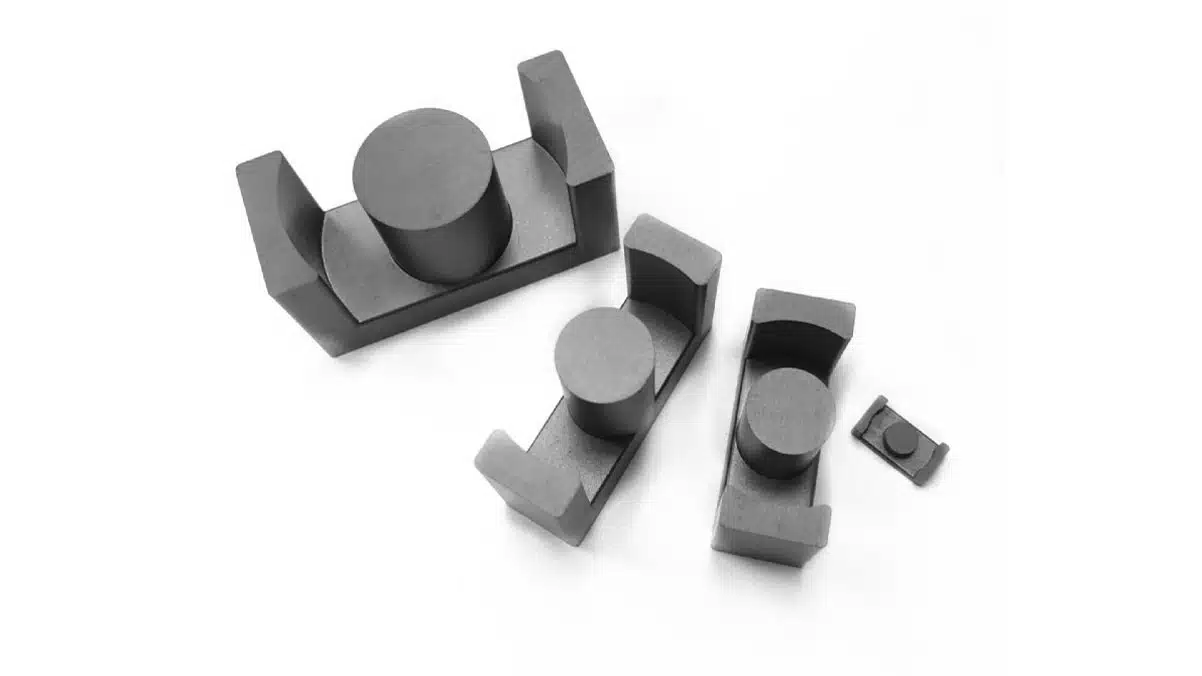
The choice of core shape for a custom core depends on the specific application and its requirements. Here are some common shapes used in magnetic design:

  • Toroidal Cores: they are great when we need compactness and high efficiency. Toroidal cores are commonly found in Transformers, Inductors, and Power Supplies.
  • E-Core: these cores resemble the letter “E” and consist of three parallel limbs with a central leg that connect them. They are often used in power Transformers and Inductors to improve magnetic coupling and reduce leakage flux.
  • U-Core: similar to E-cores, but they lack the central leg, forming a “U” shape instead. U-shaped cores are commonly used in magnetic switches and relays, providing a low-reluctance path for magnetic flux.
  • Pot Cores: these cores are cylindrical, with a centered winding window and a closed magnetic path. They’re commonly used in high-frequency applications like switching Power Supplies and RF Transformers. Pot cores help minimize magnetic flux leakage and offer good thermal dissipation.
  • ETD Cores: ETD cores have a rectangular or square shape with a centered winding window. They’re commonly used in power Transformers and Inductors for high-frequency applications, striking a balance between compactness and winding space.
  • Planar Cores: these are flat cores made of laminated sheets. They find application in planar Transformers, Inductors, and Power Supplies. Planar cores offer a low-profile design, efficient heat dissipation, and good high-frequency characteristics.
  • Custom Shapes: depending on specific requirements, custom shapes can be designed to optimize performance. These shapes can vary widely, including complex geometries tailored to the magnetic circuit and space constraints.

Remember, the choice of core shape also depends on factors like operating frequency, power levels, desired magnetic properties, size constraints, and thermal considerations. Engineers select the shape that best meets the application requirements while optimizing factors like magnetic coupling, efficiency, and space utilization.

Summary

In conclusion, custom magnetic components will give you a competitive advantage by increasing performance, improving efficiency, and optimizing size, frequency, and configurations.

Custom Magnetics, in combination with expert guidance, are essential to maximize the benefits as well as having more control over design, making them a great choice in various industries.
Related

Source: Frenetic

Recent Posts

Bourns Adds ACXX57SQ Air Coil Inductors for RF Design

18.9.2026
5
Frenetic planar ER transformer simulation for a 5 kW 800 V-to-50 V PSFB converter, showing low-profile core geometry and high-current planar winding arrangement

5 kW 800 V-to-50 V PSFB Transformer Design for Data Centers

18.9.2026
12
Exxelia PM film capacitor and passive-component technologies for BepiColombo space electronics

Exxelia Passive Components Support BepiColombo Mission

16.9.2026
23

On-Chip 3D-Printed Copper Microinductors: A New Route to Compact RF Electronics

10.9.2026
32
Murata DLW32SH_MF 1210 surface-mount common mode choke coil with metal terminals for automotive CAN FD signal-line noise suppression

Murata Introduces Common Mode Chokes for Automotive CAN FD up to 150°C

10.9.2026
33
onsemi solid-state transformer concept for 800 V HVDC AI data center power conversion with SiC modules, DC-link capacitors and high-frequency magnetics

Solid-State Transformers for 800 V AI Data Centers: Passive Component Design Considerations

9.9.2026
128

SCHURTER THT DIP Switches Support Hardware-Level Configuration

9.9.2026
4
Compact inductive rotary position encoder sensor near a motor shaft, representing the Vishay RAIK045I MP encoder category

Vishay Introduces 16-Bit Inductive Encoder for Motor-Adjacent Position Sensing

9.9.2026
25

Coilcraft Introduces Automotive Common Mode Chokes Target CISPR 25 Class 5 EMC Compliance

7.9.2026
30

Upcoming Events

Sep 29
16:00 - 17:00 CEST

Cybersecurity 2026

Sep 30
15:00 - 16:00 CEST

Positronic Space and Military Connectors

Oct 14
17:00 - 18:00 CEST

Live Demo! Discover KYOCERA AVX Antenna Integrator Studio (AIS)

View Calendar

Popular Posts

  • Buck Converter Design and Calculation

    0 shares
    Share 0 Tweet 0
  • LLC Resonant Converter Design and Calculation

    0 shares
    Share 0 Tweet 0
  • Boost Converter Design and Calculation

    0 shares
    Share 0 Tweet 0
  • Flyback Converter Design and Calculation

    0 shares
    Share 0 Tweet 0
  • Capacitor Charging and Discharging

    0 shares
    Share 0 Tweet 0
  • Resistor Symbols

    0 shares
    Share 0 Tweet 0
  • MLCC and Ceramic Capacitors

    0 shares
    Share 0 Tweet 0
  • Audio Capacitors: Choosing Capacitors for Crossover Circuits

    0 shares
    Share 0 Tweet 0
  • Ohm’s Law Answers Your Questions

    0 shares
    Share 0 Tweet 0
  • Thermistors Basics, NTC and PTC Thermistors

    0 shares
    Share 0 Tweet 0

Newsletter Subscription


Passive Components Blog

© 2015–2026
All rights reserved

  • Home
  • Privacy Policy
  • EPCI Membership & Advertisement
  • About

No Result
View All Result
  • Home
  • Knowledge Blog
  • Dossiers
  • PCNS

© 2015–2026
All rights reserved