










Passive Components Blog
No Result
View All Result
  • Home
  • NewsFilter
    • All
    • Aerospace & Defence
    • Antenna
    • Applications
    • Automotive
    • Capacitors
    • Circuit Protection Devices
    • electro-mechanical news
    • Filters
    • Fuses
    • Inductors
    • Industrial
    • Integrated Passives
    • inter-connect news
    • Market & Supply Chain
    • Market Insights
    • Medical
    • Modelling and Simulation
    • New Materials & Supply
    • New Technologies
    • Non-linear Passives
    • Oscillators
    • Passive Sensors News
    • Resistors
    • RF & Microwave
    • Telecommunication
    • Weekly Digest

    DMASS: European Components Distribution Returns To Growth In Q1 2026

    German Component Distribution Market Rebounds in Q1 2026 According to FBDi

    Nippon Chemi-Con Announces New Capacitor series for AI, Automotive and Immersion Cooling

    Ultrahigh Energy Storage in Lead‑Free BiFeO₃‑Based Ceramic Capacitors via Local Polar Structure Design

    Molex Expanded AirBorn SInergy Hybrid Connectors with 25 A Power Modules

    Murata Expands Ansys Simulation Models for RF inductors, MLCCs, and Power Inductors

    Sumida Introduces SMD Metal Inductors for High‑Current Automotive DC/DC Converters

    Hirose Releases 0.5 mm Floating Board-to-Board Connector for EV Powertrain Designs

    Imec Presents High-density MIMCAP RF interposer for III-V chiplets

    Trending Tags

    • Ripple Current
    • RF
    • Leakage Current
    • Tantalum vs Ceramic
    • Snubber
    • Low ESR
    • Feedthrough
    • Derating
    • Dielectric Constant
    • New Products
    • Market Reports
  • VideoFilter
    • All
    • Antenna videos
    • Capacitor videos
    • Circuit Protection Video
    • Filter videos
    • Fuse videos
    • Inductor videos
    • Inter-Connect Video
    • Non-linear passives videos
    • Oscillator videos
    • Passive sensors videos
    • Resistor videos

    Why Isolated DC/DC Power Supplies Fail Late, Würth Elektronik Podcast

    Designing 800 V DC EMC Filters: Calculation, Simulation and Measurement

    Current Sense Transformer Datasheet and Design‑in Guide

    Designing a USB Type‑C Flyback Planar Transformer with Frenetic’s Planar Tool

    Magnetics Design in High‑Frequency GaN Converters

    Qi2 Wireless Charging: Inductors, Capacitors and EMC Filters

    Two‑capacitor paradox explained for engineers

    Capacitances of Nonlinear MLCCs: What Datasheets Don’t Tell You

    Tapped Inductor Buck Converter Fundamentals

    Trending Tags

    • Capacitors explained
    • Inductors explained
    • Resistors explained
    • Filters explained
    • Application Video Guidelines
    • EMC
    • New Products
    • Ripple Current
    • Simulation
    • Tantalum vs Ceramic
  • Knowledge Blog
  • DossiersNew
  • Suppliers
    • Who is Who
  • PCNS
    • PCNS 2025
    • PCNS 2023
    • PCNS 2021
    • PCNS 2019
    • PCNS 2017
  • Events
  • Home
  • NewsFilter
    • All
    • Aerospace & Defence
    • Antenna
    • Applications
    • Automotive
    • Capacitors
    • Circuit Protection Devices
    • electro-mechanical news
    • Filters
    • Fuses
    • Inductors
    • Industrial
    • Integrated Passives
    • inter-connect news
    • Market & Supply Chain
    • Market Insights
    • Medical
    • Modelling and Simulation
    • New Materials & Supply
    • New Technologies
    • Non-linear Passives
    • Oscillators
    • Passive Sensors News
    • Resistors
    • RF & Microwave
    • Telecommunication
    • Weekly Digest

    DMASS: European Components Distribution Returns To Growth In Q1 2026

    German Component Distribution Market Rebounds in Q1 2026 According to FBDi

    Nippon Chemi-Con Announces New Capacitor series for AI, Automotive and Immersion Cooling

    Ultrahigh Energy Storage in Lead‑Free BiFeO₃‑Based Ceramic Capacitors via Local Polar Structure Design

    Molex Expanded AirBorn SInergy Hybrid Connectors with 25 A Power Modules

    Murata Expands Ansys Simulation Models for RF inductors, MLCCs, and Power Inductors

    Sumida Introduces SMD Metal Inductors for High‑Current Automotive DC/DC Converters

    Hirose Releases 0.5 mm Floating Board-to-Board Connector for EV Powertrain Designs

    Imec Presents High-density MIMCAP RF interposer for III-V chiplets

    Trending Tags

    • Ripple Current
    • RF
    • Leakage Current
    • Tantalum vs Ceramic
    • Snubber
    • Low ESR
    • Feedthrough
    • Derating
    • Dielectric Constant
    • New Products
    • Market Reports
  • VideoFilter
    • All
    • Antenna videos
    • Capacitor videos
    • Circuit Protection Video
    • Filter videos
    • Fuse videos
    • Inductor videos
    • Inter-Connect Video
    • Non-linear passives videos
    • Oscillator videos
    • Passive sensors videos
    • Resistor videos

    Why Isolated DC/DC Power Supplies Fail Late, Würth Elektronik Podcast

    Designing 800 V DC EMC Filters: Calculation, Simulation and Measurement

    Current Sense Transformer Datasheet and Design‑in Guide

    Designing a USB Type‑C Flyback Planar Transformer with Frenetic’s Planar Tool

    Magnetics Design in High‑Frequency GaN Converters

    Qi2 Wireless Charging: Inductors, Capacitors and EMC Filters

    Two‑capacitor paradox explained for engineers

    Capacitances of Nonlinear MLCCs: What Datasheets Don’t Tell You

    Tapped Inductor Buck Converter Fundamentals

    Trending Tags

    • Capacitors explained
    • Inductors explained
    • Resistors explained
    • Filters explained
    • Application Video Guidelines
    • EMC
    • New Products
    • Ripple Current
    • Simulation
    • Tantalum vs Ceramic
  • Knowledge Blog
  • DossiersNew
  • Suppliers
    • Who is Who
  • PCNS
    • PCNS 2025
    • PCNS 2023
    • PCNS 2021
    • PCNS 2019
    • PCNS 2017
  • Events
No Result
View All Result
Passive Components Blog
No Result
View All Result

Top 10 Articles on Passive-Components in 2024

31.12.2024
Reading Time: 7 mins read
A A

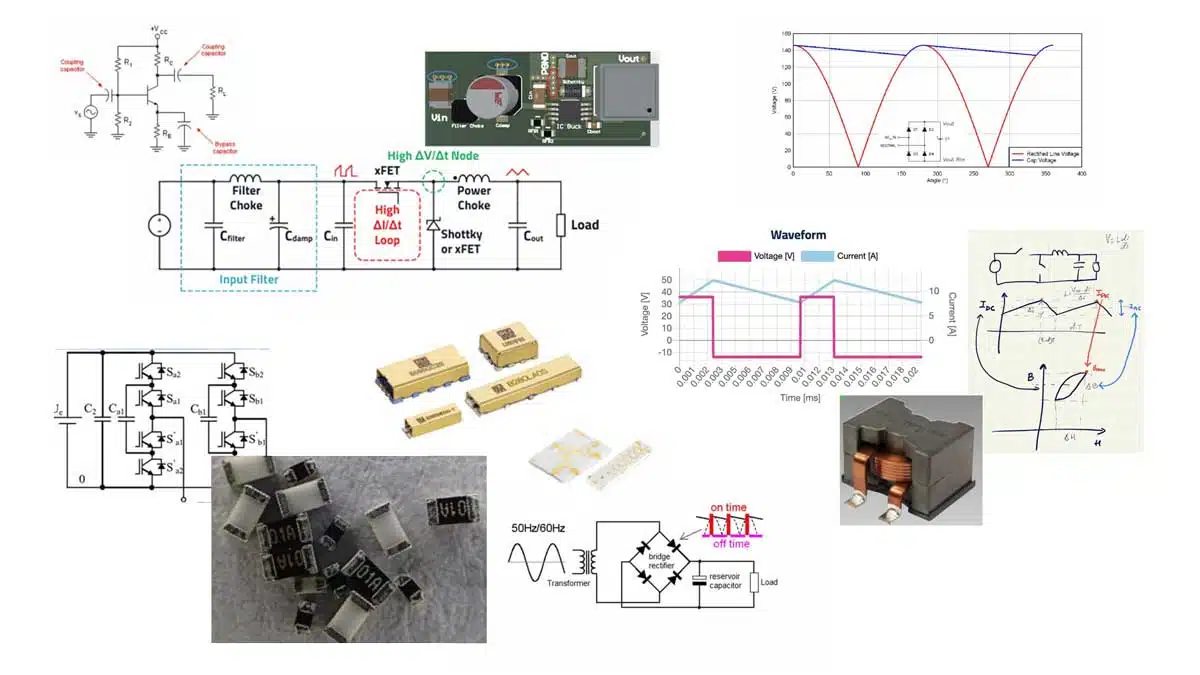
In 2024, the passive components blog maintained its commitment to supporting the passive components industry and engineers by sharing news, educational articles, and insights into the latest industry trends and challenges.

We hope you have found our insights valuable. We appreciate your visits to the passive-components.eu articles and newsletters. Thank you also to our long-term EPCI members and partners for their continued support.

RelatedPosts

DMASS: European Components Distribution Returns To Growth In Q1 2026

German Component Distribution Market Rebounds in Q1 2026 According to FBDi

Nippon Chemi-Con Announces New Capacitor series for AI, Automotive and Immersion Cooling

Here is a list of most read articles in 2024 on the passive-components.eu domain:

1. What is a Dielectric Constant of Plastic Materials?

This article, recognized as one of the top articles of 2023, discusses the dielectric constant of plastic materials, including how to calculate it and the factors that influence it. It provides an overview of typical ε (dielectric constant) values for various common organic dielectrics and includes an extensive list of 120 polar and non-polar plastic materials, detailing their minimum and maximum permittivity values. The article was updated in 2024 to include the range of dissipation factor (DF) values and links to additional articles on flammability / UL94 considerations and coefficient of linear thermal expansion (CTE). Read more.

2. Ripple Current and its Effects on the Performance of Capacitors

Capacitors are critical elements in most analog and digital electronic circuits. One of the limitation – the power dissipated by a capacitor is a function of ripple current and ESR equivalent series resistance. As such, the ripple current capability is one of the key parameters to consider when selecting a capacitor for a specific application. Learn more in this article. Read more.

3. Buck Converter Design and Calculation

With permission from Würth Elektronik, we used their “DC/DC Converter Handbook” to enhance our knowledge blog about passive components by including guidelines related to power converters, specifically focusing on the use of passive components. The most popular article in this series is the post on Buck Converter Design and Calculation. However, articles about other types of converters are also highly regarded by electronic hardware designers:

  • SEPIC Converter Design and Calculation
  • Boost Converter Design and Calculation
  • Flyback Converter Design and Calculation

4. How to Design an Inductor

This article written by Dr. Chema Molina, Frenetic describes the practical process How to design an inductor that also serve as inductor selection guide. Each type of inductor is specific for a different application and the design procedure will be different. Reading the basics of inductor design, you have to choose a core (with a specific gap or distributed gap), and a winding (selecting the type of wire) to comply with some electrical specifications of inductance and current rating. Read more.

5. Why Low ESR Matters in Capacitor Design

Learn about Energy Loss Mechanisms In Capacitors in this article. A practical capacitor is a non-ideal component. Its circuit model contains series inductance (ESL) and series resistance (ESR). Although equivalent series resistance is often shown in circuit models as a constant value, it varies depending on operating conditions. ESR is resistance from a combination of energy loss mechanisms under specific operating conditions. Lowest ESR capacitors on the other hand may not be always the best choice. Too low ESR of capacitors in certain applications such as feedback capacitors could eventually cause some issues with the operating amplifier oscillations out of operating conditions. LDO type circuits have been also very sensitive on capacitor ESR range and designers shall include shift of ESR with temperature as well. Read more.

6. Understanding High-Precision Resistor Temperature Coefficient of Resistance

Individual resistor manufacturers use different methods for defining TCR on their published datasheets. In most cases, this definition does not provide enough information to enable an end user to accurately predict the influence of temperature changes on the resistance value. Where such published TCR variances are of concern, of course, is in their potential to create measurement uncertainty. Particularly, in applications where high-precision resistor performance and temperature stability are absolute requirements. This uncertainty is created when there is insufficient confidence that a TCR specification has been calculated with enough data to allow for the accurate prediction of the true impact of temperature change on resistor performance. Read more.

7. Capacitor Selection for Coupling and Decoupling Applications

In circuits, capacitors are used for a wide range of applications including storing electrical charges, blocking DC components, bypassing AC components, filtering unwanted signals, and so on. The applications of a capacitor primarily depend on its characteristics. Key properties to consider when selecting a capacitor for a given application include capacitance value, voltage rating, frequency response characteristics, cost, and physical size. Other properties of a capacitor that can influence the performance of an electronic circuit include temperature characteristics, self-healing properties, aging, and flammability. Simon Ndiritu from General Dielectrics explains some basic capacitor selection guide for coupling and decoupling applications. Read more.

8. Flying Capacitors Explained

This article based on Knowles blog article explains flying capacitor circuit configuration features and benefits. The flying-capacitor size is significantly smaller than the required DC-link capacitor used in traditional booster topologies with the same power rating nevertheless there are some issues to be addressed with this topology. Read more.

9. Filter Poles and Zeros Explained

Knowles in 2024 published a series of articles explaining basic principles and operation of filters. The most read article of the series Filter Poles and Zeros Explained adopted by our knowledge blog goes in-depth on the background information of how poles and zeros impact a transfer function to show how this information can be used to improve filter’s performance. Read more. The other successful articles of the series:

  • Basic Filter Circuits Explained
  • Five Key Filter Specifications
  • Filter Q Factor Explained
  • Filter Bandwidth Explained

10. Guide to Snubber Capacitors

Capacitors used in snubber circuits are subjected to high dV/dt and extremely high values of peak and rms current. These circuits demand capacitors that can withstand current spikes with high peak and rms values. The types of capacitors that are widely used for snubber applications include film and ceramic capacitors. Whereas plastic film capacitors can be used for both high power and low power circuits, ceramic capacitors are mostly used for low power applications. Read more.
Related

Recent Posts

DMASS: European Components Distribution Returns To Growth In Q1 2026

16.6.2026
2

German Component Distribution Market Rebounds in Q1 2026 According to FBDi

16.6.2026
3

Nippon Chemi-Con Announces New Capacitor series for AI, Automotive and Immersion Cooling

16.6.2026
9

Ultrahigh Energy Storage in Lead‑Free BiFeO₃‑Based Ceramic Capacitors via Local Polar Structure Design

16.6.2026
10

Murata Expands Ansys Simulation Models for RF inductors, MLCCs, and Power Inductors

16.6.2026
7

Sumida Introduces SMD Metal Inductors for High‑Current Automotive DC/DC Converters

15.6.2026
13

Knowles Releases 3825 X1/Y2 Safety MLCCs for High‑Voltage Applications

11.6.2026
35

Knowles Expands High Q Ceramic Core Inductors

11.6.2026
31

TAIYO YUDEN Releases 220uF 1210 Automotive MLCC

11.6.2026
49

Upcoming Events

Jun 16
16:00 - 17:00 CEST

EMC with EMC – EMC‑compliant design with electromechanical connectors

Jul 14
16:00 - 17:00 CEST

EMC Design Essentials: Mastering Varistors and Common Mode Chokes

Jul 21
16:00 - 17:00 CEST

Safety by design: X and Y Interference suppression capacitors for power line filters

View Calendar

Popular Posts

  • Buck Converter Design and Calculation

    0 shares
    Share 0 Tweet 0
  • Boost Converter Design and Calculation

    0 shares
    Share 0 Tweet 0
  • LLC Resonant Converter Design and Calculation

    0 shares
    Share 0 Tweet 0
  • MLCC and Ceramic Capacitors

    0 shares
    Share 0 Tweet 0
  • Flyback Converter Design and Calculation

    0 shares
    Share 0 Tweet 0
  • Earthing Systems and IEC Classification Explained

    0 shares
    Share 0 Tweet 0
  • SEPIC Converter Design and Calculation

    0 shares
    Share 0 Tweet 0
  • Dual Active Bridge (DAB) Topology

    0 shares
    Share 0 Tweet 0
  • What Electronics Engineer Needs to Know About Passive Low Pass Filters

    0 shares
    Share 0 Tweet 0
  • MLCC Case Sizes Standards Explained

    0 shares
    Share 0 Tweet 0

Newsletter Subscription


Passive Components Blog

© EPCI - Leading Passive Components Educational and Information Site

  • Home
  • Privacy Policy
  • EPCI Membership & Advertisement
  • About

No Result
View All Result
  • Home
  • Knowledge Blog
  • Dossiers
  • PCNS

© EPCI - Leading Passive Components Educational and Information Site

This website uses cookies. By continuing to use this website you are giving consent to cookies being used. Visit our Privacy and Cookie Policy.
Go to mobile version