





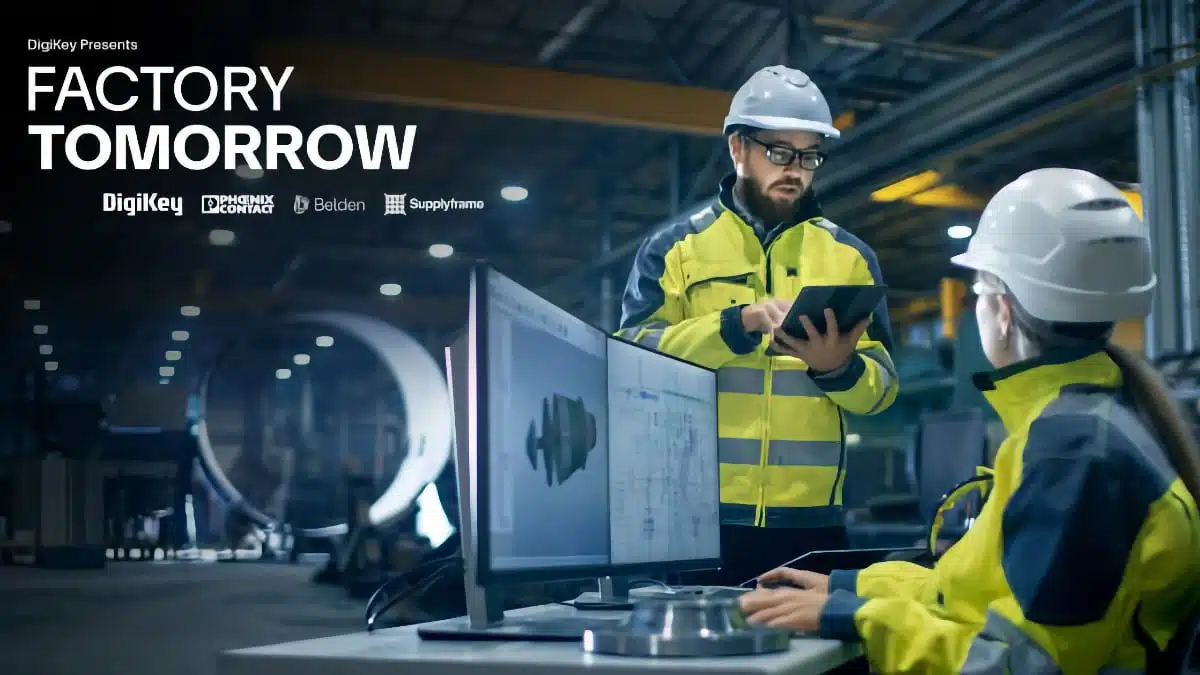
DigiKey has launched the sixth season of its Factory Tomorrow video series, focusing on the infrastructure required to support increasingly connected, automated and AI-enabled industrial environments.
The three-part season features perspectives from DigiKey, Phoenix Contact and Belden on industrial networking, AI data-center connectivity, optical infrastructure and smart manufacturing.
From AI data centers to factory-floor intelligence
The new season positions industrial digitalisation as an end-to-end infrastructure challenge. AI workloads may be processed in hyperscale, on-premises or edge data centers, but their value in production depends on reliable links between computing resources, factory networks, control systems, sensors and automation equipment.
The series examines how manufacturers can build the connectivity foundation for real-time data collection, secure transport, analysis and action. This includes the copper, fibre and optical links needed to move data through increasingly software-defined industrial environments, as well as the network architecture needed to maintain availability as systems scale.
For electronics designers, the trend extends well beyond communication hardware. Higher data throughput, distributed intelligence and denser automation nodes affect power-delivery design, EMC performance, thermal budgets and the choice of passive components throughout industrial equipment. The Industrial Robotics Dossier outlines how these system-level shifts are changing requirements for capacitors, magnetics, filters, current-sense components and protection devices.
Season 6 Highlights
- AI-ready data centers supporting industrial operations
- Industrial networking for connected factories
- Copper, fiber and optical connectivity infrastructure
- Real-time visibility and operational intelligence
- Smart manufacturing and Industry 4.0 applications
- Expert perspectives from DigiKey, Phoenix Contact and Belden
In the first video, Phoenix Contact highlights how its connectivity and industrial networking solutions support both AI-ready data centers and smart factory environments.
“Today’s digital factories need to collect, secure, transport, analyze and act on data,” said Greg Jerrehian, vice president of channel management at Phoenix Contact USA. “As a manufacturer, Phoenix Contact understands these challenges firsthand. We’re excited to share our expertise in networking, automation and connectivity to help the industry improve efficiency and optimize operations. Through our partnership with DigiKey, we’re accelerating access to new technologies and helping customers achieve success faster.”
The second video focuses on how Belden’s customized and scalable networking solutions spanning advanced copper and fiber, multi-lane optics and high-density optical frames enable data centers to adapt to rapidly changing technology demands.
“It was a pleasure to work with DigiKey to discuss how AI is changing the landscape of factories of all kinds and how data centers are enabling that change, regardless of whether they are on-prem, using hyperscale data centers, cloud services, or somewhere in between,” said Brian Kennedy, global vertical leader – data centers, for Belden.
In the final video, experts look ahead to the future of smart manufacturing where AI, autonomous systems and sustainable industrial design converge. This episode brings together connectivity, data and intelligence into a cohesive vision for the factory of tomorrow, examining how manufacturers can build flexible, energy-efficient and resilient systems capable of evolving alongside emerging technologies.
To learn more about the video series and how DigiKey is supporting the development of AI-ready infrastructure, connectivity and more, visit DigiKey’s Factory Tomorrow webpage.
Phoenix Contact addresses connected industrial infrastructure
In the first episode, Phoenix Contact discusses connectivity and industrial networking for both AI-ready data centers and smart-factory installations. The core message is that modern production systems must be able to collect, protect, transport, analyse and act on operational data with low latency and high reliability.
This requirement places growing emphasis on robust industrial Ethernet infrastructure, secure network segmentation, reliable field connectivity and power architectures that support controllers, remote I/O, sensors, drives and edge-computing systems. In practical installations, the continued move toward decentralised automation also raises the value of hybrid interconnect approaches that combine power and communications while reducing cabling complexity.
One example is Binder B23 hybrid connectivity for One Cable Automation, which combines power contacts with shielded Ethernet or EtherCAT data pairs in one circular interface. Such architectures can simplify distributed machine wiring while supporting deterministic industrial communication.
Belden focuses on scalable data connectivity
The second Factory Tomorrow episode focuses on Belden’s networking approach for data centers facing rapid changes in computing density and bandwidth requirements. The discussion covers advanced copper and fibre connectivity, multi-lane optics and high-density optical frames.
As AI applications increase both average rack power and transient workload demand, data-center infrastructure must evolve in parallel across power, cooling and networking. Optical interconnects and dense fibre systems are central to scaling bandwidth, while copper remains important for shorter-reach links, power delivery and equipment interconnection.
The power side of this evolution is equally significant. AI infrastructure is moving toward higher-voltage distribution concepts to manage high rack-level power demand and reduce current-related losses. The article C0G High-Voltage MLCC for 800V AI Servers PDN discusses the role of high-voltage ceramic capacitors in emerging AI-server power-delivery architectures, including the progression toward 800 V DC distribution.
Why connectivity affects passive-component selection
Although Factory Tomorrow Season 6 is principally focused on connectivity and industrial infrastructure, the technologies discussed have direct implications for component selection and system reliability.
Industrial systems combining high-speed networking, power conversion and automation must control conducted and radiated interference across multiple interfaces. Network ports, switch-mode power supplies, servo drives, distributed I/O and communication gateways all create potential EMC interactions. Designers therefore need to consider the complete passive-component chain, including common-mode chokes, EMI filters, decoupling capacitors, DC-link capacitors, inductors and transient-protection devices.
For equipment operating close to motors, converters and high-speed communication lines, EMC design is not simply a compliance exercise. It influences communication resilience, signal integrity, machine uptime and the ability to add more networked equipment without creating interference problems. The growing integration of power and data in distributed automation is one reason why industrial architecture, cabling, grounding and filtering should be evaluated together rather than as isolated subsystem decisions.
A broader view of smart manufacturing
The final episode looks ahead to smart manufacturing systems where AI, autonomous operations and sustainable industrial design increasingly converge. The stated objective is a more flexible, energy-efficient and resilient industrial environment that can evolve alongside new automation and computing technologies.
For manufacturers, the immediate takeaway is that AI adoption is not limited to deploying algorithms or adding computing capacity. Successful implementation requires investment in the supporting layers: reliable physical connectivity, scalable industrial networks, data infrastructure, power quality, EMC robustness and maintainable system architecture.
DigiKey’s Factory Tomorrow Season 6 is therefore relevant not only to automation specialists, but also to engineers responsible for industrial power electronics, networked equipment, cabinets, drives, edge devices and component qualification. As factory systems become more interconnected, the boundaries between data-center design, industrial networking and machine-level electronics will continue to narrow.
Further reading
- Industrial Robotics Dossier
- Passive Components for Industrial Automation and Robotics Dossier
- C0G High-Voltage MLCC for 800V AI Servers PDN
- In the Age of AI, Every Watt Counts: Implications for Components
Source
This article is based on the DigiKey press release announcing Factory Tomorrow Season 6, including the company’s overview of the three-part video series and contributions from Phoenix Contact and Belden.