


Passive Components Blog
No Result
View All Result
  • Home
  • NewsFilter
    • All
    • Aerospace & Defence
    • Antenna
    • Applications
    • Automotive
    • Capacitors
    • Circuit Protection Devices
    • electro-mechanical news
    • Filters
    • Fuses
    • Inductors
    • Industrial
    • Integrated Passives
    • inter-connect news
    • Market & Supply Chain
    • Market Insights
    • Medical
    • Modelling and Simulation
    • New Materials & Supply
    • New Technologies
    • Non-linear Passives
    • Oscillators
    • Passive Sensors News
    • Resistors
    • RF & Microwave
    • Telecommunication
    • Weekly Digest

    ECIA Industry Pulse April 2026: Sentiment Cools but Stays Strong

    Industrial Passive Components Markets and Technologies 2026

    Automotive Passive Components Technology Dossier

    Samsung Electro-Mechanics Signs 1.5T KRW Silicon Capacitor AI Contract

    Murata Expands Thermistor Production Capacity at Yokaichi Plant

    Hirose Expands Compact High‑Voltage EV connectors

    Qi2 Wireless Charging: Inductors, Capacitors and EMC Filters

    Samsung Introduced Low ESL 3-Terminal Reverse-Geometry MLCCs for High-Performance ADAS

    Würth Elektronik Presents New Bidirectional Digital Isolators

    Trending Tags

    • Ripple Current
    • RF
    • Leakage Current
    • Tantalum vs Ceramic
    • Snubber
    • Low ESR
    • Feedthrough
    • Derating
    • Dielectric Constant
    • New Products
    • Market Reports
  • VideoFilter
    • All
    • Antenna videos
    • Capacitor videos
    • Circuit Protection Video
    • Filter videos
    • Fuse videos
    • Inductor videos
    • Inter-Connect Video
    • Non-linear passives videos
    • Oscillator videos
    • Passive sensors videos
    • Resistor videos

    Qi2 Wireless Charging: Inductors, Capacitors and EMC Filters

    Two‑capacitor paradox explained for engineers

    Capacitances of Nonlinear MLCCs: What Datasheets Don’t Tell You

    Tapped Inductor Buck Converter Fundamentals

    Planar vs Conventional Transformer: When it Make Sense

    Modeling Fringing Field Losses in Inductors & Transformers

    Why Power Inductors Use a Ferrite Core With an Air Gap

    Transformer-Based Power-Line Harvester Magnetic Design

    Thermal Modeling of Magnetics

    Trending Tags

    • Capacitors explained
    • Inductors explained
    • Resistors explained
    • Filters explained
    • Application Video Guidelines
    • EMC
    • New Products
    • Ripple Current
    • Simulation
    • Tantalum vs Ceramic
  • Knowledge Blog
  • DossiersNew
  • Suppliers
    • Who is Who
  • PCNS
    • PCNS 2025
    • PCNS 2023
    • PCNS 2021
    • PCNS 2019
    • PCNS 2017
  • Events
  • Home
  • NewsFilter
    • All
    • Aerospace & Defence
    • Antenna
    • Applications
    • Automotive
    • Capacitors
    • Circuit Protection Devices
    • electro-mechanical news
    • Filters
    • Fuses
    • Inductors
    • Industrial
    • Integrated Passives
    • inter-connect news
    • Market & Supply Chain
    • Market Insights
    • Medical
    • Modelling and Simulation
    • New Materials & Supply
    • New Technologies
    • Non-linear Passives
    • Oscillators
    • Passive Sensors News
    • Resistors
    • RF & Microwave
    • Telecommunication
    • Weekly Digest

    ECIA Industry Pulse April 2026: Sentiment Cools but Stays Strong

    Industrial Passive Components Markets and Technologies 2026

    Automotive Passive Components Technology Dossier

    Samsung Electro-Mechanics Signs 1.5T KRW Silicon Capacitor AI Contract

    Murata Expands Thermistor Production Capacity at Yokaichi Plant

    Hirose Expands Compact High‑Voltage EV connectors

    Qi2 Wireless Charging: Inductors, Capacitors and EMC Filters

    Samsung Introduced Low ESL 3-Terminal Reverse-Geometry MLCCs for High-Performance ADAS

    Würth Elektronik Presents New Bidirectional Digital Isolators

    Trending Tags

    • Ripple Current
    • RF
    • Leakage Current
    • Tantalum vs Ceramic
    • Snubber
    • Low ESR
    • Feedthrough
    • Derating
    • Dielectric Constant
    • New Products
    • Market Reports
  • VideoFilter
    • All
    • Antenna videos
    • Capacitor videos
    • Circuit Protection Video
    • Filter videos
    • Fuse videos
    • Inductor videos
    • Inter-Connect Video
    • Non-linear passives videos
    • Oscillator videos
    • Passive sensors videos
    • Resistor videos

    Qi2 Wireless Charging: Inductors, Capacitors and EMC Filters

    Two‑capacitor paradox explained for engineers

    Capacitances of Nonlinear MLCCs: What Datasheets Don’t Tell You

    Tapped Inductor Buck Converter Fundamentals

    Planar vs Conventional Transformer: When it Make Sense

    Modeling Fringing Field Losses in Inductors & Transformers

    Why Power Inductors Use a Ferrite Core With an Air Gap

    Transformer-Based Power-Line Harvester Magnetic Design

    Thermal Modeling of Magnetics

    Trending Tags

    • Capacitors explained
    • Inductors explained
    • Resistors explained
    • Filters explained
    • Application Video Guidelines
    • EMC
    • New Products
    • Ripple Current
    • Simulation
    • Tantalum vs Ceramic
  • Knowledge Blog
  • DossiersNew
  • Suppliers
    • Who is Who
  • PCNS
    • PCNS 2025
    • PCNS 2023
    • PCNS 2021
    • PCNS 2019
    • PCNS 2017
  • Events
No Result
View All Result
Passive Components Blog
No Result
View All Result

Vishay Releases New Generation of Automotive EMI Shielded Inductor

5.6.2024
Reading Time: 3 mins read
A A

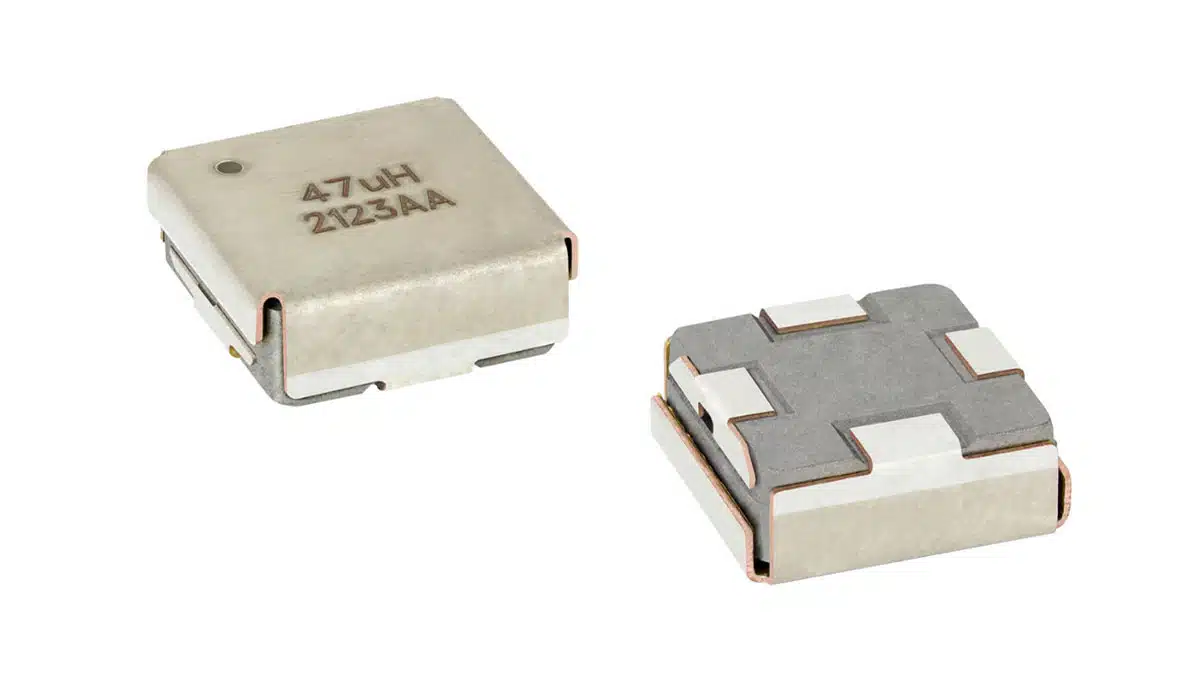
Vishay Intertechnology releases second-generation automotive grade IHLE® inductor with integrated EMI shield in 4040 case size.

Vishay Intertechnology, Inc. (NYSE: VSH) expanded its IHLE® series of low profile, high current power inductors featuring integrated E-field shields with a new second-generation Automotive Grade device in the 10 mm by 10 mm 4040 case size.

RelatedPosts

SPICE Simulation of Non-Linear Resistors: Vishay’s Thermistor and PPTC Modelling Ecosystem

Vishay Extends Power Inductors for DC/DC with 1212 Compact Case

Vishay Releases 2-Way Wilkinson Divider / Combiner for 15–20 GHz RF Front Ends

Offering an improved shield design over previous-generation solutions, and polarity marked for more consistent EMI performance, the Vishay Dale IHLE-4040DDEW-5A lowers costs and saves board space by potentially eliminating the need for separate board-level Faraday shielding.

Compared to traditional composite inductors, the device released today contains the electric and magnetic fields associated with EMI in a tin-plated copper integrated shield. When the shield is connected to ground, the IHLE-4040DDEW-5A provides up to 20 dB reduction in radiated noise interference, and a further 6 dB reduction in magnetic flux leakage to minimize crosstalk to nearby board components. The inductor features continuous high temperature operation to +155 °C and improved operating and isolation voltage ratings of 75 V and 100 V, respectively.

The IHLE-4040DDEW-5A power inductor is optimized for energy storage in switch mode power supplies and provides excellent noise attenuation when used as a DC power line choke. AEC-Q200 qualified, the device is designed for filtering and DC/DC conversion in entertainment / navigation systems; LED drivers; and noise suppression for motors, automotive domain control units (DCU), and other noise-sensitive applications.

Packaged in a 100 % lead (Pb)-free, magnetically shielded, iron alloy encapsulant, the IHLE-4040DDEW-5A offers high resistance to thermal shock, moisture, and mechanical shock from the additional mounting support provided by its two shield terminals. The inductor is RoHS-compliant, halogen-free, and Vishay Green.

Samples and production quantities of the IHLE-4040DDEW-5A are available now, with lead times of 16 weeks.

 Low EndHigh End
Inductance @ 100 kHz (μH)0.4768
DCR typ. @ 25 °C (mΩ)1.55240
DCR max. @ 25 °C (mΩ)1.66252
Heat rating current typ. (A)(1)322.6
Saturation current typ. (A)(2)283.5
Saturation current typ. (A)(3)40.14.9
SRF typ. (MHz)32.03.5
Case size40404040
Part numberIHLE4040DDEWR47M5AIHLE4040DDEW680M5A
Device Specification
  • (¹) DC current (A) that will cause an approximate ΔT of 40 °C
  • (²) DC current (A) that will cause L0 to drop approximately 20 %
  • (3) DC current (A) that will cause L0 to drop approximately 30 %
Related

Source: Vishay

Recent Posts

Industrial Passive Components Markets and Technologies 2026

21.5.2026
14

Automotive Passive Components Technology Dossier

21.5.2026
18

Hirose Expands Compact High‑Voltage EV connectors

21.5.2026
7

Qi2 Wireless Charging: Inductors, Capacitors and EMC Filters

21.5.2026
17

Samsung Introduced Low ESL 3-Terminal Reverse-Geometry MLCCs for High-Performance ADAS

20.5.2026
28

Würth Elektronik Presents New Bidirectional Digital Isolators

20.5.2026
19

Using Stress–Strain Curves to Diagnose Tantalum Powders for Capacitors

20.5.2026
24

Coilcraft Introduces SMT Current Sense Transformers for High‑Performance Power Electronics

20.5.2026
22

Nichicon Extends Rechargeable Batteries Temperature to Rival Supercapacitors

19.5.2026
26

Upcoming Events

Jun 2
16:00 - 17:00 CEST

Calculation, Simulation and Measurement of 800V EMC Filters

Jun 16
16:00 - 17:00 CEST

EMC with EMC – EMC‑compliant design with electromechanical connectors

View Calendar

Popular Posts

  • Buck Converter Design and Calculation

    0 shares
    Share 0 Tweet 0
  • Boost Converter Design and Calculation

    0 shares
    Share 0 Tweet 0
  • Flyback Converter Design and Calculation

    0 shares
    Share 0 Tweet 0
  • LLC Resonant Converter Design and Calculation

    0 shares
    Share 0 Tweet 0
  • MLCC and Ceramic Capacitors

    0 shares
    Share 0 Tweet 0
  • Capacitor Charging and Discharging

    0 shares
    Share 0 Tweet 0
  • What Electronics Engineer Needs to Know About Passive Low Pass Filters

    0 shares
    Share 0 Tweet 0
  • Dual Active Bridge (DAB) Topology

    0 shares
    Share 0 Tweet 0
  • Ripple Current and its Effects on the Performance of Capacitors

    3 shares
    Share 3 Tweet 0
  • Samsung Electro-Mechanics Releases High-Capacitance MLCCs for AI Server Applications

    0 shares
    Share 0 Tweet 0

Newsletter Subscription


Passive Components Blog

© EPCI - Leading Passive Components Educational and Information Site

  • Home
  • Privacy Policy
  • EPCI Membership & Advertisement
  • About

No Result
View All Result
  • Home
  • Knowledge Blog
  • Dossiers
  • PCNS

© EPCI - Leading Passive Components Educational and Information Site

This website uses cookies. By continuing to use this website you are giving consent to cookies being used. Visit our Privacy and Cookie Policy.
Go to mobile version