




Passive Components Blog
No Result
View All Result
  • Home
  • NewsFilter
    • All
    • Aerospace & Defence
    • Antenna
    • Applications
    • Automotive
    • Capacitors
    • Circuit Protection Devices
    • electro-mechanical news
    • Filters
    • Fuses
    • Inductors
    • Industrial
    • Integrated Passives
    • inter-connect news
    • Market & Supply Chain
    • Market Insights
    • Medical
    • Modelling and Simulation
    • New Materials & Supply
    • New Technologies
    • Non-linear Passives
    • Oscillators
    • Passive Sensors News
    • Resistors
    • RF & Microwave
    • Telecommunication
    • Weekly Digest

    Wk 28 Electronics Supply Chain Digest

    Bourns Introduces Automotive BMS Signal Transformer with Integrated Common Mode Chokes

    Itelcond Introduces High‑Voltage Aluminium Capacitors for Modern IGBT DC‑links

    Bourns Introduces Automotive Shielded Power Inductors for Compact DC‑DC Converters

    EMC Design Fundamentals: Safe Use of Varistors and Common Mode Chokes in Mains and Data-Line Filters

    Murata Unveils Lead Disc Ceramic Capacitors for Automotive Safety and EMI Suppression

    SCHURTER Releases Intelligent Three‑Terminal Fuses for Safer Li‑ion Battery Systems

    Can Copper Conductive Inks Displace Silver in Hybrid Electronics?

    Square-Wave Harmonics and RMS Currents in Power Converters

    Trending Tags

    • Ripple Current
    • RF
    • Leakage Current
    • Tantalum vs Ceramic
    • Snubber
    • Low ESR
    • Feedthrough
    • Derating
    • Dielectric Constant
    • New Products
    • Market Reports
  • VideoFilter
    • All
    • Antenna videos
    • Capacitor videos
    • Circuit Protection Video
    • Filter videos
    • Fuse videos
    • Inductor videos
    • Inter-Connect Video
    • Non-linear passives videos
    • Oscillator videos
    • Passive sensors videos
    • Resistor videos

    EMC Design Fundamentals: Safe Use of Varistors and Common Mode Chokes in Mains and Data-Line Filters

    Ferrite versus Nanocrystalline Power Inductor Cores: Turns, Gap and Size

    KYOCERA AVX Presents Antenna Integrator Studio Tutorial for Antenna Placement and RF Design

    Power Design Simulation Tools for Faster Inductor Selection and Loss Optimization

    EMC‑Compliant PCB and Connector Design Guidelines

    Why Isolated DC/DC Power Supplies Fail Late, Würth Elektronik Podcast

    Designing 800 V DC EMC Filters: Calculation, Simulation and Measurement

    Current Sense Transformer Datasheet and Design‑in Guide

    Designing a USB Type‑C Flyback Planar Transformer with Frenetic’s Planar Tool

    Trending Tags

    • Capacitors explained
    • Inductors explained
    • Resistors explained
    • Filters explained
    • Application Video Guidelines
    • EMC
    • New Products
    • Ripple Current
    • Simulation
    • Tantalum vs Ceramic
  • Knowledge Blog
  • Dossiers
    • AI Hardware Dossier
    • Power Converter Dossier
    • Automotive Dossier
    • Capacitor Dossier
    • Resistor Dossier
    • Inductor Dossier
    • Circuit Protection Dossier
  • Suppliers
    • Who is Who
  • PCNS
    • PCNS 2025
    • PCNS 2023
    • PCNS 2021
    • PCNS 2019
    • PCNS 2017
  • Events
  • Home
  • NewsFilter
    • All
    • Aerospace & Defence
    • Antenna
    • Applications
    • Automotive
    • Capacitors
    • Circuit Protection Devices
    • electro-mechanical news
    • Filters
    • Fuses
    • Inductors
    • Industrial
    • Integrated Passives
    • inter-connect news
    • Market & Supply Chain
    • Market Insights
    • Medical
    • Modelling and Simulation
    • New Materials & Supply
    • New Technologies
    • Non-linear Passives
    • Oscillators
    • Passive Sensors News
    • Resistors
    • RF & Microwave
    • Telecommunication
    • Weekly Digest

    Wk 28 Electronics Supply Chain Digest

    Bourns Introduces Automotive BMS Signal Transformer with Integrated Common Mode Chokes

    Itelcond Introduces High‑Voltage Aluminium Capacitors for Modern IGBT DC‑links

    Bourns Introduces Automotive Shielded Power Inductors for Compact DC‑DC Converters

    EMC Design Fundamentals: Safe Use of Varistors and Common Mode Chokes in Mains and Data-Line Filters

    Murata Unveils Lead Disc Ceramic Capacitors for Automotive Safety and EMI Suppression

    SCHURTER Releases Intelligent Three‑Terminal Fuses for Safer Li‑ion Battery Systems

    Can Copper Conductive Inks Displace Silver in Hybrid Electronics?

    Square-Wave Harmonics and RMS Currents in Power Converters

    Trending Tags

    • Ripple Current
    • RF
    • Leakage Current
    • Tantalum vs Ceramic
    • Snubber
    • Low ESR
    • Feedthrough
    • Derating
    • Dielectric Constant
    • New Products
    • Market Reports
  • VideoFilter
    • All
    • Antenna videos
    • Capacitor videos
    • Circuit Protection Video
    • Filter videos
    • Fuse videos
    • Inductor videos
    • Inter-Connect Video
    • Non-linear passives videos
    • Oscillator videos
    • Passive sensors videos
    • Resistor videos

    EMC Design Fundamentals: Safe Use of Varistors and Common Mode Chokes in Mains and Data-Line Filters

    Ferrite versus Nanocrystalline Power Inductor Cores: Turns, Gap and Size

    KYOCERA AVX Presents Antenna Integrator Studio Tutorial for Antenna Placement and RF Design

    Power Design Simulation Tools for Faster Inductor Selection and Loss Optimization

    EMC‑Compliant PCB and Connector Design Guidelines

    Why Isolated DC/DC Power Supplies Fail Late, Würth Elektronik Podcast

    Designing 800 V DC EMC Filters: Calculation, Simulation and Measurement

    Current Sense Transformer Datasheet and Design‑in Guide

    Designing a USB Type‑C Flyback Planar Transformer with Frenetic’s Planar Tool

    Trending Tags

    • Capacitors explained
    • Inductors explained
    • Resistors explained
    • Filters explained
    • Application Video Guidelines
    • EMC
    • New Products
    • Ripple Current
    • Simulation
    • Tantalum vs Ceramic
  • Knowledge Blog
  • Dossiers
    • AI Hardware Dossier
    • Power Converter Dossier
    • Automotive Dossier
    • Capacitor Dossier
    • Resistor Dossier
    • Inductor Dossier
    • Circuit Protection Dossier
  • Suppliers
    • Who is Who
  • PCNS
    • PCNS 2025
    • PCNS 2023
    • PCNS 2021
    • PCNS 2019
    • PCNS 2017
  • Events
No Result
View All Result
Passive Components Blog
No Result
View All Result

Surface Mount Capacitors for DC-DC Converter Applications

20.12.2023
Reading Time: 6 mins read
A A

This article written by Naotaka Hata, KYOCERA-AVX Corporation provides SMD capacitor technologies benchmark in DC-DC converter applications. This whitepaper outlines the critical distinctions between these various capacitors, the applications that each capacitor type tends to be suitable for, and finishes with a discussion of capacitor requirements as related to DC-DC converters.

Tantalum, polymer, ceramic, film, and aluminum capacitors each offer a different set of operating and performance characteristics.

RelatedPosts

KYOCERA AVX Presents Antenna Integrator Studio Tutorial for Antenna Placement and RF Design

KYOCERA AVX Releases NTN Antenna Selection Guide Brochure

KYOCERA 10 µF 0201 MLCC Brings High‑Capacitance into Mobile Designs

Choosing the proper capacitor when designing DC-DC converters requires a careful understanding of these differences. High voltage front-end connections to the power source typically rely on aluminum capacitors, while intermediate step-down voltages often look towards the tantalum and ceramic families to take advantage of volumetric efficiency.

The final load decoupling and bypass capacitors are generally found in the ceramic and film families.

Types of SMD Capacitors

Surface mount (SMD) capacitors can be constructed using several different technologies to achieve a range of voltage tolerance, bulk capacitance, and parasitic device characteristics. As shown in Figure 1, these technologies can be roughly broken down between ceramic, film, tantalum electrolytic, and aluminum electrolytic with varying degrees of application overlap.

It is the job of the circuit designer to select from these capacitor families for a particular application, keeping in mind that multiple capacitors can be combined in series or parallel to achieve their goals. These goals may also include environmental performance, reliability benchmarks, and physical form-factor attributes.
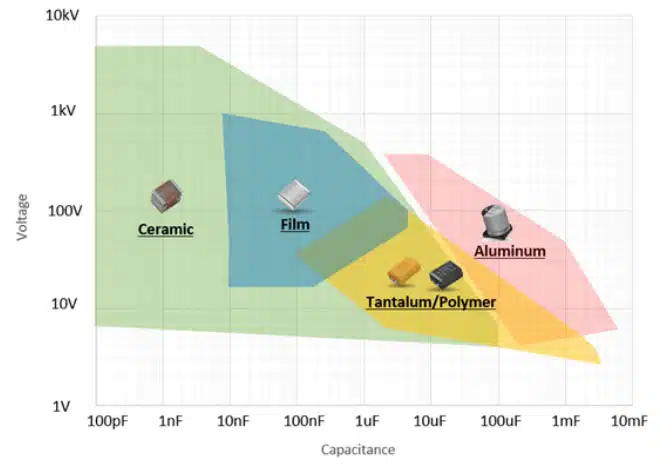
Figure 1: Capacitor technologies landscape based on voltage and bulk capacitance

Ceramic Capacitors

Multilayer ceramic capacitors (MLCC) have many advantages in modern electronic design, including small size, high withstand voltage, and long service life. They have become the first choice of engineers for most common bulk capacitance needs, including precision filters, resonators, power supply bypass devices, and decoupling elements. KYOCERA AVX offers a broad range of SMD ceramic capacitors, including the unique Flexiterm and Flexisafe technologies for enhanced safety and reliability.

Film Capacitors

Film capacitors came of age due to advancements in the polymer industry that enabled the metallization of thin plastic dielectrics. These capacitors can be divided into several families based on their application power requirements. On the low end of the spectrum, small surface mount chip capacitors are available in three common dielectrics: metalized Polyethylene Naphtalate (PEN), metalized Polyethylene Terephtalate (PET-HT), and metalized polyphenylene sulfide (PPS). These devices have become ubiquitous on PCBs for various functions, including decoupling, smoothing, filtering, and impedance matching. KYOCERA AVX offers SMD film capacitors with superior features such as high voltage withstanding, low ESR, and no DC bias dependency.

Tantalum Capacitors

Tantalum capacitors are regarded highly in the electrolytic family for their large capacitance per unit volume and generally stable operating parameters. They exhibit self-healing properties and typically provide low electrical series resistance (ESR) with favorable AC impedance characteristics. For these reasons, the two primary applications of tantalum capacitors in circuit design have been as high capacity energy storage elements and as ripple filtering components in power supplies. KYOCERA AVX has been the leading supplier of tantalum capacitors for many years. Their portfolio covers various applications and markets and provides the highest capacitance for limited space (area/height) applications.

Polymer Tantalum Capacitors

Compared to conventional tantalum capacitors based on MnO2 electrolyte, conductive tantalum polymer capacitors have greatly improved conductivity, leading to a significant reduction in ESR through the entire operating frequency range and high ripple current. In addition, the polymer capacitor exhibits a unique self healing mechanism. Dielectric failures result in a high current path that evaporates/carbonizes the polymer material and encapsulates the failure location with a non-conductive polymer layer. The polymer material does not contain any oxygen, unlike MnO2 technology, and is non-flammable. As a result, polymer capacitors are more reliable, safer, and less sensitive to inrush current and higher ripple current limits.

Aluminum Capacitors

As of 2021, KYOCERA AVX has added aluminum electrolytic capacitors to its product lineup. Table 1 explores the differences between the electrolytic (AEA/AEH series), hybrid (AHA/AHC series), and polymer (APA/APD series). It summarizes the strengths and weaknesses of aluminum, polymer aluminum, and hybrid aluminum electrolytic capacitors. In general, traditional aluminum electrolytic devices offer the lowest cost, smallest form factor option. When other parameters are critical to a design, tradeoffs can be made with hybrid and polymer devices to achieve a longer lifetime, reduced parasitics, and environmental tolerance, to name a few examples.
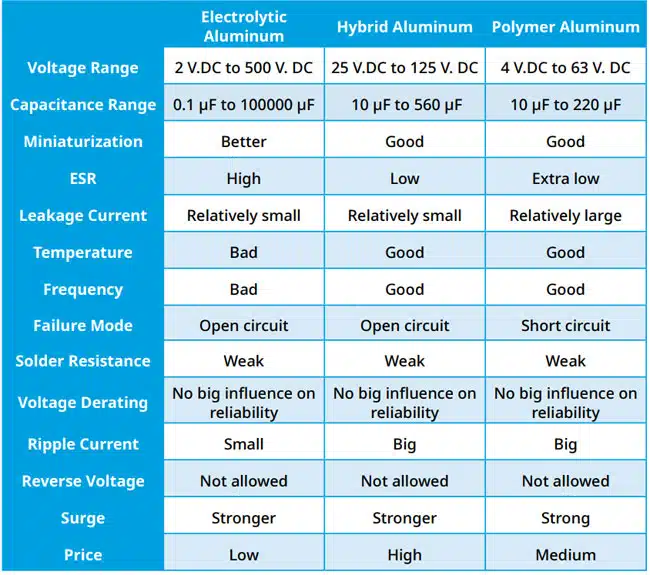
Table 1: A comparison of aluminum capacitor families

Capacitor Requirements for DC-DC Converters

DC-DC converters are often integrated into systems with numerous voltage domains. In the example (Figure 2), the high voltage source is first converted to an intermediate voltage to reduce the input range requirements of the downstream converters. This step will often use a buck converter to maximize efficiency and reduce thermal stress. The resulting intermediate voltage is then converted using a combination of buck, boost, and linear regulators to the specific voltages required for each subsystem.
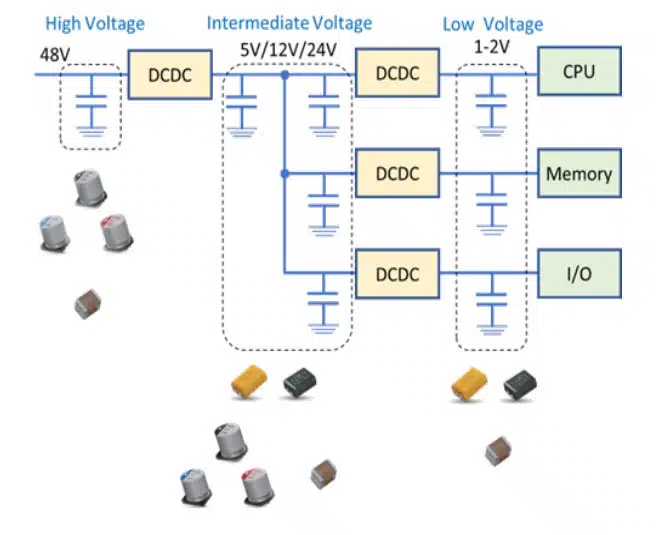
Figure 2: The three voltage and capacitance zones for typical DC-DC converters

In the high voltage domain (i.e., 48V), aluminum capacitors are the first choice in most cases. Bulk capacitance and input voltage tolerance are the two most important parameters. In applications with a height restriction, parallel MLCC devices may also be used. In the intermediate voltage domain (i.e., 5V/12V/24V), aluminum capacitors may still be the best option if there is no height restriction. However, more commonly, tantalum/polymer and MLCC are selected to achieve the smallest PCB volume.

In the low voltage domain (i.e., 1-2V), ceramic and film capacitors are the most suitable solution, especially when the switching frequency is higher than a few megahertz. If high bulk capacitance is required, tantalum/polymer can be used to minimize component count and reduce PCB volume.

Conclusion

Figure 3 summarizes the key capacitor technologies suitable for DC-DC converter applications. Depending on the individual application requirements, appropriate devices can be chosen based on bulk capacitance, voltage range, form factor, and price, to name a few parameters.
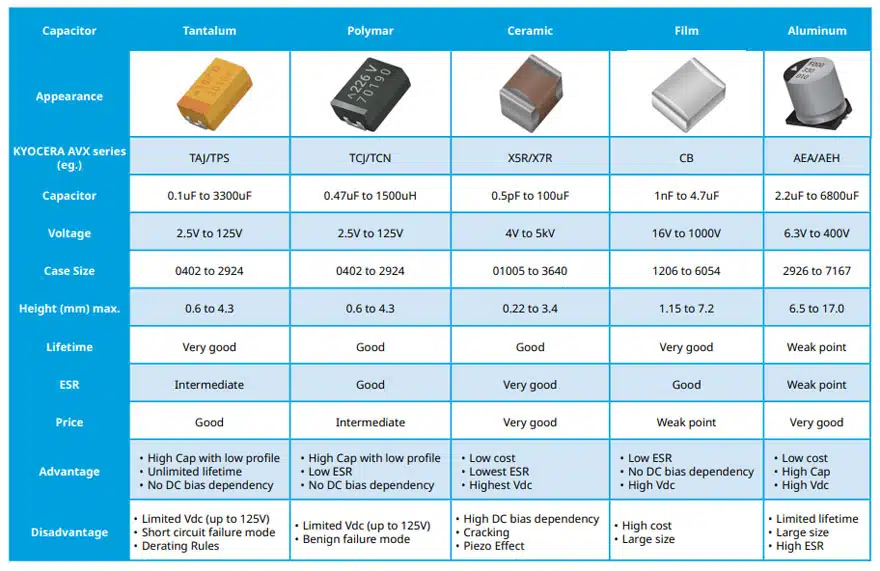

Figure 3: Five key SMD capacitor technologies benchmark; source: KYOCERA AVX
Source: KYOCERA AVX

Recent Posts

Itelcond Introduces High‑Voltage Aluminium Capacitors for Modern IGBT DC‑links

17.7.2026
45

EMC Design Fundamentals: Safe Use of Varistors and Common Mode Chokes in Mains and Data-Line Filters

16.7.2026
76

Murata Unveils Lead Disc Ceramic Capacitors for Automotive Safety and EMI Suppression

15.7.2026
57

Square-Wave Harmonics and RMS Currents in Power Converters

14.7.2026
57

LeanBOM: Practical Cross‑Technology Capacitor Search by Real Working Conditions

14.7.2026
60

In the Age of AI, Every Watt Counts: Implications for Components

13.7.2026
96

RF Filters and Passive Components Enabling the 7 Missile RF Subsystems

9.7.2026
60

Ferrite versus Nanocrystalline Power Inductor Cores: Turns, Gap and Size

9.7.2026
88

From DCL to SSC: Bridging Electrical Symptoms and Structural Indicators in Tantalum Capacitors

7.7.2026
65

Upcoming Events

Jul 28
8:00 - 11:00 CEST

Post Procurement Testing of EEE Components for LEO Space Applications

Jul 29
17:30 - 18:30 CEST

To Ferrite or to Nanocrystalline in Transformer Design

Sep 29
16:00 - 17:00 CEST

Cybersecurity 2026

View Calendar

Popular Posts

  • Boost Converter Design and Calculation

    0 shares
    Share 0 Tweet 0
  • Buck Converter Design and Calculation

    0 shares
    Share 0 Tweet 0
  • YAGEO Announces July 2026 Capacitor Price Increase

    0 shares
    Share 0 Tweet 0
  • Flyback Converter Design and Calculation

    0 shares
    Share 0 Tweet 0
  • LLC Resonant Converter Design and Calculation

    0 shares
    Share 0 Tweet 0
  • MLCC and Ceramic Capacitors

    0 shares
    Share 0 Tweet 0
  • MLCCs in the Age of AI: Q2 2026 Market Tightness

    0 shares
    Share 0 Tweet 0
  • Earthing Systems and IEC Classification Explained

    0 shares
    Share 0 Tweet 0
  • Nvidia Vera Rubin: Why One AI Rack Needs So Many More MLCC Capacitors

    0 shares
    Share 0 Tweet 0
  • Dual Active Bridge (DAB) Topology

    0 shares
    Share 0 Tweet 0

Newsletter Subscription


Passive Components Blog

© EPCI - Leading Passive Components Educational and Information Site

  • Home
  • Privacy Policy
  • EPCI Membership & Advertisement
  • About

No Result
View All Result
  • Home
  • Knowledge Blog
  • Dossiers
  • PCNS

© EPCI - Leading Passive Components Educational and Information Site

This website uses cookies. By continuing to use this website you are giving consent to cookies being used. Visit our Privacy and Cookie Policy.